



.png)



















.png)





What is cloud bursting? Exploring the mechanism, operation, and deployment
May 28, 2026Cloud bursting is a technique that allows an internal system to automatically scale to the public cloud when demand surges, helping to maintain performance without the need to invest in additional physical servers. Join Vcloudia to explore what cloud bursting is and answer questions surrounding this technique.
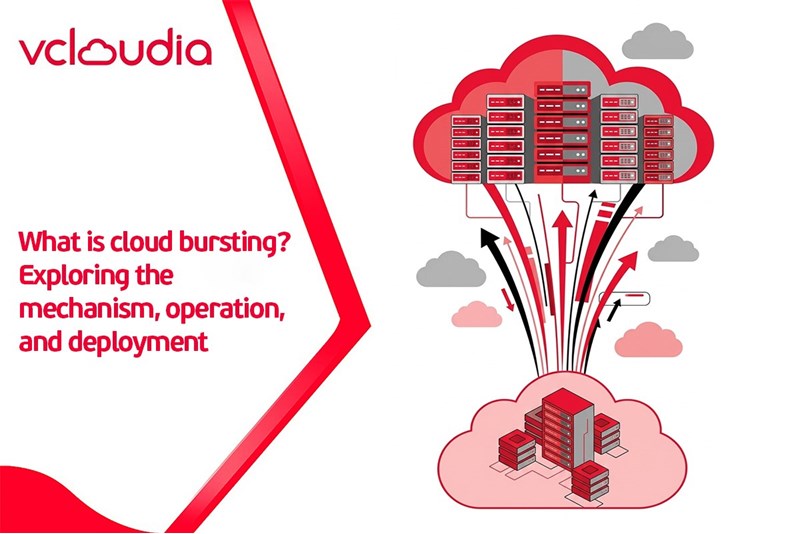
What is cloud bursting?
Cloud bursting is a flexible resource scaling model in a hybrid cloud infrastructure. When an internal system or a private server reaches its processing limit, the additional generated workload will be temporarily shifted to utilize resources from the public cloud.
This hybrid cloud model helps leverage the advantages of both on-premises infrastructure and external clouds, ensuring service performance is maintained without redundant investments in physical servers. Thanks to cloud bursting, businesses only use and pay for additional cloud resources when necessary, avoiding service disruptions even when traffic spikes.
What is the operating mechanism of cloud bursting?
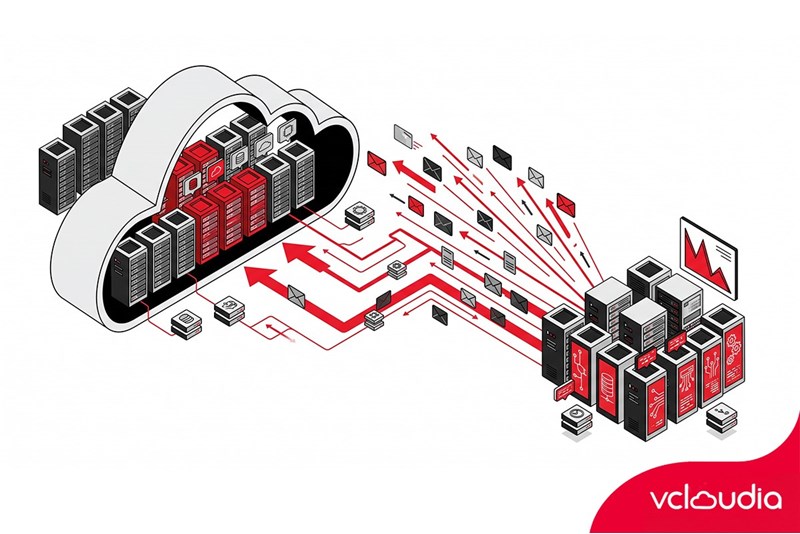
Cloud bursting operates based on a mechanism that allows the system to automatically scale to the public cloud when internal resources are insufficient to meet demands. Administrators will pre-configure resource utilization thresholds (such as CPU, RAM).
When the workload exceeds this threshold, the system triggers a "burst," scaling to the public cloud to temporarily supplement resources. The bursting process can occur automatically (based on predefined policies) or be triggered manually depending on business needs.
A load balancer will distribute excess requests from internal servers to the cloud, helping applications maintain stable performance without service interruption. When traffic decreases, resources on the public cloud are revoked to save costs.
Methods of deploying cloud bursting in cloud computing
There are 3 popular hybrid cloud bursting deployment methods, including manual scaling, automatic scaling, and distributed load balancing. Each method will have its own pros, cons, and implementation approaches depending on the level of automation and system architecture.
Benefits of cloud bursting
Cloud bursting brings many important benefits in optimizing IT infrastructure and meeting flexible demands:
- Cost savings: Businesses only have to pay for additional resources on the cloud when actually used, instead of investing in redundant infrastructure for high load levels that rarely occur. Consequently, this reduces investment and operational costs for excess capacity that is rarely utilized.
- Flexibility and scalability: Cloud bursting provides high flexibility for the system. Organizations can easily scale resources up or down according to actual needs at any given time.
- Ensuring service continuity: Cloud bursting contributes to maintaining continuous operations for critical applications. In the event that the system is at risk of overload or experiences hardware failures on-premises, "bursting" the load onto the public cloud acts as a backup tier, helping applications avoid downtime during peak periods.
Furthermore, cloud bursting also helps optimize the use of on-premises resources by prioritizing mission-critical applications. Simultaneously, the system can still scale flexibly when needed, contributing to enhancing the operational efficiency of the entire hybrid infrastructure.
Practical applications of cloud bursting for businesses
Cloud bursting is being flexibly applied by many businesses across various sectors to effectively handle surging resource demands. Below are some typical examples of how industries use cloud bursting to optimize performance and operational costs.
E-commerce industry
E-commerce websites frequently face traffic spikes during events such as flash sales and shopping festivals (e.g., November 11, Black Friday). Deploying cloud bursting allows online retail systems to automatically scale servers to serve millions of concurrent users during peak hours without crashing the website.
For instance, a large e-commerce platform can "burst" from 100 servers up to 2,000 servers on the cloud during the year-end peak season, then scale back down when traffic decreases. As a result, the customer shopping experience remains smooth, while the business does not have to maintain a large number of redundant servers year-round.
Finance – banking industry
The financial sector often has high processing volumes at certain times (e.g., end-of-period settlements, moments of strong market volatility, or new product rollouts). Cloud bursting can help banks temporarily scale computing resources to run risk analysis tasks, process transactions, or simulate complex financial scenarios in a short time.
However, due to the sensitivity of financial data, when "bursting" to the public cloud, organizations must particularly ensure compliance with security regulations and relevant laws. In practice, cloud bursting is often used by banks for less sensitive workloads or testing environments. The core banking system and critical data are still kept on private infrastructure to meet strict compliance requirements.
AI & data analytics
Artificial intelligence (AI) and big data analytics tasks often require extremely high computing power but in batches. Cloud bursting is highly useful as it allows data teams to temporarily borrow high-performance computing clusters on the cloud to run these tasks for a few hours or days and then release them.
Major cloud providers also readily offer many optimized resources for AI/Big Data (e.g., specialized GPUs, TPUs) that help accelerate processing speeds. This is a very suitable model for AI and analytics projects when computing demands fluctuate unpredictably.
Digital media and online entertainment industry
Cloud bursting helps media, streaming, and online gaming companies rapidly scale their infrastructure when there is a sudden surge in users, such as during live sports events or concerts. The system can instantly increase servers and bandwidth to ensure videos do not lag.
After the peak passes, cloud resources will be revoked to save costs. VFX studios also use cloud bursting to render films quickly without investing in fixed hardware.
Challenges in deploying hybrid cloud bursting
Despite bringing many benefits, cloud bursting also comes with numerous challenges to consider when deploying in a hybrid cloud environment:
Complex data synchronization
Workloads moving back and forth between on-premises environments and the public cloud require data to be synchronized continuously. Differences in storage architectures (e.g., on-prem uses an NFS file system, while the cloud uses object storage) make copying and synchronizing data complex.
The data volume is often very large and changes rapidly, so identifying and transferring the exact necessary data to the cloud is a major challenge. Every continuous change on-premises must be updated to the cloud, making the synchronization process prone to mistakes and errors if done manually.
Easy to waste budget if not well controlled
The cloud bursting model helps save costs in theory, but in reality, forecasting and controlling costs is very difficult due to the flexible scaling nature of cloud infrastructure. Because sudden demand spikes cannot be fully anticipated, businesses can easily face higher-than-expected bills when scaling resources to the cloud.
Security and compliance issues
When transmitting data between private and public cloud environments, sensitive information is at risk of being leaked or attacked. The expanded hybrid cloud environment increases the attack surface and complicates compliance, requiring businesses to clearly understand relevant regulations and maintain comprehensive security policies across both environments.
Application compatibility
Many applications are not designed to run flexibly on both on-premises and cloud infrastructures, especially legacy applications tightly dependent on internal systems. "Bursting" such an application to the cloud may require significant modifications or re-architecture, increasing complexity and the risk of disrupting the current system.
Conclusion
Through the detailed insights shared above, hopefully, your questions about what cloud bursting is, as well as its operating mechanism, deployment methods, and practical applications, have been answered. To deploy effectively, businesses need to pay attention to challenges such as data synchronization, security, cost control, and application compatibility.
Vcloudia Cloud Server – The Cloud You Can Count On
If you're concerned about the potential limitations of Cloud Servers, Cloud server by Vcloudia is a reliable solution for businesses of all sizes. With a modern infrastructure and comprehensive customer support, Vcloudia delivers a cloud experience with:
- Powerful connectivity to ensure stable 24/7 access
- Advanced security standards, compliant with international certifications such as ISO 27001:2013, ISO 20000:2018, ISO 9001:2015
- Flexible pricing packages tailored to your specific business needs
- Expert technical support, making migration and system deployment fast, safe, and compatible
Contact information:
- Hotline: +855 888 55 66 08 (free of charge)
- Fanpage: https://www.facebook.com/vcloudia/
- Website: https://vcloudia.com
Featured news
Related news
What is a Snapshot? The Difference Between Snapshot and Backup
Snapshot is a familiar concept in data management and protection. In the context of the information technology boom, where data is a major asset for businesses, understanding Snapshots as well as their application is a key factor for enterprises to maximize technological efficiency.
What is a Firewall? The Role and Importance of Firewalls for Users
In the context of ever-increasing cyberattacks, system security has become a top priority for many enterprises. Alongside deploying antivirus software and controlling connection ports, firewalls are also considered a key solution to effectively enhance cybersecurity.
What is DDoS? Signs, Mitigation Strategies, and Effective Prevention
DDoS is a highly dangerous cyberattack that leaves severe consequences for enterprises. Therefore, gaining a clear understanding of DDoS attacks, as well as how to detect and prevent them, is a topic of significant interest to many.
What is a Trojan? How to Detect, Avoid, and Prevent It
A Trojan is a type of malicious code or software that can cause severe consequences to computer operations. So, what is a Trojan? How can you prevent a Trojan from infiltrating your computer? In the following article, Vcloudia will provide detailed information on these issues.
What is Cloud Backup? Classification, benefits, and limitations
Cloud Backup is a solution that plays an important role in backing up and recovering data when an incident occurs. So what exactly is Cloud Backup? Let's find out the details with Vcloudia in the following article.
What is Cloud Storage? Features and Benefits of Using It
Cloud Storage is the perfect storage solution alternative to bulky, space-consuming physical hard drives. So, what is Cloud Storage? Let's explore the details with Vcloudia through the following article.
What is an API? Characteristics and applications in website design
API, short for Application Programming Interface, is a concept no longer unfamiliar in the information technology field. So what exactly is an API and why is it so important? Let's find out with Vcloudia.
What is Node.js? Instructions on how to install Node.js on cPanel
Currently, it is easy to see that Node.js is being used by quite a lot of people. This is because Node.js can support users in running on multiple platforms and multiple devices.
What is Vultr VPS? Should you use Vultr VPS?
Vultr VPS is one of the best cloud storage solutions in the world. In this article, you will learn the concept: "What is Vultr VPS?", as well as understand its advantages and disadvantages.
Zoom Cloud Meeting: What is it? Basic Things You Should Know About Zoom Cloud Meeting
In 2020, Zoom Cloud Meeting became one of the leading video conferencing software applications. It allows you to virtually interact with colleagues when in-person meetings aren't possible, and it has also been very successful for social events.