



.png)













.png)




What is Change Management in a Data Center? The 5 Core Steps Process to Ensure Uptime
30/06/2026Every hardware upgrade or patch update activity in a data center poses a potential risk of service disruption if there is a lack of control. To balance between innovation and system stability, the Change Management process in a Data Center is applied as a mandatory operational standard. Let's explore the operating mechanism of this safety checkpoint with Vcloudia right below.
What is Change Management in a Data Center?
Change Management in a Data Center is a standardized process, often built based on the ITIL or ISO 20000 framework – aimed at strictly controlling the entire lifecycle of a change impacting the IT system.
Unlike reactive incident handling operations, Change Management is a proactive process, covering from the proposal, planning, approval, and execution phases to post-deployment evaluation.
The ultimate goal of this process is not only to complete the upgrade, but to transition the system from State A to State B with absolute safety. All change scenarios must be directed towards minimizing risks to the lowest level, ensuring data integrity and maintaining service continuity, absolutely causing no disruption for customers.
In a complex infrastructure environment like a Data Center, Change Management does not overlook any elements, covering all 3 component layers:
- Physical and Environmental Layer: Includes impacts on the power system (UPS, PDU), cooling system (Chiller, PAC), server component replacements (Server components), or Rack relocations.
- System Software Layer: Controls the updates of bug patches, upgrades of operating systems, Firmware, or the deployment of new virtualization platforms.
- Network and Connectivity Layer: Manages changes regarding Routing/Switching configurations, firewall rule modifications, or connection cabling system replanning.
Why is Change Management important for a Data Center?
According to the annual report of the Uptime Institute, over 70% of outage incidents in data centers do not stem from equipment failures, but from human errors during the system operation and configuration process.
Therefore, Change Management in a Data Center is not a cumbersome administrative procedure, but a protective shield for the system against the 3 biggest risks:
1. Maximize the minimization of operational risks
Every system has weaknesses, and an uncontrolled change is the exact moment that weakness is exposed.
- Human error control: This process eliminates arbitrary actions. Every execution command must go through a cross-checking and approval step by a council of experts, ensuring no single engineer can "single-handedly" cause harm to the system.
- Domino effect prevention: A minor change at the network layer can crash an entire application system. Change Management evaluates the chain impact to prevent this worst-case scenario.
2. Ensure service quality commitments
For a Data Center, Uptime (continuous operating time) is the lifeline.
The Change Management process helps to plan reasonable maintenance timeframes, usually when traffic is at its lowest, and prepares standby backup plans. Thus, it helps enterprises maintain an SLA commitment of 99.99% or higher, uphold their reputation, and avoid costly contract penalties.
3. Trace and support root cause investigation
When an incident occurs, the first question is always: "Who did what at what time?".
- Audit Trail: The Change Management system stores the history of all changes. This is the data black box that helps to transparentize responsibilities.
- Shorten MTTR (Mean Time To Repair): By knowing exactly which change has just been made, the technical team can quickly isolate the incident and execute a Rollback (returning to the old state) immediately, instead of blindly searching for the cause in despair.
The 5-step process for implementing Change Management in a Data Center
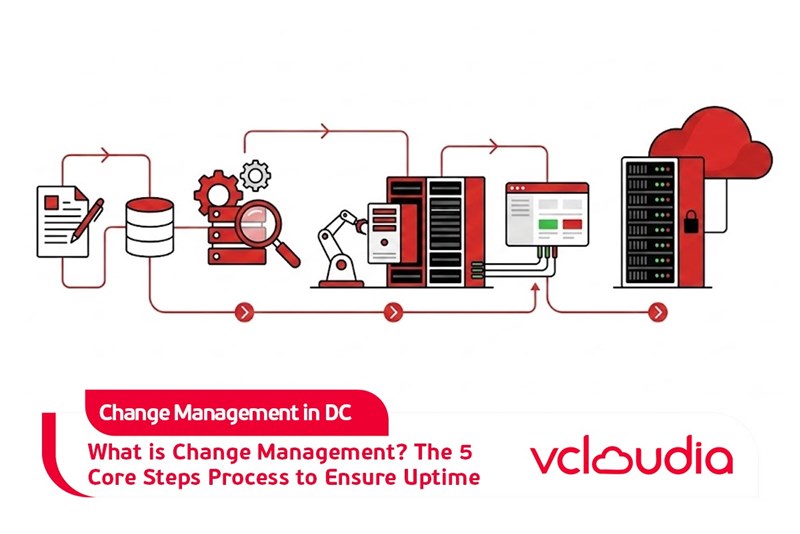
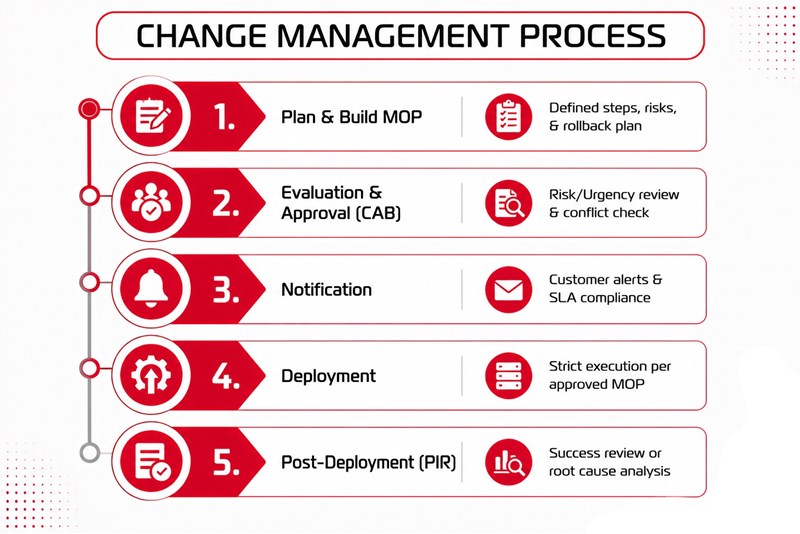
Any impact on the physical or logical infrastructure of a Data Center, even as minor as adjusting the system clock, must strictly comply with the 5-step process below to ensure absolute safety.
1. Plan and build the MOP
This is the foundational step. Engineers are not allowed to execute multiple processes simultaneously to avoid resource conflicts and difficulties in error tracing if an incident occurs. At this step, a MOP (Method of Procedure) document, also known as a detailed technical script, will be initiated. The MOP must clearly answer 3 issues:
- Procedure: The specific execution steps.
- Risks: What will happen if the procedure fails?
- Rollback Plan: The plan to immediately restore the system to its original state if an incident occurs.
2. Evaluation and Approval
After a ticket is created, the MOP will be forwarded to the CAB (Change Advisory Board). Council members are usually senior experts, rotated to ensure objectivity. The CAB council will thoroughly review based on the criteria:
- Risk analysis: The danger level of this change.
- Urgency: The importance and priority level.
- Resources: The necessary equipment, software, and personnel (internal or external partners).
- Conflict: Does it affect other ongoing maintenance activities?
3. Notification and communication
If the change has the potential to affect customer services, the Change Management process in a Data Center must obligatorily have a transparent notification step. Information about the maintenance plan (start/end time, impact scope) will be sent to the customer care department to send advance notification emails to related parties, ensuring compliance with service quality commitments.
4. Deployment
The assigned engineer will proceed to execute the change during the approved maintenance timeframe. The unalterable principle: Absolutely comply with the MOP. Engineers are not allowed to arbitrarily create or execute steps outside the approved script.
5. Post-deployment evaluation
After completion, the council will execute the PIR (Post-Implementation Review) process to evaluate the results:
- If successful: Acknowledge the good points and update them into the Knowledge Base.
- If failed (or forced to Rollback): Analyze the root causes, draw lessons learned to adjust the MOP for subsequent times.
This rigorous process turns complex technical operations into standard processes, making Change Management in a Data Center a powerful tool to maintain stability and continuity for the system.
Conclusion
Data infrastructure is the heart of an enterprise, and Change Management is the heartbeat that helps that heart always operate stably. Complying with international standard change management processes not only helps eliminate operational risks but is also an ironclad commitment to the system's availability.
Looking for a high-performance, secure solution?
Explore the services offered by Vcloudia – a leading provider of Cloud Computing and Data Center solutions. Contact us for expert consultation and find the right model for your needs:
- Hotline: +855 888 55 66 08 (free of charge)
- Fanpage: https://www.facebook.com/vcloudia/
- Website: https://vcloudia.com
ព័ត៌មានពិសេស
ព័ត៌មានដែលទាក់ទង
What is a Snapshot? The Difference Between Snapshot and Backup
Snapshot is a familiar concept in data management and protection. In the context of the information technology boom, where data is a major asset for businesses, understanding Snapshots as well as their application is a key factor for enterprises to maximize technological efficiency.
What is a Firewall? The Role and Importance of Firewalls for Users
In the context of ever-increasing cyberattacks, system security has become a top priority for many enterprises. Alongside deploying antivirus software and controlling connection ports, firewalls are also considered a key solution to effectively enhance cybersecurity.
What is DDoS? Signs, Mitigation Strategies, and Effective Prevention
DDoS is a highly dangerous cyberattack that leaves severe consequences for enterprises. Therefore, gaining a clear understanding of DDoS attacks, as well as how to detect and prevent them, is a topic of significant interest to many.
What is a Trojan? How to Detect, Avoid, and Prevent It
A Trojan is a type of malicious code or software that can cause severe consequences to computer operations. So, what is a Trojan? How can you prevent a Trojan from infiltrating your computer? In the following article, Vcloudia will provide detailed information on these issues.
What is Cloud Backup? Classification, benefits, and limitations
Cloud Backup is a solution that plays an important role in backing up and recovering data when an incident occurs. So what exactly is Cloud Backup? Let's find out the details with Vcloudia in the following article.
What is Cloud Storage? Features and Benefits of Using It
Cloud Storage is the perfect storage solution alternative to bulky, space-consuming physical hard drives. So, what is Cloud Storage? Let's explore the details with Vcloudia through the following article.
What is an API? Characteristics and applications in website design
API, short for Application Programming Interface, is a concept no longer unfamiliar in the information technology field. So what exactly is an API and why is it so important? Let's find out with Vcloudia.
What is Node.js? Instructions on how to install Node.js on cPanel
Currently, it is easy to see that Node.js is being used by quite a lot of people. This is because Node.js can support users in running on multiple platforms and multiple devices.
What is Vultr VPS? Should you use Vultr VPS?
Vultr VPS is one of the best cloud storage solutions in the world. In this article, you will learn the concept: "What is Vultr VPS?", as well as understand its advantages and disadvantages.
Zoom Cloud Meeting: What is it? Basic Things You Should Know About Zoom Cloud Meeting
In 2020, Zoom Cloud Meeting became one of the leading video conferencing software applications. It allows you to virtually interact with colleagues when in-person meetings aren't possible, and it has also been very successful for social events.