



.png)














.png)





What is Cable management in a Data Center? Its role and effective implementation methods
Jun 30, 2026In a modern Data Center, where hundreds to thousands of servers, networking devices, and storage systems operate in parallel, the connecting cables are the lifeblood of the entire IT infrastructure. However, if these cable routes are not organized scientifically, the Data Center can easily fall into a state of operational disorder, become difficult to scale, and harbor many serious risks.
This is the reason why cable management in a Data Center has become a strategic factor, rather than merely a matter of aesthetics or tidiness.
What is Cable management in a Data Center?
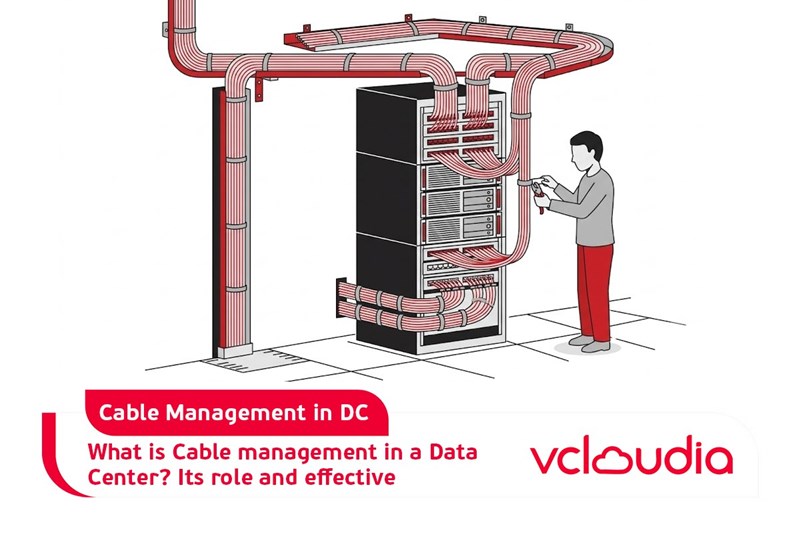
Cable management in a Data Center can be understood as all the methods, processes, and technical solutions used to organize, route, secure, and control the cabling system inside the data center. This cabling system includes power cables, network cables, fiber optic cables, and specific connection cables serving servers, storage devices, and network infrastructure.
Unlike ordinary wiring in an office or a small server room, cable management in a Data Center must meet very strict requirements regarding device density, scalability, stability, and operational standards. Each cable not only plays a role in transmitting data or supplying power but is also directly related to the performance, availability, and maintainability of the entire system.
A properly designed cable management system allows the operations team to easily identify connection flows, quickly troubleshoot incidents, and simultaneously maintain an optimal cooling environment for the Data Center throughout its operational lifecycle.
The role of cable management in a Data Center
Cable management plays a foundational role in ensuring the Data Center operates stably and sustainably. When the cabling system is scientifically managed, the physical connections between servers, switches, storage, and network devices become clear, minimizing the risk of confusion or incorrect manipulation during operation.
Another important role of cable management is supporting optimal airflow and cooling systems. In a Data Center, cold and hot air flows need to be strictly controlled to maintain stable temperatures for the equipment. Cluttered cables obstructing air circulation will drastically reduce cooling efficiency, forcing the CRAC or CRAH systems to work harder, thereby driving up energy costs.
Additionally, cable management directly affects uptime and SLA. When an incident occurs, a clearly labeled and logically routed cabling system will help the technical team quickly pinpoint the point of failure, shorten recovery time, and limit downtime. For Data Centers providing cloud or colocation services, this is a matter of survival.
Common problems when cable management is poor
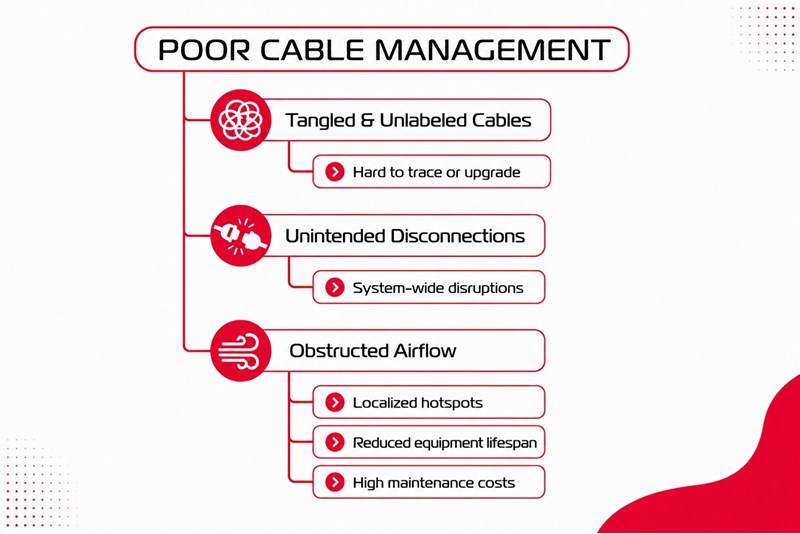
In reality, many Data Centers, especially server rooms expanded in a makeshift manner, encounter a series of problems because cable management is not adequately invested in. The most common situation is cables getting tangled and overlapping each other without any clear diagram or identification labels. This makes tracing connections almost impossible, especially when equipment needs to be replaced or upgraded.
Poor cable management also increases the risk of unintended disconnections. Just one mistaken cable unplugging action can cause disruption to the whole system, affecting many services simultaneously. For large-scale Data Centers, this risk becomes even more severe.
Not stopping there, incorrectly routed cabling systems also obstruct airflow, creating localized hotspots within the server racks. Over time, this reduces the lifespan of the equipment, increases the failure rate, and incurs significant maintenance costs. This is the price that many businesses only realize when their Data Center has already become overloaded.
Cable management methods in a Data Center
Horizontal Cable Management
Horizontal cable management is usually applied within the scope of a server rack, where cable routes are routed in parallel along each tier of equipment. This method helps keep the front and rear of the rack tidy, easy to observe, and simultaneously reduces pressure on the connection ports of the devices.
In Data Centers with medium density, horizontal cable management is a popular choice due to its easy implementation and reasonable cost. However, if not carefully calculated, this method can quickly become overloaded as the number of cables increases.
Vertical Cable Management
For high-density Data Centers, vertical cable management provides superior efficiency. Cables are routed vertically along both sides of the rack, helping to free up space at the front and rear of the equipment. This approach not only improves airflow but also makes system expansion much more flexible. Vertical cable management is particularly suitable for Data Centers deploying multiple consecutive server racks, where there are high requirements for synchronization and future scalability.
Cable management on ceilings and raised floors
Besides managing cables within the racks, organizing cables on the ceiling or under the raised floor also plays an important role. Cable tray and ladder rack systems allow cables to be routed along fixed paths, reducing pressure on the racks and keeping the Data Center space constantly well-ventilated. In Data Centers using raised floors, cables are usually routed under the floor to utilize space and support cold air flows. However, this requires a clear management diagram to avoid confusion and ensure future maintainability.
Common cable management equipment and solutions
To deploy cable management effectively, Data Centers often use many specialized devices such as patch panels, cable trays, D-rings, cable arms, and specific types of cable ties. Patch panels help centralize and manage network connections, reduce pressure on switches, and easily change configurations when necessary.
Cable trays and ladder racks serve as cable guides on a large scale, while small accessories like velcro, cable labels, and color coding help increase identification capability and reduce the risk of incorrect manipulation. Combining these solutions synchronously is the key to building a sustainable cable management system.
Conclusion
Cable management in a Data Center is not just about organizing cables neatly but is a core part of the IT infrastructure strategy. A properly designed and implemented cable management system will help the Data Center operate stably, optimize cooling efficiency, reduce downtime risks, and be ready to scale when demand surges.
Vcloudia Cloud Server – The Cloud You Can Count On
If you're concerned about the potential limitations of Cloud Servers, Cloud Server by Vcloudia is a reliable solution for businesses of all sizes. With a modern infrastructure and comprehensive customer support, Vcloudia delivers a cloud experience with:
- Powerful connectivity to ensure stable 24/7 access
- Advanced security standards, compliant with international certifications such as ISO 27001:2013, ISO 20000:2018, ISO 9001:2015
- Flexible pricing packages tailored to your specific business needs
- Expert technical support, making migration and system deployment fast, safe, and compatible
Contact information:
- Hotline: +855 888 55 66 08 (free of charge)
- Fanpage: https://www.facebook.com/vcloudia/
- Website: https://vcloudia.com
Featured news
Related news
What is a Snapshot? The Difference Between Snapshot and Backup
Snapshot is a familiar concept in data management and protection. In the context of the information technology boom, where data is a major asset for businesses, understanding Snapshots as well as their application is a key factor for enterprises to maximize technological efficiency.
What is a Firewall? The Role and Importance of Firewalls for Users
In the context of ever-increasing cyberattacks, system security has become a top priority for many enterprises. Alongside deploying antivirus software and controlling connection ports, firewalls are also considered a key solution to effectively enhance cybersecurity.
What is DDoS? Signs, Mitigation Strategies, and Effective Prevention
DDoS is a highly dangerous cyberattack that leaves severe consequences for enterprises. Therefore, gaining a clear understanding of DDoS attacks, as well as how to detect and prevent them, is a topic of significant interest to many.
What is a Trojan? How to Detect, Avoid, and Prevent It
A Trojan is a type of malicious code or software that can cause severe consequences to computer operations. So, what is a Trojan? How can you prevent a Trojan from infiltrating your computer? In the following article, Vcloudia will provide detailed information on these issues.
What is Cloud Backup? Classification, benefits, and limitations
Cloud Backup is a solution that plays an important role in backing up and recovering data when an incident occurs. So what exactly is Cloud Backup? Let's find out the details with Vcloudia in the following article.
What is Cloud Storage? Features and Benefits of Using It
Cloud Storage is the perfect storage solution alternative to bulky, space-consuming physical hard drives. So, what is Cloud Storage? Let's explore the details with Vcloudia through the following article.
What is an API? Characteristics and applications in website design
API, short for Application Programming Interface, is a concept no longer unfamiliar in the information technology field. So what exactly is an API and why is it so important? Let's find out with Vcloudia.
What is Node.js? Instructions on how to install Node.js on cPanel
Currently, it is easy to see that Node.js is being used by quite a lot of people. This is because Node.js can support users in running on multiple platforms and multiple devices.
What is Vultr VPS? Should you use Vultr VPS?
Vultr VPS is one of the best cloud storage solutions in the world. In this article, you will learn the concept: "What is Vultr VPS?", as well as understand its advantages and disadvantages.
Zoom Cloud Meeting: What is it? Basic Things You Should Know About Zoom Cloud Meeting
In 2020, Zoom Cloud Meeting became one of the leading video conferencing software applications. It allows you to virtually interact with colleagues when in-person meetings aren't possible, and it has also been very successful for social events.