



.png)


















.png)





What is BCP? Understanding the role of BCP in the Data Center
Jun 30, 2026In the digital era, especially in the Data Center environment, the requirement for service continuity is almost absolute. This is the reason why the Business Continuity Plan (BCP) has become a vital element. So what is BCP? What role does BCP play in the Data Center? The article below by Vcloudia will analyze in detail to help you understand better!
What is BCP?
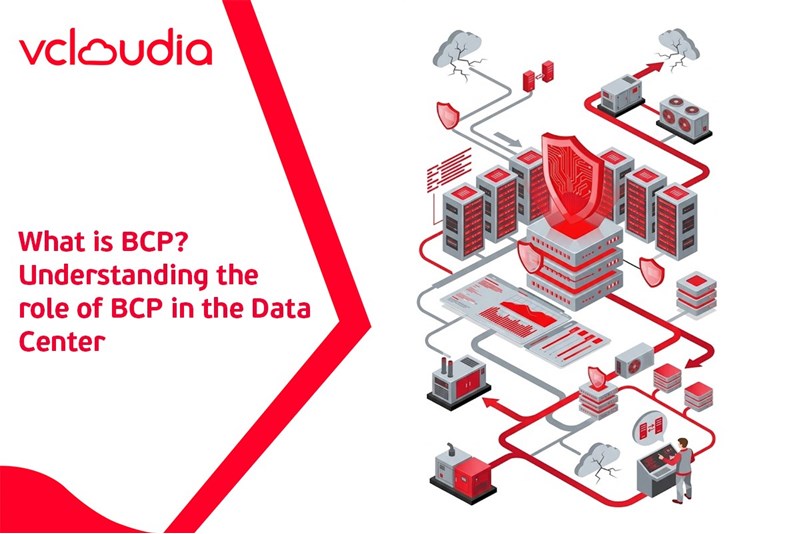
BCP (Business Continuity Plan) is a plan built to ensure that an organization can continue to operate when an incident, crisis, or disaster occurs. The core objective of BCP is not to prevent all risks, but to minimize the impact of risks to the lowest level and maintain critical operations during a disruption.
Within the general scope of an enterprise, BCP includes the policies, procedures, and resources necessary to ensure that business operations are not severely disrupted when facing situations such as natural disasters, infrastructure failures, cyberattacks, widespread power outages, or personnel crises. However, when applied to the Data Center environment, BCP has a much more profound and complex significance.
The Data Center is the heart of an enterprise's IT infrastructure. All applications, ERP systems, CRM, e-commerce websites, SaaS platforms, or online financial services depend on the stability of the data center. If the Data Center stops operating, the entire digital value chain behind it will be paralyzed. Therefore, BCP in the Data Center aims not only to maintain the operations of the data center itself but also to ensure continuity for the customer ecosystem running on it.
BCP is often confused with the Disaster Recovery Plan (DRP). In fact, DRP focuses on restoring the IT system after a disaster, while BCP has a broader scope, encompassing people, operational processes, communications, and the supply chain. In the Data Center, DRP is a part of BCP, but BCP covers the entire strategy of maintaining operations when an incident occurs.
Core components of BCP in the Data Center
An effective BCP in the Data Center must be built on the foundation of comprehensive risk analysis and a clear understanding of the importance of each service. The first indispensable component is the Business Impact Analysis (BIA), which helps analyze the business impact. BIA helps identify which systems are the most important, the level of impact if disrupted, and the maximum acceptable downtime before causing severe losses.
From the BIA, the Data Center determines critical metrics such as RTO (Recovery Time Objective) and RPO (Recovery Point Objective). For example, an online payment system may require an RTO of only a few minutes and an RPO of almost zero. Meanwhile, an internal data storage system can accept a longer RTO.
Another important component is risk analysis and incident scenario development. The Data Center must identify potential threats such as power outages, fires, floods, DDoS attacks, ransomware, severe hardware failures, or configuration errors. Each scenario needs to have a specific and clear response plan.
BCP in the Data Center also includes an infrastructure redundancy strategy, such as backup power systems (UPS, generators), backup cooling systems, multi-carrier network connections, as well as High Availability models or the deployment of a backup site (DR Site). All of these are to ensure that when one component fails, the system continues to operate.
The process of building a BCP for the Data Center
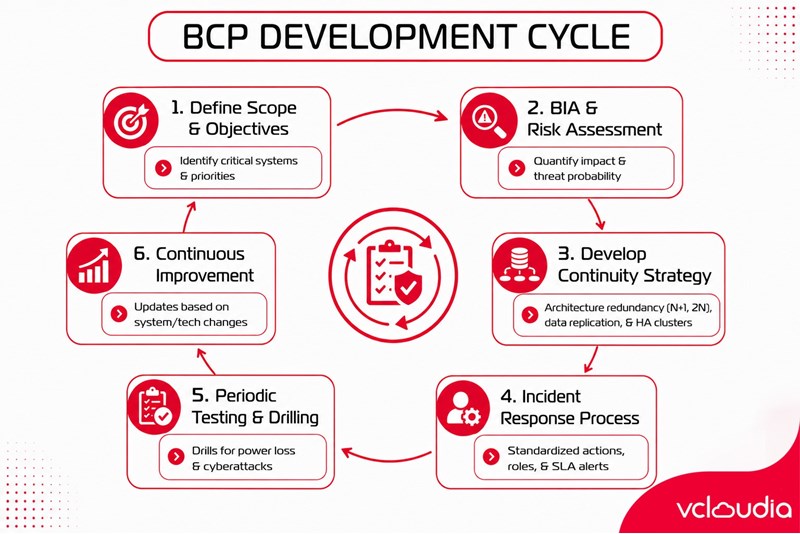
Defining the scope and objectives
The first step in building a BCP is to clearly define the scope of application. The Data Center needs to clarify which systems, services, and areas are included in the plan. Not all components have the same priority level. Defining objectives helps focus resources on the most critical services.
Conducting BIA and risk assessment
After defining the scope, the Data Center conducts a business impact analysis. BIA helps quantify the level of damage when a system is disrupted. Concurrently, there is a risk assessment to determine the probability and impact of each threat. This is the basis for selecting appropriate control measures.
Developing an operation continuity strategy
Based on the results of the BIA and risk assessment, the Data Center develops a strategy to maintain operations. This strategy may include designing an N+1 or 2N redundant architecture, deploying an HA server cluster, using real-time data replication technology, or building a backup data center in a different geographical location.
Building an incident response process
An effective BCP must have a clear response process. When an incident occurs, the monitoring system will detect and trigger the process. Technical personnel are assigned specific tasks while simultaneously notifying customers according to the committed SLA. The response time and actions must be standardized to minimize downtime.
Periodic testing and drilling
BCP cannot exist merely on paper. The Data Center needs to conduct periodic testing, including power outage drills, cyberattack simulations, or tests of switching to the backup site. Testing helps detect vulnerabilities in the process and ensures that the operation team is ready to respond.
Continuous update and improvement
IT infrastructure is constantly changing. Expanding the system, deploying new technologies, or changing the network architecture can all affect the BCP. Therefore, the plan needs to be updated regularly to accurately reflect the operational reality.
The role of BCP in the Data Center
BCP acts as a safeguard for the data center against unforeseen events. First and foremost, it helps ensure uptime, a vital factor in the Data Center industry. Data centers committing to an SLA of 99.9% or higher must have a robust BCP to meet this requirement.
BCP also helps minimize financial losses. One hour of downtime for an e-commerce or banking system can cause billions of dongs in losses. When the Data Center has an effective business continuity plan, the disruption time is minimized as much as possible.
In addition, BCP enhances brand reputation. Customers are increasingly concerned about the system's resilience to incidents. A Data Center that is transparent about its BCP plan and regularly tests it will build strong trust. BCP also contributes to meeting international compliance standards such as ISO 22301 for business continuity management or ISO 27001 for information security. This is especially important for businesses operating in the financial, healthcare, government, or e-commerce sectors.
When should businesses require a Data Center to have a clear BCP?
Businesses operating 24/7 systems such as banks, fintech, e-commerce platforms, or SaaS providers are required to choose a Data Center with a transparent and verified BCP. If the system is disrupted, the loss is not only revenue but also reputation and customer trust.
Businesses that store critical data or customers' personal data should also prioritize data centers with a clear BCP. Protecting data availability is a non-negotiable factor. Even small and medium-sized enterprises undergoing digital transformation should consider this factor. When operations depend on online platforms, choosing a Data Center with a professional continuity plan is a long-term investment in stability.
Trends in BCP development in modern Data Centers
In an increasingly complex technological environment, BCP is also developing towards being more flexible and automated. Hybrid Cloud and Multi-site architectures help distribute risks, reducing dependence on a single location. Real-time data replication technology and automated orchestration enable rapid system switching when an incident occurs.
Automation and AI are also being integrated into monitoring systems to detect anomalies earlier. Instead of waiting for an incident to happen, the system can predict and trigger preventive actions. In addition, Zero Downtime architecture is becoming the goal of many modern Data Centers. This requires BCP to not only stop at a reactive level but to be integrated right from the infrastructure design phase.
Conclusion
In a Data Center environment, where every second of downtime can cause massive damage, BCP plays a crucial role in protecting the infrastructure, data, and business reputation. Building and maintaining a BCP not only helps the Data Center meet its SLA, minimize risks, and enhance competitiveness, but also brings peace of mind to customers. In the context of strong digital transformation, choosing a data center with a clear and periodically tested BCP is a strategic step to ensure sustainable and long-term stable business operations.
Looking for a high-performance, secure solution?
Explore the services offered by Vcloudia – a leading provider of Cloud Computing and Data Center solutions. Contact us for expert consultation and find the right model for your needs:
- Hotline: +855 888 55 66 08 (free of charge)
- Fanpage: https://www.facebook.com/vcloudia/
- Website: https://vcloudia.com
Featured news
Related news
What is a Snapshot? The Difference Between Snapshot and Backup
Snapshot is a familiar concept in data management and protection. In the context of the information technology boom, where data is a major asset for businesses, understanding Snapshots as well as their application is a key factor for enterprises to maximize technological efficiency.
What is a Firewall? The Role and Importance of Firewalls for Users
In the context of ever-increasing cyberattacks, system security has become a top priority for many enterprises. Alongside deploying antivirus software and controlling connection ports, firewalls are also considered a key solution to effectively enhance cybersecurity.
What is DDoS? Signs, Mitigation Strategies, and Effective Prevention
DDoS is a highly dangerous cyberattack that leaves severe consequences for enterprises. Therefore, gaining a clear understanding of DDoS attacks, as well as how to detect and prevent them, is a topic of significant interest to many.
What is a Trojan? How to Detect, Avoid, and Prevent It
A Trojan is a type of malicious code or software that can cause severe consequences to computer operations. So, what is a Trojan? How can you prevent a Trojan from infiltrating your computer? In the following article, Vcloudia will provide detailed information on these issues.
What is Cloud Backup? Classification, benefits, and limitations
Cloud Backup is a solution that plays an important role in backing up and recovering data when an incident occurs. So what exactly is Cloud Backup? Let's find out the details with Vcloudia in the following article.
What is Cloud Storage? Features and Benefits of Using It
Cloud Storage is the perfect storage solution alternative to bulky, space-consuming physical hard drives. So, what is Cloud Storage? Let's explore the details with Vcloudia through the following article.
What is an API? Characteristics and applications in website design
API, short for Application Programming Interface, is a concept no longer unfamiliar in the information technology field. So what exactly is an API and why is it so important? Let's find out with Vcloudia.
What is Node.js? Instructions on how to install Node.js on cPanel
Currently, it is easy to see that Node.js is being used by quite a lot of people. This is because Node.js can support users in running on multiple platforms and multiple devices.
What is Vultr VPS? Should you use Vultr VPS?
Vultr VPS is one of the best cloud storage solutions in the world. In this article, you will learn the concept: "What is Vultr VPS?", as well as understand its advantages and disadvantages.
Zoom Cloud Meeting: What is it? Basic Things You Should Know About Zoom Cloud Meeting
In 2020, Zoom Cloud Meeting became one of the leading video conferencing software applications. It allows you to virtually interact with colleagues when in-person meetings aren't possible, and it has also been very successful for social events.