






















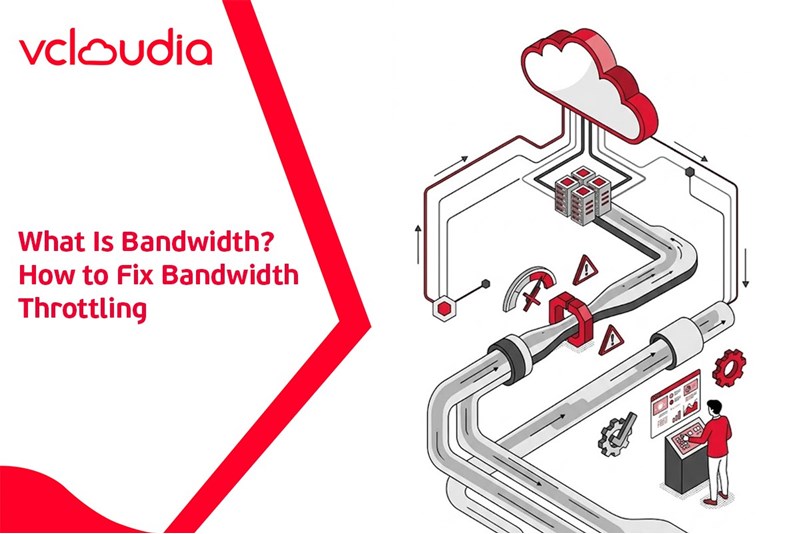
What Is Bandwidth? How to Fix Bandwidth Throttling
Aug 24, 2026Many users of cloud services often inquire about bandwidth's significance. In reality, bandwidth is a critical element directly influencing data upload and download speeds, alongside the ability to access and utilize cloud applications and resources. This article, presented by Vcloudia, will define bandwidth and explain its effect on your cloud service experience.
What Is Bandwidth?
Bandwidth refers to the maximum volume of data that can be transmitted across a network connection within a defined timeframe. A larger bandwidth facilitates faster data transmission rates.
The two primary units for measuring bandwidth are bits per second (bps) and bytes per second (Bps). One byte per second (Bps) is equivalent to eight bits per second (bps), meaning a speed measured in bytes per second will indicate a higher value.
So, what constitutes a bandwidth limit? A bandwidth limit enables users to restrict their download and upload activities when accessing the internet. This measure is implemented to ensure a stable connection. Particularly when using a wireless network, limiting bandwidth helps prevent network overload, which can lead to connection interruptions.
How to Measure Bandwidth
Measuring bandwidth involves testing data transmission performance to assess the quality and speed of internet access. Bandwidth measurement also assists in identifying network problems such as latency, connection failures, or bandwidth restrictions. This information then helps in deciding on an appropriate internet bandwidth package.
Tools such as Test TCP (TTCP) and PRTG Network Monitor can be used to measure a network connection's bandwidth.
Bandwidth Classifications
Bandwidth is classified based on its scope of use:
- Domestic bandwidth: Used for transmitting data between servers located within the same country.
- International bandwidth: Used for exchanging information between servers situated in different countries.
Bandwidth is also classified based on usage capacity:
- Committed bandwidth: With this type, users are allocated a specific amount of capacity. Once this capacity is fully used, an additional fee is required for continued usage.
- Shared bandwidth: This bandwidth is designed to be shared among multiple servers to prevent server slowdowns or freezes.
- Dedicated bandwidth: This bandwidth requires payment for its use and cannot be shared with other parties.
What Is Bandwidth Latency? How to Fix This Issue
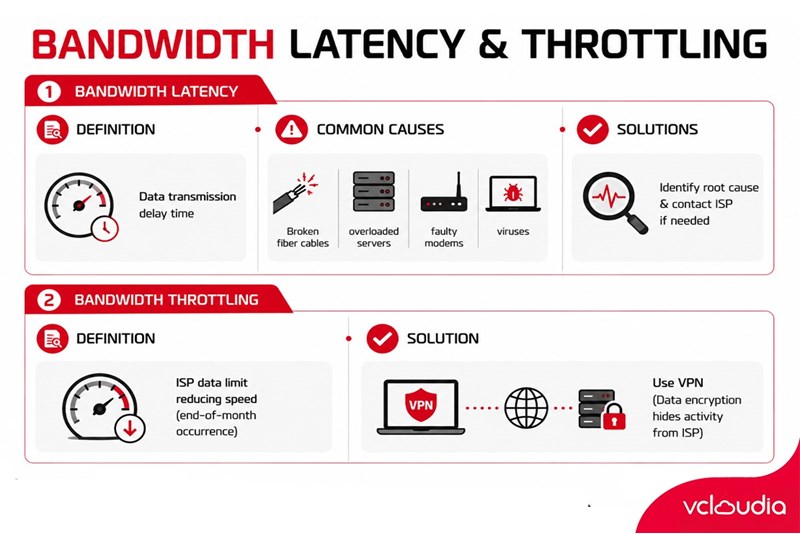
Bandwidth latency is the delay observed during data transmission. Lower bandwidth latency results in faster data transmission speeds, and conversely, higher latency leads to slower speeds. To resolve bandwidth latency, identifying the underlying cause is essential. Common causes include damaged AAG fiber optic cables, server overloads, defective modem devices, or virus infections.
A specific solution can be applied based on the particular cause. For instance, if the issue stems from the ISP, direct contact with the ISP is necessary to understand the situation.
How to Prevent Bandwidth Throttling
Bandwidth throttling occurs when Internet Service Providers (ISPs) restrict the amount of data that can pass through a network connection within a specific duration, leading to reduced internet speeds. This situation frequently happens towards the end of a billing cycle.
To avoid throttling, employing a VPN (Virtual Private Network) is advisable. When a VPN is used, transmitted data is encrypted, making it impossible for the ISP to identify the websites you are visiting. As a result, the Internet Service Provider cannot throttle your bandwidth.
How Does Bandwidth Differ from Internet Speed?
- Bandwidth relates to the quantity of data transferred, either uploaded to a website or downloaded to a computer from a website.
- Internet speed describes the rate at which data is transmitted, indicating how fast or slow it moves.
Should You Choose Domestic or International Bandwidth?
Users can select either domestic or international bandwidth services based on their specific requirements.
For Domestic Bandwidth
Domestic bandwidth refers to the speed of data transmission between devices located within the same country. Typically, domestic bandwidth is more affordable than international bandwidth. Furthermore, users can expect higher and more stable bandwidth speeds since data does not need to traverse international connections.
Users might consider opting for a domestic bandwidth service for activities such as:
- Accessing websites based in the same country.
- Streaming online videos from domestic providers.
- Playing online games hosted on domestic servers.
- Utilizing domestic cloud services.
For International Bandwidth
International bandwidth signifies the speed of data transmission between devices located in different countries. Due to its international nature, this service usually incurs a higher cost. Additionally, international bandwidth speeds can be affected by several factors, including:
- The quality of the international connection infrastructure.
- The geographical distances between the devices involved.
- The degree of network congestion at various points.
Users might consider an international bandwidth service for activities such as:
- Accessing international websites.
- Streaming online videos from international providers.
- Playing online games on international servers.
- Utilizing international cloud services.
Conclusion
By comprehending the distinctions between domestic and international bandwidth, you can effectively choose the appropriate bandwidth type to best meet your internet usage needs. It is also worth noting that you can combine both bandwidth types to optimize your internet efficiency.
Bandwidth is a crucial component for a seamless experience when using cloud services. Understanding its importance and operational principles will help you select the correct service package, optimize performance, and ensure the best user experience.
The information above provides a comprehensive overview, offering detailed answers to what bandwidth is and its impact on cloud service usage. Remember to consider your usage needs, budget, and other relevant factors when selecting a bandwidth package. For consultation and to choose the best-priced, top-quality bandwidth service package, customers are encouraged to contact Vcloudia today.
Looking for a high-performance, secure solution?
Explore the services offered by Vcloudia – a leading provider of Cloud Computing and Data Center solutions. Contact us for expert consultation and find the right model for your needs:
- Hotline: +855 888 55 66 08 (free of charge)
- Fanpage: https://www.facebook.com/vcloudia/
- Website: https://vcloudia.com
Featured news
Where Are Databases Stored?
20/11/2026Is Free Cloud Storage Worth Considering?
20/11/2026Related news
Where Are Databases Stored?
A database is a collection of structured information that is systematically organized and stored, making data management, querying, and manipulation easier and more efficient. Data within a database may include information about products, customers, transactions, or any other type of information related to business operations.
The Safest Data Storage Methods for Businesses
Data is an invaluable asset for businesses and the foundation of all business operations. Alongside today's rapid technological advancements, data is increasingly exposed to risks of loss, theft, or damage due to various causes. So, what are the safest data storage methods for businesses?
10 Popular and Secure Cloud Storage Services Today
Cloud Storage is currently the most popular solution for storing and managing data online. As a result, this service is continuously evolving, offering users an increasingly diverse range of options.
Is Free Cloud Storage Worth Considering?
Free cloud storage is currently a trend among many businesses because it not only helps optimize time and space to improve work efficiency but also saves the costs of on-premises server storage. However, businesses still face many challenges when using free plans.
On-Premise, Off-Premise, and Cloud – Which Storage Solution Is Right for Businesses?
There are three main infrastructure models that organizations can choose to deploy and manage their systems and applications: On-Premise, Off-Premise, and Cloud. So, which is the most suitable choice for businesses?
Is Cloud Storage Capacity Limited?
Storage capacity is one of the important factors that businesses need to understand before deploying a data storage system on a cloud computing platform. So, is Cloud Storage capacity limited? Join Vcloudia as we explore the answer in the following article.
How Can Small Clinics Securely Store Electronic Medical Records Without Extensive IT Infrastructure?
Does managing electronic medical records necessarily require a massive IT system? How can small clinics securely store electronic medical records without extensive IT infrastructure?
When Should You Stop Using Hard Drives and Switch to Cloud Storage?
In the following article, Vcloudia will help you understand the differences between traditional hard drives and Cloud platforms, while identifying the signs that indicate when businesses should change their storage methods to optimize security and improve system performance.
Should accounting and financial data be stored on the Cloud?
Many businesses remain quite hesitant about the security capabilities of the Cloud, especially when it comes to sensitive data. So, should accounting and financial data be stored on the Cloud? Let's join Vcloudia in finding the answer through the article below.
Differences Between HDD Servers and SSD Servers: Which Should Businesses Choose?
When choosing a storage server, businesses often consider HDD (Hard Disk Drive) and SSD (Solid State Drive) to ensure performance, speed, and costs that meet their needs. So, how do HDD and SSD servers differ? And which is the optimal choice for businesses?