



.png)















.png)





What is an Edge Data Center? A Comprehensive A - Z Guide
Aug 19, 2026An Edge Data Center is a data processing framework situated close to where data is generated, designed to optimize network performance and decrease the time it takes to access data. Join Vcloudia as we delve into this model to provide a thorough understanding in the following article!
What is an Edge Data Center?
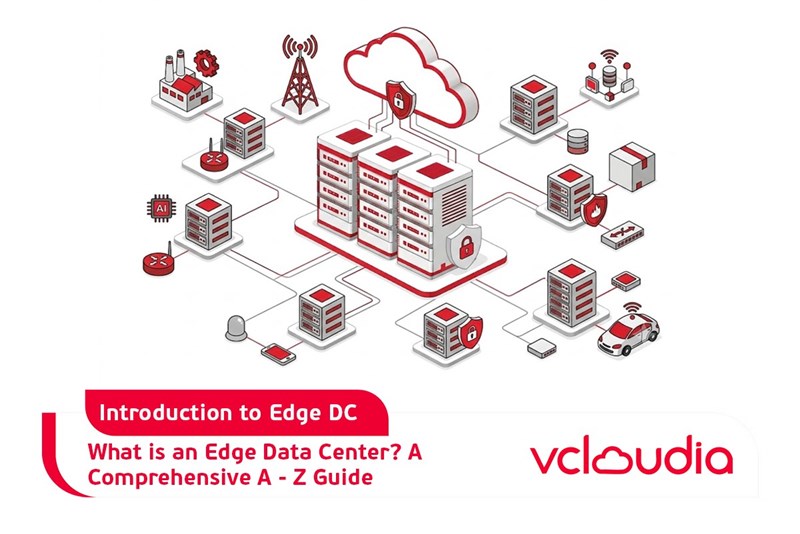
An Edge Data Center is a specific type of data center built to handle and store data near its origin, such as Internet of Things (IoT) devices or end-users. Unlike conventional, centralized data centers, Edge data centers bring the ability to process data closer to the network's perimeter.
In simpler terms, instead of data traveling back and forth between endpoints and a main data center for processing, this model allows users to process data directly at those endpoints.
Pros and cons of an Edge data center
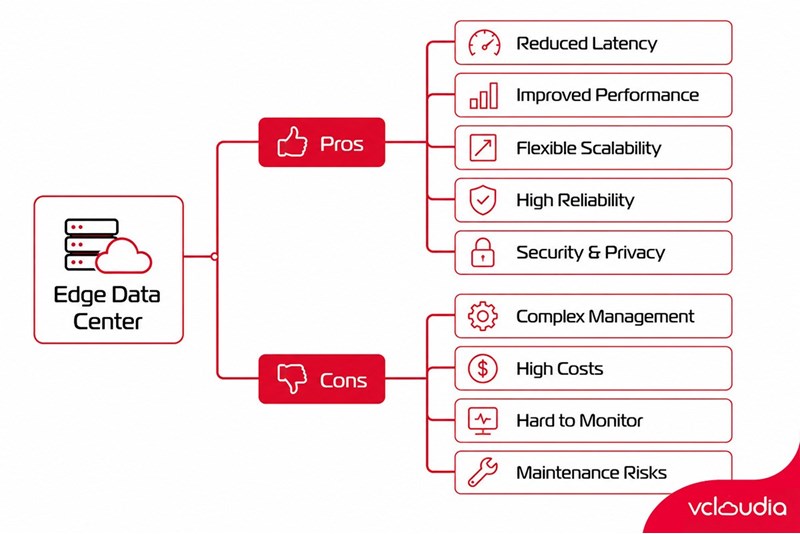
Every technological approach comes with its own set of advantages and disadvantages. Below, users can find a reference to the pros and cons associated with an Edge data center:
Pros:
- Reduced latency: A major advantage of an Edge data center is its capability to minimize latency. When data is processed near the end-user, response times become significantly quicker, which is vital for real-time applications like video streaming or IoT interactions.
- Improved performance: Processing data in proximity to the end-user helps boost application performance by alleviating network congestion and bottlenecks that can occur with centralized data centers.
- Flexible scalability: Edge data centers offer easy scalability to accommodate increasing demands without the necessity of constructing larger infrastructure remotely, thereby providing businesses with flexibility in adjusting their operational scope.
- High reliability: The Edge data center model operates by distributing workloads across various Edge locations. This dispersion across multiple sites ensures that if one Edge data center encounters a problem, others can continue to function and serve users consistently. This guarantees uninterrupted services and allows users to access necessary applications or data as usual.
- Security and data privacy: Since data is processed and stored directly on edge devices, the risk of sensitive information leakage can be diminished. Furthermore, security measures such as encryption and self-protection enhance the capability of IoT devices to defend against threats from hackers.
Cons:
- Complexity in management: With numerous distributed data centers, managing and maintaining Edge data centers can become more intricate compared to overseeing a single large data center or a few.
- High investment costs: Deploying and sustaining an Edge data center infrastructure demands substantial investment. Edge devices also frequently require upgrades to better meet processing and computing demands. Additionally, the process of installing and managing these devices necessitates significant investment in personnel and time.
- Difficult to monitor: Managing and monitoring edge devices can present numerous challenges because they are often dispersed in remote locations. Checking operational status, upgrading software, and tracking the performance of these devices also requires considerable effort and resources for effective management.
- Maintenance and incident risks: Edge data centers may face issues stemming from the external environment or other technical problems. Inadequate maintenance can lead to service disruptions or the loss of critical data.
How an Edge data center works
An Edge data center functions as a distributed intermediary, positioned close to the source of data generation or the requesting device, with the goal of enhancing processing speed and minimizing latency. Serving as an Internet Exchange Point, this data center links networks and service providers while offering local computing resources for cloud applications and real-time analytics.
Moreover, by utilizing technologies such as Edge caching, fog computing, or micro data centers (MDCs), the Edge data center also temporarily stores and processes data right at its point of creation. Critical information will be handled on-site to ensure performance and rapid response, while less urgent data will be transferred to a centralized data center for in-depth analysis or long-term storage.
Comparison of edge data centers and other data centers
Based on the comparison table, it is evident that both Edge data centers and traditional data centers possess distinct advantages, making them suitable for specific needs and applications. However, to fully leverage the power of data infrastructure, selecting a reliable provider is a crucial element.
Conclusion
Through this article, Vcloudia hopes you have gained a general understanding of Edge data centers, their operational mechanisms, and the prominent advantages and disadvantages that this model presents. We trust that the information shared above will assist businesses in making appropriate decisions to meet their technological requirements in today's continuously evolving digital landscape.
Vcloudia Cloud Server – The Cloud You Can Count On
If you're concerned about the potential limitations of Cloud Servers, Cloud Server by Vcloudia is a reliable solution for businesses of all sizes. With a modern infrastructure and comprehensive customer support, Vcloudia delivers a cloud experience with:
- Powerful connectivity to ensure stable 24/7 access
- Advanced security standards, compliant with international certifications such as ISO 27001:2013, ISO 20000:2018, ISO 9001:2015
- Flexible pricing packages tailored to your specific business needs
- Expert technical support, making migration and system deployment fast, safe, and compatible
Contact information:
- Hotline: +855 888 55 66 08 (free of charge)
- Fanpage: https://www.facebook.com/vcloudia/
- Website: https://vcloudia.com
Featured news
Related news
What is a Snapshot? The Difference Between Snapshot and Backup
Snapshot is a familiar concept in data management and protection. In the context of the information technology boom, where data is a major asset for businesses, understanding Snapshots as well as their application is a key factor for enterprises to maximize technological efficiency.
What is a Firewall? The Role and Importance of Firewalls for Users
In the context of ever-increasing cyberattacks, system security has become a top priority for many enterprises. Alongside deploying antivirus software and controlling connection ports, firewalls are also considered a key solution to effectively enhance cybersecurity.
What is DDoS? Signs, Mitigation Strategies, and Effective Prevention
DDoS is a highly dangerous cyberattack that leaves severe consequences for enterprises. Therefore, gaining a clear understanding of DDoS attacks, as well as how to detect and prevent them, is a topic of significant interest to many.
What is a Trojan? How to Detect, Avoid, and Prevent It
A Trojan is a type of malicious code or software that can cause severe consequences to computer operations. So, what is a Trojan? How can you prevent a Trojan from infiltrating your computer? In the following article, Vcloudia will provide detailed information on these issues.
What is Cloud Backup? Classification, benefits, and limitations
Cloud Backup is a solution that plays an important role in backing up and recovering data when an incident occurs. So what exactly is Cloud Backup? Let's find out the details with Vcloudia in the following article.
What is Cloud Storage? Features and Benefits of Using It
Cloud Storage is the perfect storage solution alternative to bulky, space-consuming physical hard drives. So, what is Cloud Storage? Let's explore the details with Vcloudia through the following article.
What is an API? Characteristics and applications in website design
API, short for Application Programming Interface, is a concept no longer unfamiliar in the information technology field. So what exactly is an API and why is it so important? Let's find out with Vcloudia.
What is Node.js? Instructions on how to install Node.js on cPanel
Currently, it is easy to see that Node.js is being used by quite a lot of people. This is because Node.js can support users in running on multiple platforms and multiple devices.
What is Vultr VPS? Should you use Vultr VPS?
Vultr VPS is one of the best cloud storage solutions in the world. In this article, you will learn the concept: "What is Vultr VPS?", as well as understand its advantages and disadvantages.
Zoom Cloud Meeting: What is it? Basic Things You Should Know About Zoom Cloud Meeting
In 2020, Zoom Cloud Meeting became one of the leading video conferencing software applications. It allows you to virtually interact with colleagues when in-person meetings aren't possible, and it has also been very successful for social events.