



.png)



















.png)





What is a Web Server? How It Works and Usage Considerations
Aug 24, 2026A web server is a mechanism that stores and processes requests from internet users. In essence, it operates similarly to web hosting, but it allows for handling larger demands. This article will delve into its specifics.
Basic Knowledge About Web Servers
What is Web Servers?
To begin with, let's clarify what a web server is. Vcloudia has previously published an article that elaborates on this topic, which you can refer to for deeper insights. Below is a summary of key points for your reference.
- First, a web server can be understood as a type of hardware or software that processes user requests. For instance, if Vcloudia runs a website offering web servers, domain names, etc., at the URL https://vcloudia.com, when you visit this site to look for a product, the web server will capture your requests and retrieve the information needed through your web browser.
- Second, a web server may consist of hardware, software, or a combination of both based on different circumstances.
- Third, HTTP is among the many protocols utilized for connecting a web server with a user's web browser.
At this point, it may be apparent that a web server bears a resemblance to web hosting; fundamentally, these two models are quite alike. However, distinctions exist, making each type more suited to specific audiences.
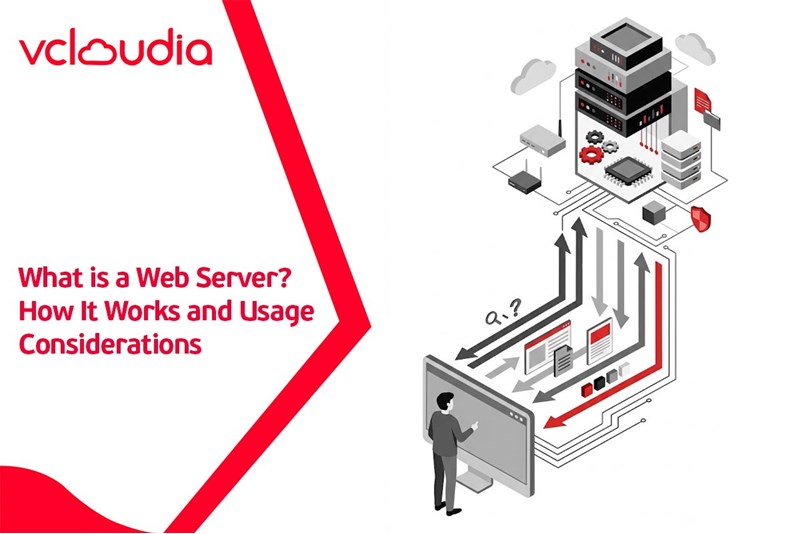
Web server is a system that stores website files and delivers them to users over the internet using the HTTP/HTTPS protocols. It acts as a digital bridge between a website's stored data and a user's web browser (like Chrome or Safari).
Differentiating Between Web Servers and Web Hosting
What accounts for the similarities between web servers and web hosting? In simple terms, a server can be viewed as a large computer system. Conversely, hosting involves partitioning a server into smaller segments to fulfill users' lesser needs. Broadly construed, a server resembles a computer's hard drive, while hosting pertains to the various sections within it, comparable to the C, D, or E drives.
Given this nature, web servers predominantly serve large clients, particularly businesses or organizations. In contrast, web hosting primarily aims at individual users. Utilizing web hosting can accommodate user needs and generally be more economical than operating a web server.
How a Web Server Works
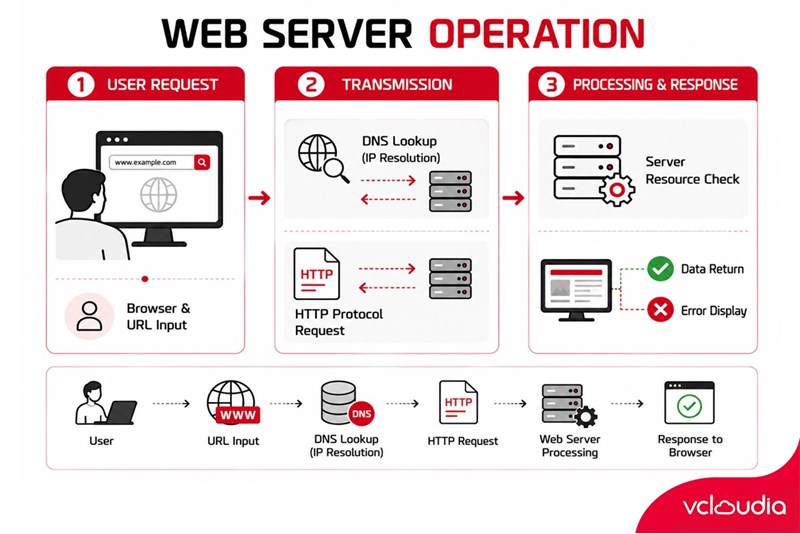
As noted in the definition above, the fundamental operating model of a web server comprises three principal elements: the Web server, the Web browser, and the HTTP protocol. The following section will elucidate the functionality of all three components.
Step 1: User Sends a Request
Internet users access any website through a web browser installed on their computer or mobile device. For example, if you enter the address of the Vcloudia website using the URL https://vcloudia.com.
Step 2: Web Browser Sends the Request to the Web Server for Processing
At this point, your web browser (be it Chrome, Brave, Firefox, etc.) will pick up the request and convert the domain name into its corresponding IP address. This conversion occurs through DNS servers. Subsequently, the browser sends a request via the HTTP protocol to the web server, indicating that a user wants to retrieve information associated with that address. It requests the server to return the results to the user.
Step 3: Web Server Checks, Returns Results, and the Browser Displays Results for the User
Once the web server receives the request from the browser, it will look through its system to verify if there are resources related to the sought address. If found, it will send back the information through the HTTP protocol for the web browser to display to the user. If not found, it will present error messages or notifications indicating "content not found." This process continues to repeat itself.
Some Considerations When Using a Web Server
From the information provided above, it becomes evident that web servers cater to users who are businesses or websites experiencing high traffic that necessitates abundant resources. Therefore, you should make informed decisions based on your specific usage requirements.
If you plan to use a web server, consider the following aspects:
- Ensure continuous operation of the Web server: A web server's main role is to deliver data. This obligation not only pertains to users actively searching but also includes requests from search engines like Google, Bing, or Yahoo. Therefore, it is crucial to ensure the web server functions around the clock. This is why specialized servers are constructed for this purpose rather than relying on standard workstations.
- Select a suitable configuration: The hardware setup of the web server must correspond with expected traffic levels. Avoid excessive redundancy that could lead to waste, or significant deficits that may slow down the website. If the web server is underpowered, high volumes of simultaneous visits may result in sluggish access, adversely impacting the user experience.
Conclusion
If you are seeking information about web servers, we hope this article has provided valuable insights. The key takeaway from this discussion is that web servers are not intended for minimal usage needs or a newly launched website with average traffic. The management and upkeep of a web server come with specific requirements, particularly regarding the two considerations mentioned earlier.
Looking for a high-performance, secure solution?
Explore the services offered by Vcloudia – a leading provider of Cloud Computing and Data Center solutions. Contact us for expert consultation and find the right model for your needs:
- Hotline: +855 888 55 66 08 (free of charge)
- Fanpage: https://www.facebook.com/vcloudia/
- Website: https://vcloudia.com
Featured news
Related news
What is a Snapshot? The Difference Between Snapshot and Backup
Snapshot is a familiar concept in data management and protection. In the context of the information technology boom, where data is a major asset for businesses, understanding Snapshots as well as their application is a key factor for enterprises to maximize technological efficiency.
What is a Firewall? The Role and Importance of Firewalls for Users
In the context of ever-increasing cyberattacks, system security has become a top priority for many enterprises. Alongside deploying antivirus software and controlling connection ports, firewalls are also considered a key solution to effectively enhance cybersecurity.
What is DDoS? Signs, Mitigation Strategies, and Effective Prevention
DDoS is a highly dangerous cyberattack that leaves severe consequences for enterprises. Therefore, gaining a clear understanding of DDoS attacks, as well as how to detect and prevent them, is a topic of significant interest to many.
What is a Trojan? How to Detect, Avoid, and Prevent It
A Trojan is a type of malicious code or software that can cause severe consequences to computer operations. So, what is a Trojan? How can you prevent a Trojan from infiltrating your computer? In the following article, Vcloudia will provide detailed information on these issues.
What is Cloud Backup? Classification, benefits, and limitations
Cloud Backup is a solution that plays an important role in backing up and recovering data when an incident occurs. So what exactly is Cloud Backup? Let's find out the details with Vcloudia in the following article.
What is Cloud Storage? Features and Benefits of Using It
Cloud Storage is the perfect storage solution alternative to bulky, space-consuming physical hard drives. So, what is Cloud Storage? Let's explore the details with Vcloudia through the following article.
What is an API? Characteristics and applications in website design
API, short for Application Programming Interface, is a concept no longer unfamiliar in the information technology field. So what exactly is an API and why is it so important? Let's find out with Vcloudia.
What is Node.js? Instructions on how to install Node.js on cPanel
Currently, it is easy to see that Node.js is being used by quite a lot of people. This is because Node.js can support users in running on multiple platforms and multiple devices.
What is Vultr VPS? Should you use Vultr VPS?
Vultr VPS is one of the best cloud storage solutions in the world. In this article, you will learn the concept: "What is Vultr VPS?", as well as understand its advantages and disadvantages.
Zoom Cloud Meeting: What is it? Basic Things You Should Know About Zoom Cloud Meeting
In 2020, Zoom Cloud Meeting became one of the leading video conferencing software applications. It allows you to virtually interact with colleagues when in-person meetings aren't possible, and it has also been very successful for social events.