



.png)


















.png)





What is a Power Distribution Unit (PDU)? The Role and How to Choose a PDU for a Data Center
Jun 30, 2026In any Data Center or server room, power supply is always a vital factor that determines the stability and safety of the entire IT system. This is exactly why the Power Distribution Unit (PDU) has become an indispensable component in modern Data Center architecture. This article by Vcloudia will help you correctly understand what a PDU is, how it operates, and how to choose one to help businesses minimize risks, save costs, and be ready to scale their systems in the future.
What is a Power Distribution Unit (PDU)?
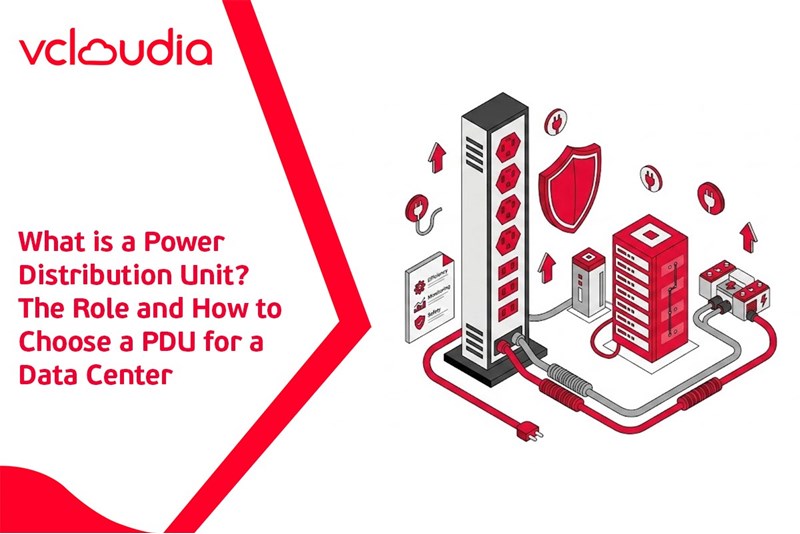
A Power Distribution Unit, commonly abbreviated as PDU, is a specialized device used to distribute electrical power from the main power source to IT equipment inside a rack, such as servers, networking devices, storage, firewalls, or localized cooling systems. Unlike standard residential power strips, PDUs are designed to operate continuously in Data Center environments with high requirements for stability, capacity, and electrical safety.
Essentially, a PDU acts as an intermediary point between the input power source (from UPS, generators, or the grid) and power-consuming IT equipment. Thanks to the PDU, electrical power is distributed evenly, controllably, and appropriately for the load of each device in the rack. This helps reduce the risk of localized overloads, limits voltage drops, and ensures that servers always operate under stable power conditions.
In modern Data Centers, PDUs no longer stop at the function of power distribution. Many types of PDUs integrate the capabilities of measurement, monitoring, and remote control, helping the operations team clearly grasp power consumption levels in real-time and proactively address issues before downtime occurs.
The Role of PDUs in a Data Center
In a Data Center environment, where hundreds or thousands of IT devices operate in parallel, the PDU plays a central role in ensuring the stability of the entire system. First of all, the PDU helps distribute power scientifically and safely, minimizing the risk of short circuits or fires caused by using inappropriate sockets or tangled power cords in the rack.
Besides, PDUs also make a significant contribution to optimizing space and airflow inside the rack. When the power supply is centrally distributed through vertically or horizontally mounted PDUs following rack standards, the power cord system becomes neater, helping the cooling airflow circulate effectively and reducing the risk of hotspots in the server cabinet.
Another increasingly important role of PDUs is supporting energy monitoring and management. Through PDUs capable of load metering or remote monitoring, businesses can track the power consumption of each rack, each branch, or even each individual outlet. This not only helps detect overload risks early but also supports more accurate infrastructure expansion planning, avoiding redundant investments.
Finally, PDUs serve as a crucial foundation for building Data Centers that meet high availability standards such as Tier III or Tier IV. Combining PDUs with UPSs, redundant power systems, and centralized monitoring solutions helps minimize the risk of service interruptions, especially for systems requiring 24/7 uptime.
Structure and Operating Principles of a Power Distribution Unit
A standard Power Distribution Unit consists of multiple components specifically designed for Data Center environments. The most noticeable component is the output receptacles, commonly utilizing industrial standards such as IEC C13, C19, or other specific standards depending on the region and capacity. These receptacles are arranged vertically or horizontally to optimize rack space.
The input section of a PDU typically connects directly to a UPS or the main power source through a heavy-duty power cord. Inside the PDU is a system of busbars, fuses, circuit breakers, or protection circuits that help distribute power evenly and disconnect the power supply when overload or short-circuit incidents occur. For high-end PDUs, internal sensors are also integrated to measure current, voltage, and power consumption.
The operating principle of a PDU is relatively simple but demands high precision. When power is supplied, the PDU will distribute electricity to each outlet according to the design, while simultaneously monitoring electrical parameters if measurement features are available. In case the current exceeds the safety threshold, the protection system will activate to break the circuit, helping to protect IT equipment from damage.
With smart PDUs, the operating principle is further extended thanks to network connectivity capabilities. Power data is sent back to the central management system, allowing the operations team to monitor, analyze, and even remotely control the power supply via a web interface or DCIM software.
Common Types of PDUs Today
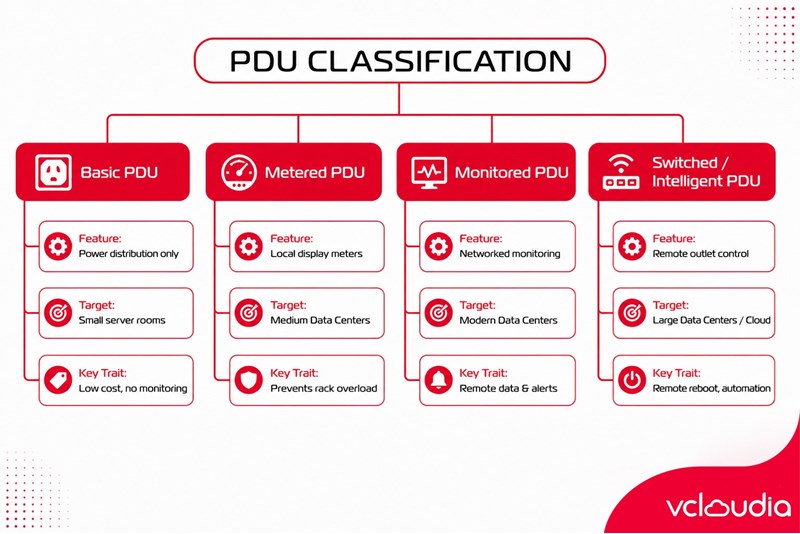
Basic PDU
A basic PDU is the simplest type, focusing solely on the power distribution function without integrating measurement or monitoring capabilities. This type of PDU is frequently used in small server rooms or environments that do not require detailed tracking of power consumption. The biggest advantage of a Basic PDU is its low cost, ease of deployment, and high durability. However, its limitation is that it does not provide information about the electrical load, making system management and expansion highly dependent on operational experience.
Metered PDU
A Metered PDU is integrated with a current or power meter, allowing the display of power consumption levels for the entire PDU or individual branches. As a result, administrators can track the electrical load in real-time and avoid rack overloads. This type of PDU is suitable for medium-sized Data Centers, where optimizing power usage begins to become important but complex remote monitoring is not yet required.
Monitored PDU
A Monitored PDU is more advanced than a Metered PDU as it allows power monitoring via network connections. Parameters such as current, voltage, and power are sent to the central management system, helping the operations team monitor remotely and receive alerts when there are signs of abnormality. This is a popular choice in modern Data Centers, where there are high requirements for control capabilities and proactive incident resolution.
Switched / Intelligent PDU
Smart PDUs not only monitor but also allow remote control of individual outlets. Administrators can turn on, turn off, or reboot devices without requiring direct physical intervention at the rack. This is particularly useful in large Data Centers or Cloud systems, where physical access faces many restrictions. Intelligent PDUs help enhance operational efficiency, reduce troubleshooting time, and support power management automation.
How to Choose the Right Power Distribution Unit
To choose the appropriate PDU, businesses need to simultaneously consider multiple technical and operational factors. First is the capacity and rated current, ensuring the PDU can meet current demands and provide redundancy for future expansion. Choosing the wrong capacity can lead to overloads or wasted resources.
Next is the form factor and the number of outlets. Depending on the rack design and equipment density, vertical or horizontal PDUs will yield different efficiencies. Additionally, the outlet standards also need to be compatible with existing IT equipment to avoid incurring unnecessary adapters.
Monitoring and management capabilities are another crucial criterion. For large systems or those requiring high uptime, PDUs with load metering or remote monitoring will enable safer and more proactive operations. Finally, businesses should consider the ability to integrate PDUs with Data Center or Cloud management systems in the future, to ensure the infrastructure can scale and adapt to long-term growth.
Conclusion
A Power Distribution Unit is not merely a simple power distribution device but also a vital foundation in the management and operation of modern Data Centers. Clearly understanding what a PDU is, the popular types of PDUs, and appropriate selection criteria will help businesses build stable, secure IT infrastructure that is ready to scale. In the context of increasing demands for Cloud, Data Centers, and digital systems, investing correctly in PDUs from the very beginning is a strategic step to ensure long-term operational efficiency and minimize risks for the entire system.
Looking for a high-performance, secure solution?
Explore the services offered by Vcloudia – a leading provider of Cloud Computing and Data Center solutions. Contact us for expert consultation and find the right model for your needs:
- Hotline: +855 888 55 66 08 (free of charge)
- Fanpage: https://www.facebook.com/vcloudia/
- Website: https://vcloudia.com
Featured news
Related news
What is a Snapshot? The Difference Between Snapshot and Backup
Snapshot is a familiar concept in data management and protection. In the context of the information technology boom, where data is a major asset for businesses, understanding Snapshots as well as their application is a key factor for enterprises to maximize technological efficiency.
What is a Firewall? The Role and Importance of Firewalls for Users
In the context of ever-increasing cyberattacks, system security has become a top priority for many enterprises. Alongside deploying antivirus software and controlling connection ports, firewalls are also considered a key solution to effectively enhance cybersecurity.
What is DDoS? Signs, Mitigation Strategies, and Effective Prevention
DDoS is a highly dangerous cyberattack that leaves severe consequences for enterprises. Therefore, gaining a clear understanding of DDoS attacks, as well as how to detect and prevent them, is a topic of significant interest to many.
What is a Trojan? How to Detect, Avoid, and Prevent It
A Trojan is a type of malicious code or software that can cause severe consequences to computer operations. So, what is a Trojan? How can you prevent a Trojan from infiltrating your computer? In the following article, Vcloudia will provide detailed information on these issues.
What is Cloud Backup? Classification, benefits, and limitations
Cloud Backup is a solution that plays an important role in backing up and recovering data when an incident occurs. So what exactly is Cloud Backup? Let's find out the details with Vcloudia in the following article.
What is Cloud Storage? Features and Benefits of Using It
Cloud Storage is the perfect storage solution alternative to bulky, space-consuming physical hard drives. So, what is Cloud Storage? Let's explore the details with Vcloudia through the following article.
What is an API? Characteristics and applications in website design
API, short for Application Programming Interface, is a concept no longer unfamiliar in the information technology field. So what exactly is an API and why is it so important? Let's find out with Vcloudia.
What is Node.js? Instructions on how to install Node.js on cPanel
Currently, it is easy to see that Node.js is being used by quite a lot of people. This is because Node.js can support users in running on multiple platforms and multiple devices.
What is Vultr VPS? Should you use Vultr VPS?
Vultr VPS is one of the best cloud storage solutions in the world. In this article, you will learn the concept: "What is Vultr VPS?", as well as understand its advantages and disadvantages.
Zoom Cloud Meeting: What is it? Basic Things You Should Know About Zoom Cloud Meeting
In 2020, Zoom Cloud Meeting became one of the leading video conferencing software applications. It allows you to virtually interact with colleagues when in-person meetings aren't possible, and it has also been very successful for social events.