



.png)


















.png)





What is a Modular Data Center? Advantages, structure, and comparison with traditional Data Centers
Jun 30, 2026In the context where businesses increasingly rely on data, the speed of IT infrastructure deployment becomes a decisive factor for competitive advantage. Instead of investing millions of dollars and spending years building a fixed data center, many organizations are shifting to a more flexible model, which is the Modular Data Center.
This article by Vcloudia will help you clearly understand what a Modular Data Center is, how its structure works, the benefits it brings to businesses, and its differences compared to traditional Data Centers.
What is a Modular Data Center?
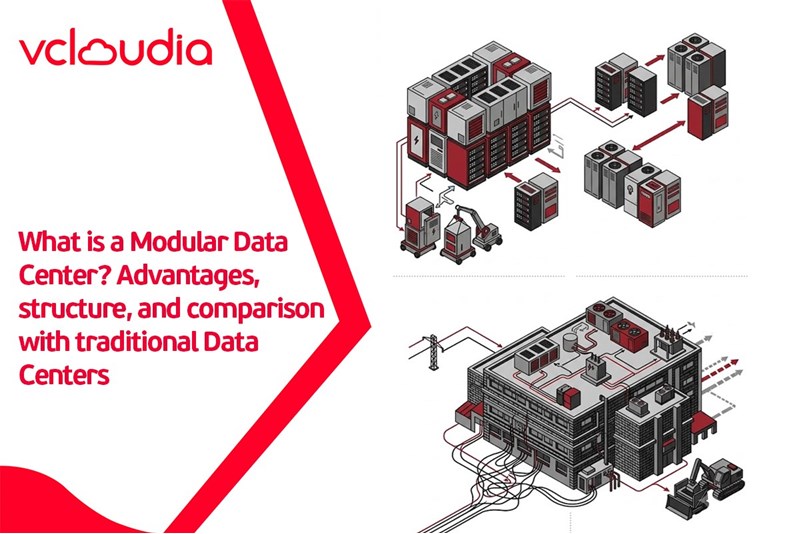
A Modular Data Center is a data center model designed as independent modules, which can be deployed, expanded, and upgraded in stages. Instead of building the entire infrastructure system within a fixed facility, this model divides the data center into multiple separate blocks, each integrating a full power supply, cooling, network system, and management solution.
The core of a Modular Data Center lies in its "plug-and-play" capability. Modules are manufactured and pre-assembled at the factory according to strict technical standards, then transported to the deployment site to be put into operation in a short time. This helps minimize construction risks, ensures better quality control, and significantly shortens the time to bring the system into operation.
Unlike traditional Data Centers that require long-term planning and massive upfront investment, a Modular Data Center allows businesses to expand according to actual needs. When the volume of data or the number of users increases, businesses only need to add more modules instead of upgrading the entire infrastructure.
Structure of a Modular Data Center
A complete Modular Data Center consists of multiple integrated infrastructure layers. Each component is designed to operate independently while still ensuring overall connectivity.
Physical infrastructure module
The physical infrastructure part is the skeleton of the entire system. Depending on the deployment model, the module can be designed as a standard ISO container or a specialized pre-fabricated frame. Inside are server rack systems, fire protection systems, humidity control, and thermal insulation that meet international standards.
The module design helps optimize installation space and ensures mobility. Some models can be deployed outdoors, in industrial zones, or in areas with limited infrastructure without the need to build a traditional server room.
Power supply system
Power supply plays a vital role in every Data Center. In the modular model, the electrical system is often pre-integrated, including UPS, PDU, and Automatic Transfer Switch (ATS) mechanisms. Thanks to the synchronized design, each module can operate stably even if part of the system encounters a failure. The ability to allocate power to each module helps optimize capacity utilization. Businesses do not need to invest in redundant power supplies from the beginning but can upgrade gradually according to actual scale.
Integrated cooling system
Temperature is a factor that directly affects the performance and lifespan of IT equipment. Modular Data Centers often use in-row cooling systems, compact CRACs, or rack-density cooling technologies.
Thanks to the enclosed design, the cooling system is optimized for each module, helping to save energy and reduce operating costs. Precise control of hot and cold airflows also helps improve the PUE index, an important factor in evaluating the energy efficiency of a data center.
Network and connectivity system
The network infrastructure in a Modular Data Center is built with a flexible architecture, allowing for expansion when adding new modules. Core switches, access switches, and optical fiber systems are organized scientifically to reduce latency and increase stability. This design ensures that each module can integrate seamlessly into the overall system without causing service disruption.
Monitoring and management system
Monitoring is a crucial element to ensure continuous operation. Modular Data Centers often integrate DCIM solutions that allow real-time tracking of temperature, electrical load, humidity, and system performance. Centralized monitoring capability helps technical teams detect issues early, optimize resources, and make decisions based on real data.
How does a Modular Data Center work?
Regarding operating principles, each module in the system functions as an independent unit. When a business deploys the initial phase, only a few modules are put into operation. As demand increases, new modules are added without affecting the running system. The modules are linked via the central network backbone. Data can be distributed among modules according to load, helping to balance resources and ensure high availability.
This operating method is suitable for fast-growing business environments or those with highly fluctuating traffic. Instead of a large-scale upgrade causing downtime, businesses can expand gradually while maintaining service stability.
Advantages of deploying a Modular Data Center
Rapid deployment
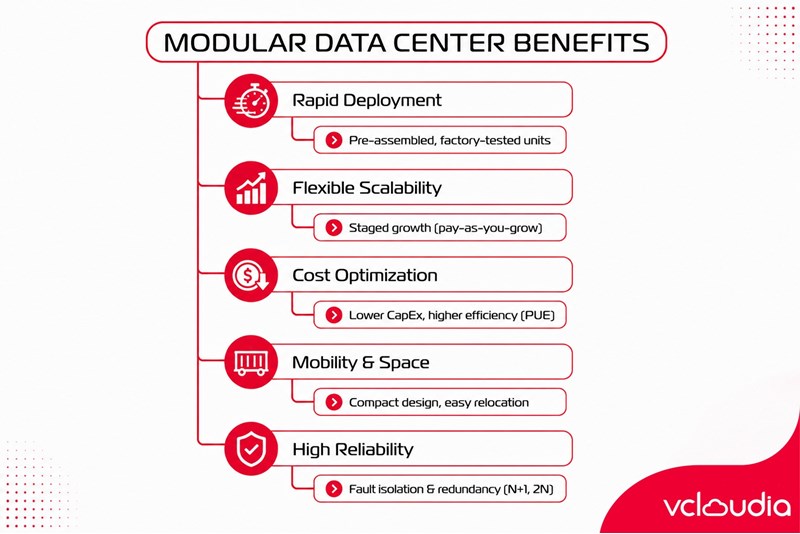
One of the most outstanding advantages of a Modular Data Center is its superior deployment speed compared to the traditional model. Instead of having to design, build infrastructure, and install electrical, cooling, and network systems on-site for many months or even years, the modular model is manufactured and pre-assembled at the factory according to synchronized technical standards. When transported to the deployment site, the system only needs to be connected to the power supply, transmission lines, and initially configured before being put into operation. This helps significantly shorten deployment time to just a few weeks or a few months depending on the scale.
For technology enterprises, e-commerce, fintech, or fast-growing startups, bringing IT infrastructure into operation early can create a significant competitive advantage. Short deployment time also helps businesses react flexibly to market demands.
Flexible expansion capability according to actual needs
Unlike traditional Data Centers which must have large-scale investments from the beginning, a Modular Data Center allows for staged expansion. Businesses can start with an appropriate number of modules for current needs, then add more when the system load increases. The modular expansion model helps limit over-provisioning, which means investing redundantly in unused resources. This is particularly important in a context where data and traffic volumes can fluctuate strongly according to seasons or campaigns.
Optimizing investment and operating costs
A Modular Data Center helps businesses optimize both initial investment costs and long-term operating costs. Instead of spending large capital on a large-scale data center, businesses can allocate their budget according to each development stage. The cooling and power distribution systems in the modular model are often optimally designed for each module, helping to reduce energy loss. As a result, the Power Usage Effectiveness (PUE) index can be improved compared to some traditional Data Centers designed with excess capacity.
Saving space and easy relocation
Some Modular Data Centers are designed in the form of standard containers or compact pre-fabricated modules. This helps optimize usable space and allows deployment in areas with limited space.
Particularly, containerized models can be relocated when a business changes its operating location or expands to a new area. This mobility brings great advantages to businesses operating in manufacturing, oil and gas, telecommunications, or industries requiring distributed IT infrastructure.
Increasing reliability and availability
Thanks to the independent module structure, a Modular Data Center can isolate incidents within the scope of each separate block. If one module encounters a problem with power or cooling, the other modules can still continue to operate normally.
Besides, many models are designed according to N+1 or 2N redundancy standards, helping to increase fault tolerance and ensure high availability. This is a particularly important factor for financial systems, e-commerce, or digital services that require near-absolute uptime.
Comparison between Modular Data Center and traditional Data Center
Popular Modular Data Center models today
Containerized Data Center
Containerized Data Center is the most popular type of modular model. The system is fully integrated with IT equipment, power supply, and cooling inside a standard ISO container. The biggest advantage of this model is its mobility and the ability to deploy quickly in many different locations. The container model is suitable for environments requiring quick deployment such as industrial zones, resource exploitation areas, or regions with limited infrastructure.
Micro Data Center
A Micro Data Center is a miniature version of a data center, often located at branches, offices, or edge points. This model supports processing data close to the source of generation, reducing latency and optimizing transmission bandwidth back to the main center. Micro Data Centers are particularly suitable for IoT, smart monitoring systems, multi-point retail, and 5G infrastructure.
Prefabricated Data Center
A Prefabricated Data Center is pre-assembled at the factory as large modules, then transported and installed at the deployment site. The production process is strictly controlled, ensuring uniform quality and minimizing technical risks. This model is often used in medium to large-scale projects, where businesses want to shorten construction time while still ensuring high standards.
Edge Modular Data Center
An Edge Modular Data Center is deployed close to end-users to reduce latency and increase data processing speed. In the context where real-time applications are becoming increasingly popular such as streaming, online gaming, autonomous vehicles, or industrial IoT, the edge data center plays an important role. Thanks to the modular structure, edge nodes can be flexibly deployed across many different locations, creating a distributed network that is still easy to manage centrally.
When should you deploy a Modular Data Center?
Businesses should consider a Modular Data Center when they need to expand quickly but have not clearly defined a long-term scale. This model is also suitable for organizations deploying infrastructure in multiple different locations or areas with restricted construction conditions.
Technology startups, fintech, e-commerce, and smart manufacturing businesses are groups that clearly benefit from the flexibility of the modular model. When growth speed and adaptability are key factors, a Modular Data Center becomes a strategic choice.
Conclusion
A Modular Data Center is a flexible, modern data center solution suitable for the digital infrastructure development trend. Thanks to the independent modular design, flexible expansion capabilities, and fast deployment time, this model helps businesses optimize costs and enhance system availability.
Vcloudia Cloud Server – The Cloud You Can Count On
If you're concerned about the potential limitations of Cloud Servers, Cloud Server by Vcloudia is a reliable solution for businesses of all sizes. With a modern infrastructure and comprehensive customer support, Vcloudia delivers a cloud experience with:
- Powerful connectivity to ensure stable 24/7 access
- Advanced security standards, compliant with international certifications such as ISO 27001:2013, ISO 20000:2018, ISO 9001:2015
- Flexible pricing packages tailored to your specific business needs
- Expert technical support, making migration and system deployment fast, safe, and compatible
Contact information:
- Hotline: +855 888 55 66 08 (free of charge)
- Fanpage: https://www.facebook.com/vcloudia/
- Website: https://vcloudia.com
Featured news
Related news
What is a Snapshot? The Difference Between Snapshot and Backup
Snapshot is a familiar concept in data management and protection. In the context of the information technology boom, where data is a major asset for businesses, understanding Snapshots as well as their application is a key factor for enterprises to maximize technological efficiency.
What is a Firewall? The Role and Importance of Firewalls for Users
In the context of ever-increasing cyberattacks, system security has become a top priority for many enterprises. Alongside deploying antivirus software and controlling connection ports, firewalls are also considered a key solution to effectively enhance cybersecurity.
What is DDoS? Signs, Mitigation Strategies, and Effective Prevention
DDoS is a highly dangerous cyberattack that leaves severe consequences for enterprises. Therefore, gaining a clear understanding of DDoS attacks, as well as how to detect and prevent them, is a topic of significant interest to many.
What is a Trojan? How to Detect, Avoid, and Prevent It
A Trojan is a type of malicious code or software that can cause severe consequences to computer operations. So, what is a Trojan? How can you prevent a Trojan from infiltrating your computer? In the following article, Vcloudia will provide detailed information on these issues.
What is Cloud Backup? Classification, benefits, and limitations
Cloud Backup is a solution that plays an important role in backing up and recovering data when an incident occurs. So what exactly is Cloud Backup? Let's find out the details with Vcloudia in the following article.
What is Cloud Storage? Features and Benefits of Using It
Cloud Storage is the perfect storage solution alternative to bulky, space-consuming physical hard drives. So, what is Cloud Storage? Let's explore the details with Vcloudia through the following article.
What is an API? Characteristics and applications in website design
API, short for Application Programming Interface, is a concept no longer unfamiliar in the information technology field. So what exactly is an API and why is it so important? Let's find out with Vcloudia.
What is Node.js? Instructions on how to install Node.js on cPanel
Currently, it is easy to see that Node.js is being used by quite a lot of people. This is because Node.js can support users in running on multiple platforms and multiple devices.
What is Vultr VPS? Should you use Vultr VPS?
Vultr VPS is one of the best cloud storage solutions in the world. In this article, you will learn the concept: "What is Vultr VPS?", as well as understand its advantages and disadvantages.
Zoom Cloud Meeting: What is it? Basic Things You Should Know About Zoom Cloud Meeting
In 2020, Zoom Cloud Meeting became one of the leading video conferencing software applications. It allows you to virtually interact with colleagues when in-person meetings aren't possible, and it has also been very successful for social events.