



.png)














.png)





What is a Micro Data Center and why are businesses shifting to this model?
Jun 30, 2026In the context of exponentially growing data, businesses no longer rely solely on a centralized data center located at their headquarters. The Micro Data Center has emerged as a flexible, compact IT infrastructure solution that still ensures high performance and reliability. So, what is a Micro Data Center? Why are increasingly more businesses choosing this model instead of building a traditional Data Center or expanding centralized infrastructure?
In the article below, Vcloudia will comprehensively analyze with you from structure and operating principles to benefits and practical deployment models.
What is a Micro Data Center?
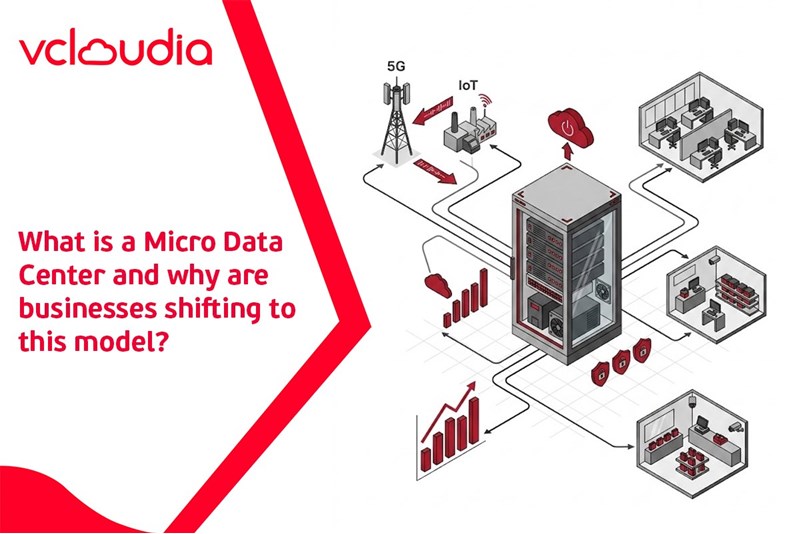
A Micro Data Center (MDC) is a compact data center, fully integrating IT infrastructure components such as a rack, power supply system, cooling, networking equipment, and a monitoring system within a small space, typically occupying an area equivalent to one or a few standard 19-inch racks.
Unlike a traditional Data Center that requires a separate machine room, a high-capacity HVAC system, and complex electrical infrastructure, a Micro Data Center is designed following an "all-in-one" model. This means that the entire system is pre-integrated into a unified block, which can be rapidly deployed in offices, branch locations, factories, or edge environments.
Micro Data Centers are particularly suitable for distributed environments, where businesses need to process data close to the source of generation rather than transmitting everything back to a main center. This is also an important part of modern Edge Computing architecture.
The structure of a Micro Data Center
Although a standard Micro Data Center has a small scale, it still ensures all the infrastructure components equivalent to a compact Data Center.
Integrated Rack System
The heart of a Micro Data Center is the integrated rack system, usually following the 19-inch standard. The cabinet is enclosed, featuring secure locking doors, a physical access control system, and soundproofing as well as thermal insulation capabilities. The rack-based design helps optimize space and guarantees the ability to organize cables and equipment according to industry standards. Many systems also integrate built-in environmental sensors inside the cabinet to monitor temperature, humidity, and the operational status of the equipment.
Integrated power supply system
The power supply in a Micro Data Center typically includes a built-in UPS to ensure the ability to maintain operations during grid power outages. Additionally, there is a PDU to distribute power to each device in the rack. Some high-end models additionally integrate an ATS (Automatic Transfer Switch) that allows automatic power switching between the main grid and a generator. This ensures the continuity of the system, particularly in manufacturing or financial environments.
Integrated cooling system
Because there is no separate server room, the Micro Data Center uses a localized cooling system mounted directly to the rack or in the form of miniature in-row cooling. This design helps optimize hot and cold airflow and maintains a stable temperature for IT equipment. Integrated cooling solutions generally operate independently from the building's HVAC system, enabling the Micro Data Center to be flexibly deployed across various locations.
Networking systems and IT equipment
Inside a Micro Data Center, there can be servers, storage, switches, routers, and firewalls depending on the intended use. For Edge models, the system also integrates an IoT gateway or on-site AI processing equipment. Thanks to its lightweight design, businesses can deploy critical workloads right at the branch without relying entirely on the main data center.
Monitoring and management system
Modern Micro Data Centers are often integrated with remote management software similar to a miniature DCIM. This system allows real-time tracking of temperature, electrical load, UPS status, cooling fan condition, and incident alerts. Remote monitoring capabilities are especially critical when a business deploys multiple distributed Micro Data Centers across various locations.
How does a Micro Data Center operate?
A Micro Data Center operates based on the principle of distributed data processing, wherein computing, storage, and security capacities are deployed right at the location closest to the source of data generation. Instead of transmitting all data back to a centralized data center for processing, the system will execute processing locally at the Micro Data Center, then only synchronize necessary data to the central Data Center or the Cloud.
When an IoT device, manufacturing machine, retail POS system, or internal application generates data, this information is sent directly to the server located in the on-site Micro Data Center. Here, the system can perform tasks such as real-time data analysis, transaction processing, temporary storage, or triggering automation mechanisms.
This mechanism brings three core benefits. First is reducing latency because data does not have to travel through the WAN network back to the center. Second is reducing bandwidth load due to not having to transmit all raw data. Third is increasing operational continuity even when the connection to the center encounters issues.
In terms of infrastructure, a Micro Data Center operates like a miniature Data Center. The integrated power system, including an online or line-interactive UPS, guarantees a continuous power supply. When grid power fails, the UPS will maintain operations long enough to activate the generator or perform a safe shutdown.
Furthermore, the integrated monitoring software allows the IT team to remotely track the system's status. Parameters such as electrical load, temperature, humidity, fan status, and UPS battery are all displayed in real time. When detecting an anomaly, the system will send an immediate alert. It is the combination of local processing, integrated infrastructure, and remote management capabilities that has helped the Micro Data Center become an ideal solution for the modern Edge Computing model.
Advantages of a Micro Data Center
Fast and simple deployment
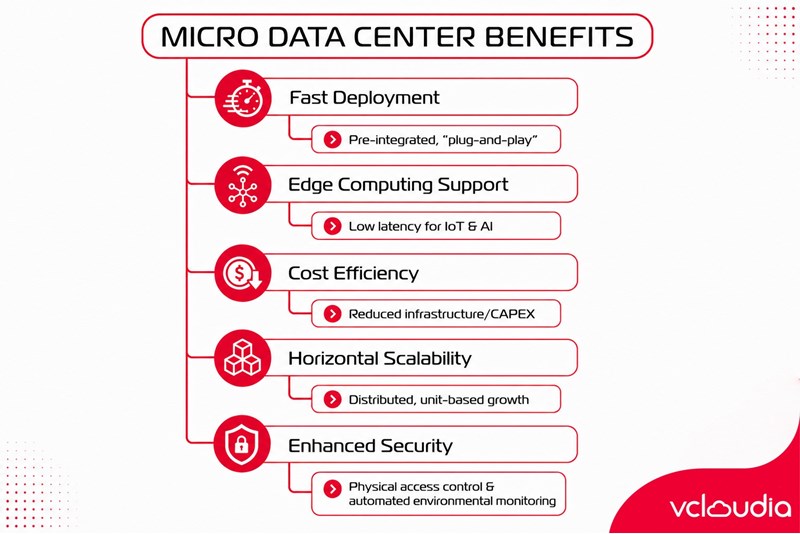
One of the most prominent advantages of a Micro Data Center is its extremely rapid deployment capability. Because it is manufactured, assembled, and tested at the factory in a pre-integrated form, businesses hardly have to perform complex on-site construction. The deployment process typically only involves transporting the system to the installation site, connecting power, configuring the network, and bringing it into operation. The deployment time can be shortened from several months to a few weeks, or even a few days depending on the scale. This is especially important for businesses expanding branches rapidly or needing to deploy IT infrastructure urgently to serve a new project.
Suitable for Edge Computing and IoT
In the era of IoT and 5G, millions of end devices continuously generate data. If all this data were sent to the central Data Center, the network system would quickly become overloaded.
A Micro Data Center allows data processing right at the edge, helping to reduce latency to a minimum. This is particularly crucial for:
- Smart manufacturing factories
- AI camera systems analyzing images
- Real-time payment applications
- Streaming or AR/VR services
Saving initial investment costs
Building a traditional Data Center room requires a massive investment in infrastructure construction, central cooling systems, raised floors, backup power systems, and specialized fire protection systems. In contrast, a Micro Data Center integrates all components into a single block. Businesses do not need to build a specialized machine room, thereby significantly reducing initial CAPEX costs.
Flexible and easily scalable
A Micro Data Center allows businesses to deploy in a distributed model. When expansion is needed, simply add a new system at the required location instead of upgrading the entire main data center.
This horizontal scalability helps businesses:
- Optimize development strategies stage by stage
- Reduce the risk of redundant investment
- Easily restructure infrastructure when changing business models
Enhancing security and control
The Micro Data Center features an enclosed design, integrating electronic locks, door opening sensors, and physical access control. This helps absolutely minimize the risk of unauthorized access. Besides, the continuous environmental monitoring system tracks factors like temperature, humidity, smoke, or vibrations. Upon detecting an anomaly, the system will trigger alerts or automatically shut down equipment to protect hardware. Combined with network security solutions like firewalls, VPNs, and intrusion detection systems, the Micro Data Center creates a safe and tightly controlled IT environment.
Comparing Micro Data Center and Modular Data Center
Popular Micro Data Center models today
Single-rack Micro Data Center
This is the most common model on the market. The entire power system, cooling, PDU, and IT equipment are integrated into a single rack. This model is suitable for small and medium-sized businesses, retail stores, or branch offices that need independent IT infrastructure but lack a dedicated server room space.
Micro Data Center for enterprise branches
Many large enterprises deploy Micro Data Centers at each branch to ensure continuous system operations even upon losing connection to the center. This model helps process transactions locally, store data temporarily, and synchronize to the center periodically.
Micro Data Center for factories and industries
In manufacturing environments, data from machinery and sensors must be analyzed immediately to optimize operational processes. A Micro Data Center in a factory often features a dust-resistant, vibration-resistant, and high-temperature-tolerant design. This system acts as a central data coordinator for smart production lines.
Micro Data Center for telecommunications and 5G
With the development of 5G, edge stations require the ability to process data close to users to reduce latency for streaming, gaming, or AI services. Micro Data Centers placed at telecommunication stations help process content right at the broadcasting point, optimizing the user experience.
When should businesses deploy a Micro Data Center?
Businesses should deploy a Micro Data Center when their operating model is highly distributed geographically. For organizations owning multiple branches, such as retail chains, banks, hospitals, schools, or logistics enterprises, data is frequently generated at various points and needs to be processed quickly on-site before being synchronized back to the center. If heavily reliant on WAN connections to transmit data to the main Data Center, the system could face risks involving latency, bandwidth congestion, or disruptions when the transmission line encounters an incident. The Micro Data Center then serves as a miniature data center placed right at the branch, enabling local storage and processing, reducing the load on central infrastructure, and increasing operational proactiveness.
In the context where applications requiring real-time data processing are increasingly popular, the Micro Data Center becomes a suitable choice for environments needing low latency. Smart manufacturing factories, AI camera systems, industrial IoT applications, or instant payment platforms all demand near-instantaneous responses. Deploying a Micro Data Center at the data generation point allows the system to process directly at the source, reducing latency, ensuring continuity, and improving overall performance.
Conclusion
The Micro Data Center is a compact IT infrastructure solution that fully integrates power, cooling, and IT equipment within a single, small-scale system. Thanks to its fast, flexible deployment capabilities and suitability for Edge Computing, this model is becoming a trend in modern infrastructure architecture.
Vcloudia Cloud Server – The Cloud You Can Count On
If you're concerned about the potential limitations of Cloud Servers, Cloud Server by Vcloudia is a reliable solution for businesses of all sizes. With a modern infrastructure and comprehensive customer support, Vcloudia delivers a cloud experience with:
- Powerful connectivity to ensure stable 24/7 access
- Advanced security standards, compliant with international certifications such as ISO 27001:2013, ISO 20000:2018, ISO 9001:2015
- Flexible pricing packages tailored to your specific business needs
- Expert technical support, making migration and system deployment fast, safe, and compatible
Contact information:
- Hotline: +855 888 55 66 08 (free of charge)
- Fanpage: https://www.facebook.com/vcloudia/
- Website: https://vcloudia.com
Featured news
Related news
What is a Snapshot? The Difference Between Snapshot and Backup
Snapshot is a familiar concept in data management and protection. In the context of the information technology boom, where data is a major asset for businesses, understanding Snapshots as well as their application is a key factor for enterprises to maximize technological efficiency.
What is a Firewall? The Role and Importance of Firewalls for Users
In the context of ever-increasing cyberattacks, system security has become a top priority for many enterprises. Alongside deploying antivirus software and controlling connection ports, firewalls are also considered a key solution to effectively enhance cybersecurity.
What is DDoS? Signs, Mitigation Strategies, and Effective Prevention
DDoS is a highly dangerous cyberattack that leaves severe consequences for enterprises. Therefore, gaining a clear understanding of DDoS attacks, as well as how to detect and prevent them, is a topic of significant interest to many.
What is a Trojan? How to Detect, Avoid, and Prevent It
A Trojan is a type of malicious code or software that can cause severe consequences to computer operations. So, what is a Trojan? How can you prevent a Trojan from infiltrating your computer? In the following article, Vcloudia will provide detailed information on these issues.
What is Cloud Backup? Classification, benefits, and limitations
Cloud Backup is a solution that plays an important role in backing up and recovering data when an incident occurs. So what exactly is Cloud Backup? Let's find out the details with Vcloudia in the following article.
What is Cloud Storage? Features and Benefits of Using It
Cloud Storage is the perfect storage solution alternative to bulky, space-consuming physical hard drives. So, what is Cloud Storage? Let's explore the details with Vcloudia through the following article.
What is an API? Characteristics and applications in website design
API, short for Application Programming Interface, is a concept no longer unfamiliar in the information technology field. So what exactly is an API and why is it so important? Let's find out with Vcloudia.
What is Node.js? Instructions on how to install Node.js on cPanel
Currently, it is easy to see that Node.js is being used by quite a lot of people. This is because Node.js can support users in running on multiple platforms and multiple devices.
What is Vultr VPS? Should you use Vultr VPS?
Vultr VPS is one of the best cloud storage solutions in the world. In this article, you will learn the concept: "What is Vultr VPS?", as well as understand its advantages and disadvantages.
Zoom Cloud Meeting: What is it? Basic Things You Should Know About Zoom Cloud Meeting
In 2020, Zoom Cloud Meeting became one of the leading video conferencing software applications. It allows you to virtually interact with colleagues when in-person meetings aren't possible, and it has also been very successful for social events.