



.png)


















.png)





What is a Mantrap in a Data Center? Its Role in Data Center Security
Jun 30, 2026In the digital era, all critical systems are operated within Data Centers. As cyberattacks become increasingly sophisticated, many organizations heavily focus on system security, firewalls, and data encryption. However, an equally important yet often overlooked factor is physical security.
Therefore, the Mantrap in a Data Center was introduced as an advanced physical access control layer, helping to prevent unauthorized entry right from the doorway. So, what is a Mantrap, how does it work, and why has it become a standard in modern data centers? Let's explore the details with Vcloudia in the article below.
What is a Mantrap in a Data Center?
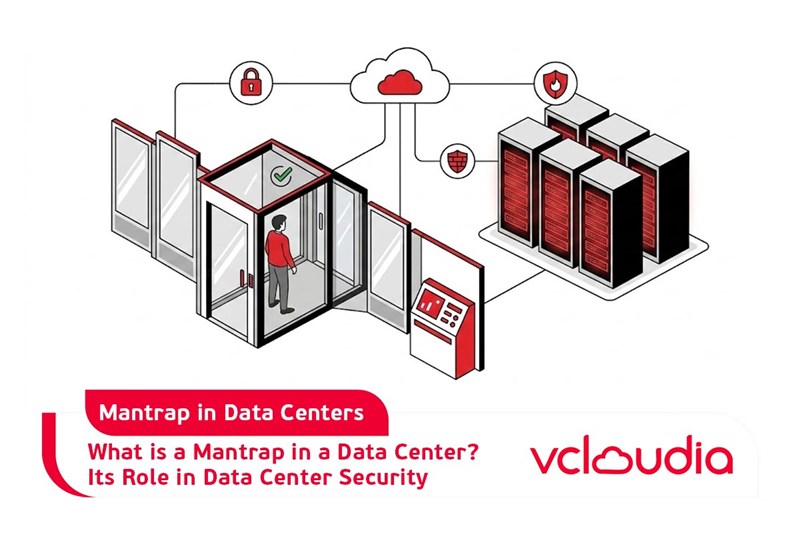
A Mantrap in a Data Center is an access control area designed with two interlocking doors, aiming to ensure that only one person is allowed to enter the server room at a time and must undergo an identity verification process before accessing sensitive areas.
Unlike standard access doors that only require swiping a card or entering a PIN, a Mantrap creates a security buffer zone between the outside and the server room. The person accessing must step into the intermediate space, and the rear door will automatically lock before the front door is opened. This helps prevent the act of tailgating, one of the common risks in physical security.
In a Data Center environment, where each server rack can contain data worth millions of USD, a Mantrap acts as a crucial physical defense layer, complementing cybersecurity measures and internal controls.
Structure and Operating Mechanism of a Mantrap System
Interlocking doors design
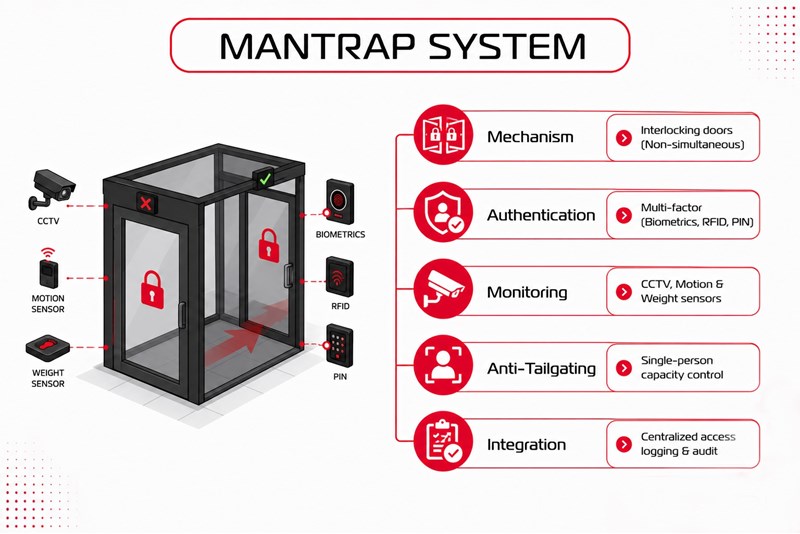
The heart of a Mantrap system is the interlocking door mechanism. The two doors cannot be opened simultaneously. Only when the first door is completely closed does the system allow the second door to open. This design ensures there is no gap for unauthorized individuals to exploit for entry. The space between the two doors is usually designed just enough for one person to stand. Some systems also integrate weight sensors or human presence sensors to detect instances where multiple people intentionally enter at the same time.
User authentication system (magnetic cards, fingerprints, biometrics)
To pass through a Mantrap, users must authenticate their identity. Forms of authentication may include:
- Magnetic cards or RFID cards
- Personal PIN codes
- Fingerprints
- Iris recognition
- Facial recognition
In Data Centers requiring high security, Multi-Factor Authentication is often applied. This means that the person accessing must provide at least two verification factors before being granted access.
Surveillance cameras and motion sensors
A Mantrap is always monitored by high-resolution security cameras. All entry and exit activities are recorded and stored to serve audits or investigations when necessary. Besides, motion sensors and human presence sensors help detect unusual behaviors. If the recognition system detects more than one person in the space, an alert will be triggered immediately.
Anti-tailgating mechanism
Tailgating is the act of a person without access rights closely following an authorized person to sneak into the server room. A Mantrap is designed to completely prevent this situation by:
- Limiting the space to one person
- Controlling the weight or the number of people
- Not allowing the next door to open if anomalies are detected
This is the key difference between a Mantrap and standard access doors.
Integrated Access Control System
A Mantrap does not operate independently but is integrated with the overall Access Control System of the Data Center. When an individual is granted access, the information is synchronized into the central system. Every entry and exit is logged, including time, identity, and the accessed area. This helps increase traceability and serves security audits.
The Role of a Mantrap in Data Center Security
In the defense-in-depth security model of a Data Center, a Mantrap is not merely a special door system but also acts as a mandatory physical security checkpoint before any individual can approach the core infrastructure space. If firewalls, IDS/IPS, or network segmentation systems protect the logical layer, the Mantrap is the strict control layer at the physical level.
An important point to understand is that the majority of severe security incidents do not stem from complex cyberattacks but rather from human factors: negligence, insider threats, or unauthorized access. A server room may have its data encrypted at the highest level, but if someone can walk in and unplug cables, remove hard drives, or plug foreign devices into the system, the entire logical security layer above becomes meaningless. A Mantrap is the mechanism to prevent that scenario.
Firstly, a Mantrap ensures the "one person at a time" principle, meaning that each time only one person is authenticated and passes through. This completely eliminates the possibility of multiple people entering in a single turn without separate identity verification.
Secondly, a Mantrap supports traceability. All entries and exits are fully logged: time, identity, authentication method, and accompanying camera images. When an incident occurs, the operations team can quickly isolate the involved individuals instead of conducting a widespread investigation.
Thirdly, a Mantrap is a crucial element in the audit process and compliance with international security standards. Certifications such as ISO 27001, PCI DSS, SOC 2, or Data Center Tier standards all require strict physical access control. In many cases, enterprise customers, especially banks, fintech companies, and cloud providers, will demand proof that the Mantrap system operates in reality rather than just on design documents.
Fourthly, a Mantrap helps minimize insider risks. Not all threats come from the outside. An employee with access rights, if not monitored according to the proper procedures, can still commit unauthorized acts. A Mantrap adds an extra layer of authentication while making every action monitored and recorded, thereby increasing deterrence.
What Risks Does a Mantrap Help Prevent?
Tailgating and Piggybacking
Tailgating (following closely behind) and piggybacking (exploiting an authorized person to enter together) are the two most common forms of intrusion in environments with basic access control. In a model that only uses magnetic cards or PIN codes, an authorized employee swipes their card to open the door and unintentionally or intentionally lets the person behind enter with them without authentication. In a normal office environment, this might just be a procedural violation. However, in a Data Center containing server systems, storage devices, and sensitive data, this is a severe risk.
A Mantrap entirely eliminates this possibility thanks to the interlocking door mechanism. When a person steps into the Mantrap space, the rear door will close and lock before the front door opens. The weight sensor system or motion sensors can detect if more than one person steps in together. If anomalies are detected, the system will lock both doors and send an alert to the security department. Thanks to this, tailgating is practically impossible to occur without being detected.
Unauthorized Intrusion
Unauthorized intrusion can occur in many scenarios: using fake cards, stealing login credentials, exploiting peak hours, or posing as technicians or service providers. If relying solely on a simple control layer, the possibility of slipping through still exists. A Mantrap increases the difficulty of intrusion acts by requiring multi-step authentication. For example: magnetic card + PIN code + biometrics. Even if the intruder possesses a valid card, they still have to bypass the biometric authentication layer, which is nearly impossible to forge at a professional level.
Additionally, the cameras in the Mantrap space usually record close-up facial images, creating conditions for direct comparison with previous identification data. This makes identity forgery acts much riskier and easier to detect.
Theft of Equipment or Data
Equipment in a Data Center holds high value: servers, switches, firewalls, SAN/NAS storage devices, network modules... Not to mention the intangible value of the data stored inside. A stolen hard drive could contain financial information, customer data, or intellectual property. A Mantrap helps strictly control both the entry and exit directions. When leaving the server room, employees must still pass through the Mantrap space. Cameras and surveillance systems can detect acts of carrying unauthorized equipment.
In highly demanding environments, a Mantrap can also integrate object detection systems or require confirmation of previously approved tasks. This creates a two-way process, not only controlling who goes in but also controlling what they bring out.
Infrastructure Sabotage
Not all risks are related to theft. A minor act of sabotage such as accidentally unplugging an uplink cable, mistakenly turning off a PDU, altering physical equipment configurations, or disrupting the cooling system can also cause widespread downtime. In a Data Center environment, downtime equates to massive financial losses, SLA violations, and negative impacts on brand reputation.
A Mantrap limits this risk by ensuring only personnel with rights can access critical areas. Simultaneously, it fully records the access history for traceability when incidents occur. When every action can be reviewed, the risk of intentional or careless sabotage will significantly decrease.
Popular Types of Mantraps in Data Centers
Basic Mantrap (2 interlocking doors)
This is the most common model, consisting of two electronic interlocking doors and a single-factor authentication system (usually magnetic cards). When one door opens, the other will automatically lock. This type is suitable for medium-sized Data Centers, less sensitive areas, or auxiliary technical rooms. The initial investment cost is lower while still ensuring the one-person-at-a-time control principle.
Mantrap Integrated with Biometrics
This system adds an authentication layer based on biological traits such as fingerprints, irises, or facial recognition. Biometrics help reduce the risk of card sharing or PIN code disclosure. In financial or large-scale cloud environments, this is almost a mandatory requirement. The security level is higher because biological traits are hard to duplicate and are tied to each individual.
Multi-layer Mantrap (Multi-Factor Authentication)
This is an advanced model, combining multiple authentication factors such as: Something you have (magnetic card), something you know (PIN), and something you are (biometrics). Only when all factors are valid does the system allow the next door to open. This model is suited for Data Centers processing highly sensitive data such as banking, government, healthcare, or data centers meeting high compliance standards.
Mantrap Integrated with Facial Recognition AI
The modern generation of Mantraps can integrate AI to analyze faces in real-time, detecting abnormal behaviors or comparing them against the personnel database. AI not only verifies identities but also analyzes behaviors such as unusual movements, deliberately covering the face, or carrying foreign objects. Consequently, the system not only reacts when violations occur but can also provide early warnings for potential risks.
Benefits of Deploying a Mantrap in a Data Center
Investing in a Mantrap is not just to meet security requirements but also brings long-term strategic benefits. First and foremost, a Mantrap enhances the level of physical safety, minimizing the possibility of unauthorized intrusion. This directly protects technological assets and customer data.
Secondly, the system helps elevate corporate reputation. During the bidding process or when providing Data Center services, proving the existence of a standard-compliant Mantrap system helps build strong trust with customers, especially large organizations.
Thirdly, a Mantrap supports effective audits. Comprehensive access logs help shorten incident investigation times, minimize damages, and ensure transparency in operations.
Fourthly, in the long run, a Mantrap helps reduce legal risks. In the event of a data breach, the enterprise can prove it applied strict physical security measures, thereby reducing legal liabilities and financial losses.
Challenges When Deploying a Mantrap
Despite bringing many benefits, a Mantrap also poses some challenges. The initial investment cost is relatively high, including hardware, software, system integration, and operator training. For large-scale Data Centers, the cost can increase significantly if multiple control areas are deployed.
Additionally, if the authentication process is too complex, user experience might be affected, especially in cases requiring emergency troubleshooting. Therefore, enterprises need to design a process that balances security and operational efficiency.
Conclusion
A Mantrap in a Data Center is not just an access control door, but a core component in a multi-layered physical security architecture. In a context where data becomes a strategic asset, investing in a Mantrap is not merely an infrastructure expense, but an investment for the safety, reputation, and sustainable development of the enterprise.
Looking for a high-performance, secure solution?
Explore the services offered by Vcloudia – a leading provider of Cloud Computing and Data Center solutions. Contact us for expert consultation and find the right model for your needs:
- Hotline: +855 888 55 66 08 (free of charge)
- Fanpage: https://www.facebook.com/vcloudia/
- Website: https://vcloudia.com
Featured news
Related news
What is a Snapshot? The Difference Between Snapshot and Backup
Snapshot is a familiar concept in data management and protection. In the context of the information technology boom, where data is a major asset for businesses, understanding Snapshots as well as their application is a key factor for enterprises to maximize technological efficiency.
What is a Firewall? The Role and Importance of Firewalls for Users
In the context of ever-increasing cyberattacks, system security has become a top priority for many enterprises. Alongside deploying antivirus software and controlling connection ports, firewalls are also considered a key solution to effectively enhance cybersecurity.
What is DDoS? Signs, Mitigation Strategies, and Effective Prevention
DDoS is a highly dangerous cyberattack that leaves severe consequences for enterprises. Therefore, gaining a clear understanding of DDoS attacks, as well as how to detect and prevent them, is a topic of significant interest to many.
What is a Trojan? How to Detect, Avoid, and Prevent It
A Trojan is a type of malicious code or software that can cause severe consequences to computer operations. So, what is a Trojan? How can you prevent a Trojan from infiltrating your computer? In the following article, Vcloudia will provide detailed information on these issues.
What is Cloud Backup? Classification, benefits, and limitations
Cloud Backup is a solution that plays an important role in backing up and recovering data when an incident occurs. So what exactly is Cloud Backup? Let's find out the details with Vcloudia in the following article.
What is Cloud Storage? Features and Benefits of Using It
Cloud Storage is the perfect storage solution alternative to bulky, space-consuming physical hard drives. So, what is Cloud Storage? Let's explore the details with Vcloudia through the following article.
What is an API? Characteristics and applications in website design
API, short for Application Programming Interface, is a concept no longer unfamiliar in the information technology field. So what exactly is an API and why is it so important? Let's find out with Vcloudia.
What is Node.js? Instructions on how to install Node.js on cPanel
Currently, it is easy to see that Node.js is being used by quite a lot of people. This is because Node.js can support users in running on multiple platforms and multiple devices.
What is Vultr VPS? Should you use Vultr VPS?
Vultr VPS is one of the best cloud storage solutions in the world. In this article, you will learn the concept: "What is Vultr VPS?", as well as understand its advantages and disadvantages.
Zoom Cloud Meeting: What is it? Basic Things You Should Know About Zoom Cloud Meeting
In 2020, Zoom Cloud Meeting became one of the leading video conferencing software applications. It allows you to virtually interact with colleagues when in-person meetings aren't possible, and it has also been very successful for social events.