



.png)















.png)





What is a Database? Classification and Applications
Aug 21, 2026Over 85% of real-world applications globally rely on databases. Therefore, comprehending and mastering database terminology is crucial for managing them effectively and optimally!
What is a Database?
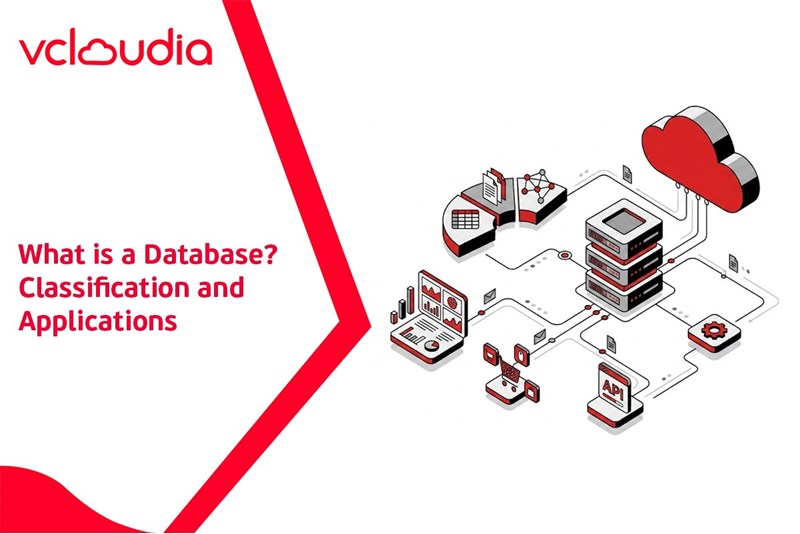
A database is a structured collection of interconnected data, stored and accessible via a computer system. Essentially, it's an organized location for storing and managing information.
Terminology of Database & Data Management
Here are some common terms associated with databases:
- Database Management System (DBMS): Software that facilitates the creation and operation of your database. A DBMS helps define data types for stored information, build storage systems, and supports operations like querying and updating data.
- Table: A database component holding data, structured into rows and columns.
- Row: A record within a table, containing information about a particular entity or object.
- Column: A field in a table that holds a specific data type, such as integers, character strings, or dates.
- Primary Key: A column or a combination of columns in a table used to uniquely identify each row within that table.
- Foreign Key: A column in one table, typically referencing a primary key in another table, used to establish and identify relationships between tables.
- Index: An optimization mechanism employed for rapid searching and access to data within a table.
- Query: A statement or request used to retrieve, update, or delete data from a database.
- Normalization: The process of designing a database to minimize data redundancy and ensure consistency and efficiency.
- ACID (Atomicity, Consistency, Isolation, Durability): A set of properties guaranteeing the consistency and reliability of transactions within a database.
- SQL (Structured Query Language): The language used to interact with databases, including querying, updating, and managing data.
- Backup: The procedure of creating copies of a database to safeguard data in the event of an incident.
- Replication: The process of copying data from one database to one or more other databases to ensure distribution and availability.
- Schema: The blueprint defining how data is organized, including tables, relationships, and other data structures.
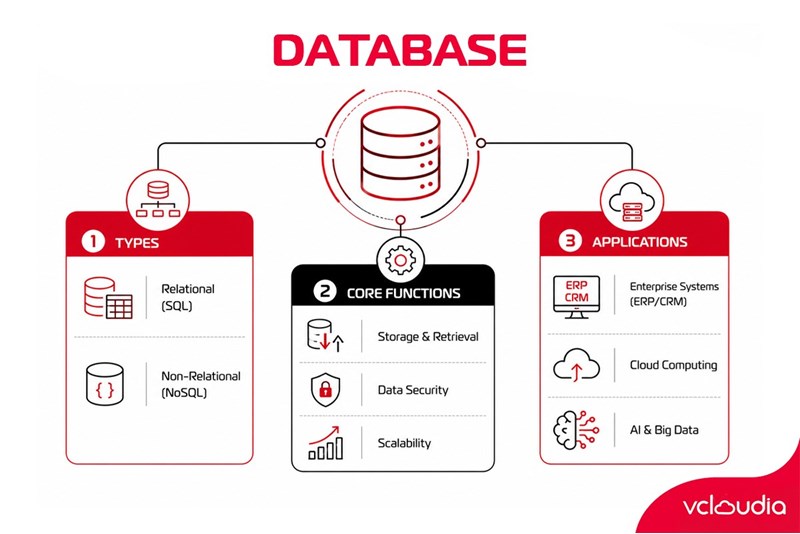
- NoSQL Database: A database type that does not rely on the relational model, often utilized for unstructured data or big data scenarios.
- Data Warehousing: The practice of aggregating and storing data from various sources to support analysis and reporting.
- ETL (Extract, Transform, Load): The process of extracting data from a source, transforming it, and then loading it into another database.
- Big Data: Extremely large and complex datasets that typically necessitate specialized technologies and databases for management and analysis.
- Data Mining: The process of analyzing data to discover information, model trends, and uncover hidden patterns.
- Database Users: Individuals who directly interact with a database. DB users can be categorized into 3 types:
+ DB Administrators: These individuals manage and operate your database. They use software and hardware to control and monitor the system's availability.
+ DB Designers: Those who communicate directly with end-users to understand their information requirements. Based on this, they define the contents, structures, relationships, and functions of the database.
+ End-Users: The people who directly manipulate the database's information (such as querying, modifying, and updating data).
Terminology regarding Database characteristics
Several terms refer to database characteristics. Among the most common are:
- Self-describing: The DBMS catalog stores the database specifications, known as meta-data. This enables the DBMS software to operate with multiple databases.
- Separation between program and data: Also called program-data independence. This permits changes to the data storage structure and operations without requiring modifications to the programs that access the DBMS.
- Data Abstraction: A data model is used to conceal storage details and present users with a conceptual view of the database.
- Support for multiple data views: Each user can perceive the database from a distinct perspective, describing only the data that specific user is interested in.
- Data sharing and multi-user transaction processing: Allows multiple individuals to access and update the database concurrently.
- Performance: Refers to fast data storage and recovery, with the capability to process large volumes of data.
- Data Model: Used to store concepts describing the database's structure, such as data types, relationships, constraints, and semantics.
- Instance: The actual data itself.
Popular Database Models
- File-based Database: This is a basic form of data storage where data is organized and kept in files on a file system. Instead of employing a dedicated Database Management System (DBMS), these files are managed directly through programming languages or text editing tools.
- Relational Database: A database type structured upon the mathematical concept of relations. In this model, data is stored in tables, with each table representing a real-world entity, and relationships between these entities are established via keys.
- Object-oriented Database: A pure data table supplemented with the distinct attributes and behaviors of each object.
- Semi-structured Database: This database type is highly flexible and does not adhere to a fixed data structure. The descriptive information of the data in this model is presented in tags for easy retrieval when needed.
Vcloudia Cloud Server – The Cloud You Can Count On
If you're concerned about the potential limitations of Cloud Servers, Cloud Server by Vcloudia is a reliable solution for businesses of all sizes. With a modern infrastructure and comprehensive customer support, Vcloudia delivers a cloud experience with:
- Powerful connectivity to ensure stable 24/7 access
- Advanced security standards, compliant with international certifications such as ISO 27001:2013, ISO 20000:2018, ISO 9001:2015
- Flexible pricing packages tailored to your specific business needs
- Expert technical support, making migration and system deployment fast, safe, and compatible
Contact information:
- Hotline: +855 888 55 66 08 (free of charge)
- Fanpage: https://www.facebook.com/vcloudia/
- Website: https://vcloudia.com
Featured news
Related news
What is a Snapshot? The Difference Between Snapshot and Backup
Snapshot is a familiar concept in data management and protection. In the context of the information technology boom, where data is a major asset for businesses, understanding Snapshots as well as their application is a key factor for enterprises to maximize technological efficiency.
What is a Firewall? The Role and Importance of Firewalls for Users
In the context of ever-increasing cyberattacks, system security has become a top priority for many enterprises. Alongside deploying antivirus software and controlling connection ports, firewalls are also considered a key solution to effectively enhance cybersecurity.
What is DDoS? Signs, Mitigation Strategies, and Effective Prevention
DDoS is a highly dangerous cyberattack that leaves severe consequences for enterprises. Therefore, gaining a clear understanding of DDoS attacks, as well as how to detect and prevent them, is a topic of significant interest to many.
What is a Trojan? How to Detect, Avoid, and Prevent It
A Trojan is a type of malicious code or software that can cause severe consequences to computer operations. So, what is a Trojan? How can you prevent a Trojan from infiltrating your computer? In the following article, Vcloudia will provide detailed information on these issues.
What is Cloud Backup? Classification, benefits, and limitations
Cloud Backup is a solution that plays an important role in backing up and recovering data when an incident occurs. So what exactly is Cloud Backup? Let's find out the details with Vcloudia in the following article.
What is Cloud Storage? Features and Benefits of Using It
Cloud Storage is the perfect storage solution alternative to bulky, space-consuming physical hard drives. So, what is Cloud Storage? Let's explore the details with Vcloudia through the following article.
What is an API? Characteristics and applications in website design
API, short for Application Programming Interface, is a concept no longer unfamiliar in the information technology field. So what exactly is an API and why is it so important? Let's find out with Vcloudia.
What is Node.js? Instructions on how to install Node.js on cPanel
Currently, it is easy to see that Node.js is being used by quite a lot of people. This is because Node.js can support users in running on multiple platforms and multiple devices.
What is Vultr VPS? Should you use Vultr VPS?
Vultr VPS is one of the best cloud storage solutions in the world. In this article, you will learn the concept: "What is Vultr VPS?", as well as understand its advantages and disadvantages.
Zoom Cloud Meeting: What is it? Basic Things You Should Know About Zoom Cloud Meeting
In 2020, Zoom Cloud Meeting became one of the leading video conferencing software applications. It allows you to virtually interact with colleagues when in-person meetings aren't possible, and it has also been very successful for social events.