



.png)
















.png)





What is a Cloud Server? How Cloud Servers Work
Jun 18, 2025As businesses increasingly rely on digital infrastructure for operations and scalability, the need for a flexible, cost-effective, and easily manageable server solution has become critical. Cloud Servers have emerged as an efficient alternative to traditional physical servers, offering real-time resource adjustments, reduced downtime risks, and minimized upfront investment. This article explains what Cloud Servers are, how they work, common models, and when businesses should implement them for optimal performance and sustainability.
What is a Cloud Server?
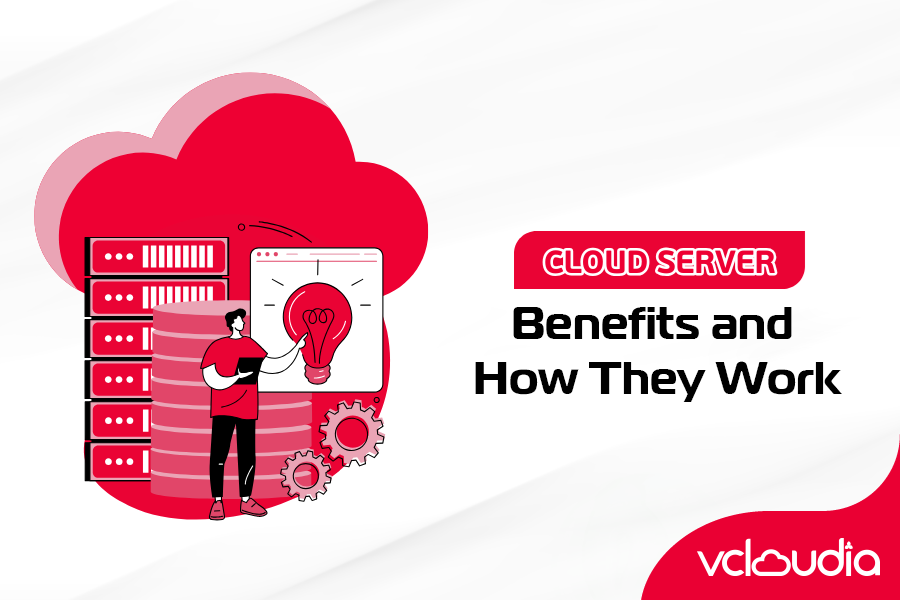
A Cloud Server is a virtualized infrastructure built on cloud computing technology, enabling users to store, manage data, and access computing resources via the internet. Cloud Servers are created by partitioning a physical server into multiple virtual machines using virtualization software called a hypervisor.
Benefits of Cloud Servers for Businesses
Integrating Cloud Servers into network infrastructure deployment and operations provides businesses with several advantages:
-
High Availability: Built-in self-monitoring mechanisms in the cloud environment ensure system uptime. In case of hypervisor failure, clients are automatically switched to another active server.
-
Scalability: Businesses can easily scale storage capacity up or down based on changing needs and workloads.
-
Performance & Load Handling: Cloud Servers handle large workloads and concurrent user requests, ensuring seamless application and website performance.
-
Easy Backup & Recovery: Automated data backup and quick restoration eliminate concerns over data loss due to technical failures or natural disasters.
-
Enhanced Security: Advanced security features such as traffic control, data encryption, and two-factor authentication help prevent cyberattacks.
-
Cost Savings: Instead of investing in physical infrastructure and its maintenance, businesses can leverage resources from cloud service providers and pay only for what they use.
How Cloud Servers Work
In a Cloud Server setup, resources such as RAM, vCPU, and storage are allocated and managed via virtualization systems. Multiple virtual servers run on a single physical server, sharing computing and storage resources.
Resources are provisioned through APIs, allowing users to define storage size, memory, CPU, and more based on their specific needs. Once these parameters are defined, cloud automation tools create and allocate the Cloud Server accordingly—ensuring security and appropriate network configuration. Users can then access the server remotely via the internet to store data, run applications, and more.
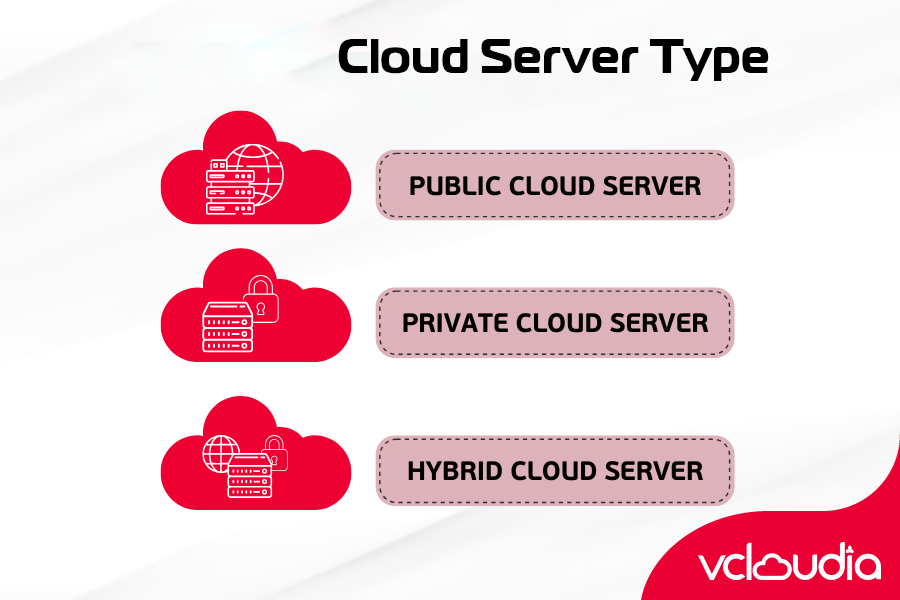
Types of Cloud Servers
Cloud Servers are commonly categorized into the following types:
-
Public Cloud Server: Hosted on a public cloud platform, where computing resources are shared and managed by a third-party provider. Businesses can scale usage flexibly, while the provider handles all underlying infrastructure and maintenance.
-
Private Cloud Server: Dedicated to a single organization, either on-premises or hosted by a provider. Private Cloud offers more control and enhanced security, making it suitable for businesses with strict compliance or security requirements.
-
Hybrid Cloud Server: Combines both public and private clouds, enabling businesses to move applications and data between environments. This model provides flexibility, cost-efficiency, and improved data security by leveraging both platforms strategically.
Common Use Cases for Cloud Servers
Businesses may adopt Cloud Servers for a variety of needs, including:
-
Hosting websites and web applications
-
Running machine learning workloads
-
Performing advanced graphics processing
-
Developing and deploying customer-facing applications
-
Hosting enterprise software (e.g., HRM, CRM systems)
-
Managing databases and executing data queries
Vcloudia’s Cloud Server – Leading Cloud Server Solution
As an experienced provider in cloud computing and data center services, Vcloudia delivers high-performance Cloud Servers that meet the IT infrastructure demands of modern businesses.
With Vcloudia’s Cloud Server, businesses can:
-
Monitor server performance in real time
-
Back up data swiftly
-
Maintain operational continuity and performance
Additional standout features of Vcloudia’s Cloud Server include:
-
Cost Efficiency: Minimize infrastructure investment and maintenance
-
Fast Provisioning: Rapidly deploy one or more servers with Fast-Provisioning technology
-
International Security Standards: Compliant with ISO 27017 for cloud services
-
Flexible Resource Scaling: Dynamically add RAM, CPU, and Storage as needed
-
High Availability: Load balancing and cluster technology prevent server overloads and ensure stable performance
For 24/7 technical support and expert consultation on Vcloudia Cloud server, please contact Vcloudia at:
- Hotline: +855 888 55 66 08 (free of charge)
- Fanpage: https://www.facebook.com/vcloudia/
- Website: https://vcloudia.com
Conclusion
Cloud Servers represent a significant leap in IT infrastructure management, allowing businesses to operate more flexibly, scale easily, and reduce operational costs compared to traditional servers. With automation, rapid deployment, and remote administration, Cloud Servers are especially suitable for companies undergoing digital transformation or requiring a robust infrastructure to support growth.
Choosing the right Cloud Server provider, such as (Vcloudia), plays a crucial role in ensuring performance, availability, and security across your entire IT system.
Featured news
Related news
What is a Snapshot? The Difference Between Snapshot and Backup
Snapshot is a familiar concept in data management and protection. In the context of the information technology boom, where data is a major asset for businesses, understanding Snapshots as well as their application is a key factor for enterprises to maximize technological efficiency.
What is a Firewall? The Role and Importance of Firewalls for Users
In the context of ever-increasing cyberattacks, system security has become a top priority for many enterprises. Alongside deploying antivirus software and controlling connection ports, firewalls are also considered a key solution to effectively enhance cybersecurity.
What is DDoS? Signs, Mitigation Strategies, and Effective Prevention
DDoS is a highly dangerous cyberattack that leaves severe consequences for enterprises. Therefore, gaining a clear understanding of DDoS attacks, as well as how to detect and prevent them, is a topic of significant interest to many.
What is a Trojan? How to Detect, Avoid, and Prevent It
A Trojan is a type of malicious code or software that can cause severe consequences to computer operations. So, what is a Trojan? How can you prevent a Trojan from infiltrating your computer? In the following article, Vcloudia will provide detailed information on these issues.
What is Cloud Backup? Classification, benefits, and limitations
Cloud Backup is a solution that plays an important role in backing up and recovering data when an incident occurs. So what exactly is Cloud Backup? Let's find out the details with Vcloudia in the following article.
What is Cloud Storage? Features and Benefits of Using It
Cloud Storage is the perfect storage solution alternative to bulky, space-consuming physical hard drives. So, what is Cloud Storage? Let's explore the details with Vcloudia through the following article.
What is an API? Characteristics and applications in website design
API, short for Application Programming Interface, is a concept no longer unfamiliar in the information technology field. So what exactly is an API and why is it so important? Let's find out with Vcloudia.
What is Node.js? Instructions on how to install Node.js on cPanel
Currently, it is easy to see that Node.js is being used by quite a lot of people. This is because Node.js can support users in running on multiple platforms and multiple devices.
What is Vultr VPS? Should you use Vultr VPS?
Vultr VPS is one of the best cloud storage solutions in the world. In this article, you will learn the concept: "What is Vultr VPS?", as well as understand its advantages and disadvantages.
Zoom Cloud Meeting: What is it? Basic Things You Should Know About Zoom Cloud Meeting
In 2020, Zoom Cloud Meeting became one of the leading video conferencing software applications. It allows you to virtually interact with colleagues when in-person meetings aren't possible, and it has also been very successful for social events.