



.png)


















.png)





What is a Carrier-neutral Data Center? Benefits and reasons why enterprises should choose it
Jun 30, 2026In the context of strong digital transformation, enterprises are not only concerned about system performance but also pay special attention to flexible connectivity. One of the infrastructure models currently prioritized for selection is the Carrier-neutral Data Center.
So what is a Carrier-neutral Data Center, how does it work, and why are more and more organizations switching to this model? The article below by Vcloudia will analyze it in detail.
What is a Carrier-neutral Data Center?
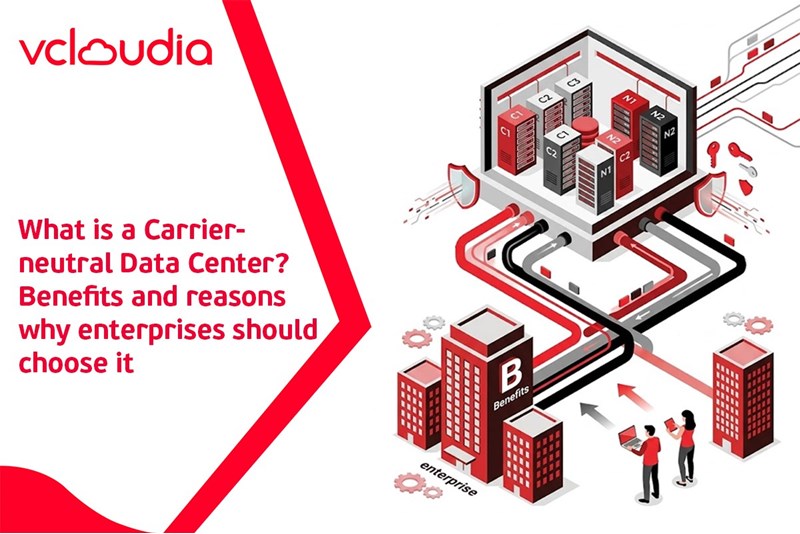
A Carrier-neutral Data Center is a data center model that allows multiple telecommunications service providers (carriers/ISPs) to co-locate and provide connectivity at the same location. Unlike a Carrier-specific Data Center which has only one or a small group of exclusive carriers, the carrier-neutral model does not prioritize any single provider, creating an open and flexible connection environment.
The core point of this model lies in its neutrality. The data center operator does not own or prioritize a specific carrier, but provides the physical and technical infrastructure for carriers to deploy their services. This creates a diverse connection ecosystem, where enterprises can access multiple transmission lines, multiple ISPs, and multiple network services within the same environment.
In the era of cloud computing, IoT, and Edge Computing, the demand for diverse and high-speed connectivity is increasingly growing. Carrier-neutral Data Centers become an important platform to ensure the flexibility, performance, and scalability of IT systems.
How does a Carrier-neutral work in a Data Center?
To clearly understand its operation, it is necessary to look at the connection structure inside a Carrier-neutral Data Center. Here, multiple network operators will deploy their own equipment and transmission systems in specialized technical areas. Enterprises renting server colocation space can connect directly to the carriers through an internal optical fiber system called cross-connect.
An important component in this model is the Meet Me Room (MMR - central connection room). This is where carriers and customers make physical connections with each other. Instead of having to pull cables outside the building or rely on a single transmission line, enterprises only need to request the deployment of a cross-connect internally within the data center, helping to shorten the time and reduce complexity.
In addition, a Carrier-neutral Data Center also acts as a traffic transit point (interconnection hub). Here, enterprises can establish direct peering with each other or connect to major cloud platforms like AWS, Microsoft Azure, Google Cloud through dedicated transmission lines.
The operating mechanism of a Carrier-neutral helps:
- Reduce reliance on a single network operator
- Increase flexibility when expanding or changing providers
- Optimize traffic and latency
Thanks to this, enterprises can build a multi-layer, multi-route network architecture (multi-homing) with high redundancy.
Benefits of a Carrier-neutral Data Center
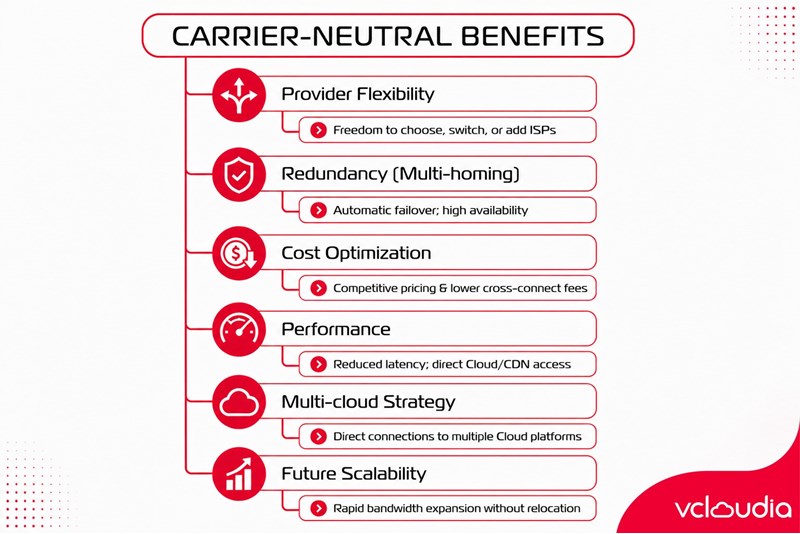
Freedom to choose and change network service providers
One of the greatest benefits of a Carrier-neutral Data Center is the enterprise's proactive right. Instead of being tied to a single carrier, the enterprise can choose an ISP that suits its needs regarding bandwidth, cost, and service quality. If a provider fails to meet the SLA or has prolonged incidents, the enterprise can entirely switch or add another carrier without having to change its infrastructure location.
Increase redundancy and readiness (High Availability)
When connecting to multiple carriers at the same time, enterprises can deploy a multi-homing or load balancing model. In the event that one transmission line encounters an issue, traffic can automatically switch to another route without disrupting the service. This is particularly important for sectors such as finance, e-commerce, and SaaS, where downtime can cause significant damage to revenue and reputation.
Optimize bandwidth costs
The competition among carriers within the same Data Center creates conditions for enterprises to negotiate better prices. Instead of accepting a fixed price, the enterprise can compare and select the most cost-optimized service package. In addition, deploying internal cross-connects is usually more economical than pulling transmission lines from the outside in.
Reduce latency and improve connection performance
Carrier-neutral Data Centers are often built in strategic locations near financial centers, Internet Exchange centers, or areas with high connectivity density. This helps to reduce latency when transmitting data between systems. Connecting directly to the Cloud or CDN via a private connection also helps improve performance compared to public Internet connections.
Support Multi-cloud Strategy
More and more enterprises are simultaneously deploying multiple Cloud platforms to optimize costs and performance. A Carrier-neutral Data Center allows direct connections to multiple Cloud providers within the same environment. As a result, the enterprise can flexibly deploy a Multi-cloud architecture, reducing the risk of relying on a single provider.
Increase future scalability
When bandwidth demands increase or when expanding into new markets, the enterprise can quickly add new connections without relocating infrastructure. This flexible scalability makes the Carrier-neutral Data Center a long-term choice for sustainable development strategies.
The role of Carrier-neutral Data Centers in the Cloud & Edge ecosystem
In modern IT architecture, a Carrier-neutral Data Center is not only a place to host servers but also acts as the connection hub for the entire digital ecosystem. For Cloud, Carrier-neutral helps enterprises establish private connections (Direct Connect, ExpressRoute…) to major cloud platforms, ensuring higher stability and security than the public Internet. For Edge Computing, this model facilitates the deployment of infrastructure closer to end users, reducing latency and increasing real-time data processing speed.
Additionally, Carrier-neutral Data Centers serve as a platform for CDN, IoT, and 5G. As devices and applications require continuous data transmission with low latency, placing infrastructure at a carrier-neutral point helps to optimize data paths.
When should an enterprise choose a Carrier-neutral Data Center?
Not every organization needs this model, but in many cases, Carrier-neutral is the optimal choice. Enterprises should consider deploying a Carrier-neutral Data Center when they have multi-carrier connectivity needs, high SLA requirements, or are implementing a Multi-cloud strategy. Financial organizations and banks often prioritize this model to ensure maximum redundancy. E-commerce and SaaS enterprises also need a flexible connection environment to serve customers on a wide scale.
In addition, multi-branch companies or enterprises expanding into international markets will benefit from the diverse connection ecosystem of a Carrier-neutral Data Center. If the goal is to build a sustainable, flexible infrastructure ready for the digital future, Carrier-neutral is a platform worth considering.
Conclusion
A Carrier-neutral Data Center is a carrier-neutral data center model, allowing multiple ISPs to co-locate and provide connectivity within the same infrastructure. Thanks to its flexibility, high redundancy capabilities, and rich connection ecosystem, this model is becoming the strategic choice of many modern enterprises. If your enterprise is looking for a stable, flexible, and future-ready infrastructure solution, the Carrier-neutral Data Center is exactly a platform worth investing in and deploying.
Vcloudia Cloud Server – The Cloud You Can Count On
If you're concerned about the potential limitations of Cloud Servers, Cloud Server by Vcloudia is a reliable solution for businesses of all sizes. With a modern infrastructure and comprehensive customer support, Vcloudia delivers a cloud experience with:
- Powerful connectivity to ensure stable 24/7 access
- Advanced security standards, compliant with international certifications such as ISO 27001:2013, ISO 20000:2018, ISO 9001:2015
- Flexible pricing packages tailored to your specific business needs
- Expert technical support, making migration and system deployment fast, safe, and compatible
Contact information:
- Hotline: +855 888 55 66 08 (free of charge)
- Fanpage: https://www.facebook.com/vcloudia/
- Website: https://vcloudia.com
Featured news
Related news
What is a Snapshot? The Difference Between Snapshot and Backup
Snapshot is a familiar concept in data management and protection. In the context of the information technology boom, where data is a major asset for businesses, understanding Snapshots as well as their application is a key factor for enterprises to maximize technological efficiency.
What is a Firewall? The Role and Importance of Firewalls for Users
In the context of ever-increasing cyberattacks, system security has become a top priority for many enterprises. Alongside deploying antivirus software and controlling connection ports, firewalls are also considered a key solution to effectively enhance cybersecurity.
What is DDoS? Signs, Mitigation Strategies, and Effective Prevention
DDoS is a highly dangerous cyberattack that leaves severe consequences for enterprises. Therefore, gaining a clear understanding of DDoS attacks, as well as how to detect and prevent them, is a topic of significant interest to many.
What is a Trojan? How to Detect, Avoid, and Prevent It
A Trojan is a type of malicious code or software that can cause severe consequences to computer operations. So, what is a Trojan? How can you prevent a Trojan from infiltrating your computer? In the following article, Vcloudia will provide detailed information on these issues.
What is Cloud Backup? Classification, benefits, and limitations
Cloud Backup is a solution that plays an important role in backing up and recovering data when an incident occurs. So what exactly is Cloud Backup? Let's find out the details with Vcloudia in the following article.
What is Cloud Storage? Features and Benefits of Using It
Cloud Storage is the perfect storage solution alternative to bulky, space-consuming physical hard drives. So, what is Cloud Storage? Let's explore the details with Vcloudia through the following article.
What is an API? Characteristics and applications in website design
API, short for Application Programming Interface, is a concept no longer unfamiliar in the information technology field. So what exactly is an API and why is it so important? Let's find out with Vcloudia.
What is Node.js? Instructions on how to install Node.js on cPanel
Currently, it is easy to see that Node.js is being used by quite a lot of people. This is because Node.js can support users in running on multiple platforms and multiple devices.
What is Vultr VPS? Should you use Vultr VPS?
Vultr VPS is one of the best cloud storage solutions in the world. In this article, you will learn the concept: "What is Vultr VPS?", as well as understand its advantages and disadvantages.
Zoom Cloud Meeting: What is it? Basic Things You Should Know About Zoom Cloud Meeting
In 2020, Zoom Cloud Meeting became one of the leading video conferencing software applications. It allows you to virtually interact with colleagues when in-person meetings aren't possible, and it has also been very successful for social events.