



.png)



















.png)





OpenStack vs VMware: Which virtualization platform should businesses choose?
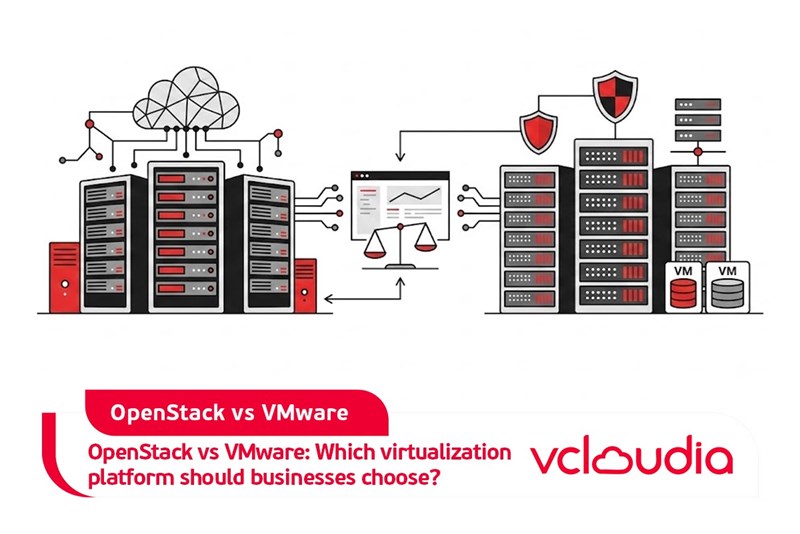
Jun 30, 2026The question, "OpenStack or VMware: Which solution should we choose?" is a topic of significant interest for many CIOs, CTOs, and infrastructure managers. In reality, OpenStack and VMware represent two different philosophies in IT infrastructure construction. One is an open-source platform geared toward large-scale Private Clouds, while the other is a commercial solution that has dominated the enterprise virtualization market for many years.
This article by Vcloudia will analyze each platform in detail, provide a comprehensive comparison, and help businesses determine the right choice for their development goals.
What is OpenStack?
OpenStack is an open-source platform designed to build and operate Cloud infrastructure under the Infrastructure as a Service (IaaS) model. Instead of relying on a public Cloud provider, businesses can use OpenStack to deploy a Private Cloud on their own physical server systems.
In essence, OpenStack is not a single piece of software but a collection of services that work together to provide compute, storage, and networking resources in a virtualized form. When deploying OpenStack, all physical resources in the Data Center are abstracted into shared resource pools. Users can create virtual machines, configure virtual networks, and allocate storage capacity via APIs or an administrative interface.
One of the greatest strengths of OpenStack is its flexibility. Because it is developed under an open-source model, businesses can customize the architecture to meet their specific needs. This is particularly suitable for large-scale organizations, telecommunications carriers, and enterprises that want comprehensive control over their infrastructure. However, flexibility comes with complexity. Deploying OpenStack requires a technical team with deep knowledge of Linux, networking, storage, and automation. This is not a "plug-and-play" solution, but a platform that requires a long-term operational strategy.
What is VMware?
VMware is one of the pioneers in server virtualization and has become a standard in many enterprises for over two decades. VMware's most prominent product is vSphere—a virtualization suite that allows multiple virtual machines to run on the same physical server.
Unlike OpenStack, VMware is a commercial platform with proprietary licensing. Businesses purchase licenses and receive official support from the vendor. This provides stability and high reliability, especially in environments requiring high availability.
VMware is renowned for its intuitive interface and relatively simple deployment process compared to open-source platforms. IT teams only need a short time to get accustomed to it and can quickly put the system into operation. However, VMware's biggest limitation lies in its licensing costs. As infrastructure scales, licensing and support costs can become a long-term burden. This is precisely why many businesses are starting to consider open-source solutions like OpenStack.
Comparison of OpenStack vs VMware
When should you choose OpenStack?
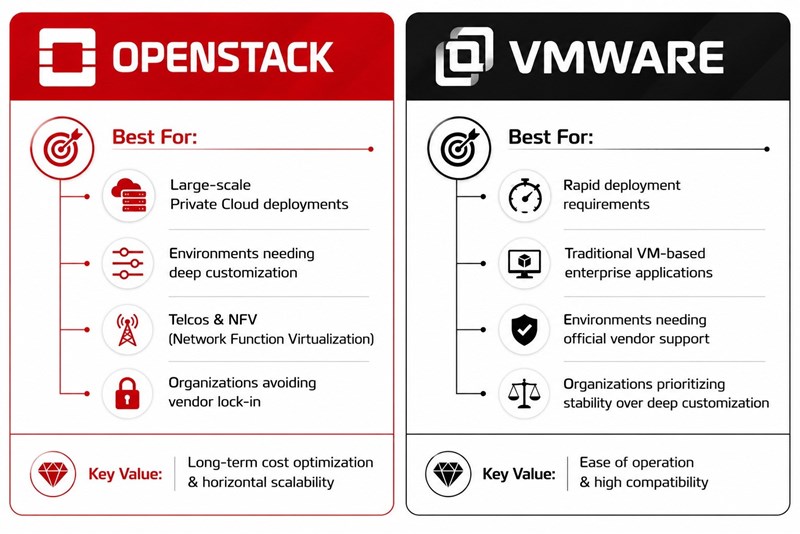
Businesses wanting to build a large-scale Private Cloud
OpenStack is the appropriate choice when a business aims to build a true Private Cloud platform rather than just stopping at server virtualization. In environments with hundreds or thousands of physical servers, the need for centralized management and flexible resource allocation becomes especially critical. OpenStack allows businesses to abstract all infrastructure resources into shared pools, thereby deploying virtual machines, virtual networks, and storage under an internal service model.
The outstanding strength of OpenStack lies in its horizontal scalability. When compute needs increase, businesses simply need to add more compute nodes to the cluster without restructuring the entire system. The distributed architecture helps the system maintain stable performance even as the number of workloads grows rapidly over time. This is a key factor for organizations that are growing strongly or running many complex internal services. For businesses oriented toward building infrastructure as an internal service platform (Internal Cloud Platform) in the long term, OpenStack provides more sustainable scalability than traditional virtualization solutions.
Requirements for deep customization and full infrastructure control
One of the strategic advantages of OpenStack is its openness and ability for deep customization. Because it is developed under an open-source model, OpenStack allows businesses to intervene directly in the deployment structure and integrate it with their own monitoring, security, or automation systems.
In environments requiring complex network configurations, multi-layer tenant partitioning, or integration with specialized storage infrastructure, OpenStack offers superior flexibility. Businesses can design network models according to their own needs instead of relying entirely on the pre-packaged architecture of a commercial vendor. Controlling the entire infrastructure stack also helps organizations reduce reliance on a single vendor. This is an important factor in a strategy to avoid technology lock-in, especially for businesses operating in the finance, telecommunications, or public service sectors.
Optimizing long-term licensing costs
At a small scale, licensing costs may not be the deciding factor. However, as infrastructure expands to hundreds of servers, commercial licensing costs can become a very large investment. OpenStack does not require software license fees, helping businesses significantly reduce long-term costs.
Of course, OpenStack is not a completely free solution. Businesses need to invest in technical personnel, training, and operations. However, for organizations with strong IT teams, the total cost of ownership over 5–10 years can be significantly lower than the traditional licensing model. For businesses with long-term expansion strategies and a desire to control technology budgets, OpenStack provides a clear financial advantage.
Telcos, ISPs, and large organizations
In the field of telecommunications and Internet service provision, the need for network function virtualization and flexible service deployment is extremely important. OpenStack is designed to support environments with high resource density and complex workloads, including Network Function Virtualization (NFV). Large carriers often need the ability to customize deeply, scale flexibly, and integrate with their own orchestration systems. OpenStack meets these requirements well thanks to its modular structure and powerful scalability.
Additionally, government organizations, large banks, or multinational corporations also prioritize OpenStack when they want to build an independent Private Cloud to ensure data control and compliance with strict internal security standards.
When should you choose VMware?
Mid-sized and large enterprises needing rapid deployment
VMware is suitable for businesses that want to deploy a virtualization infrastructure in a short time without building a complex Cloud architecture. With an optimized installation process and an intuitive management interface, VMware helps IT teams quickly put the system into operation.
In projects requiring urgent timelines or production environments that need immediate stability, VMware is usually a safe choice. Because it is pre-packaged under a commercial model, most configurations have been optimized, helping to reduce the risk of errors during the deployment process. For businesses in the initial stages of digital transformation that are not yet ready to invest in self-built Cloud infrastructure, VMware provides a practical and more accessible solution.
Traditional IT infrastructure based on VMs
If the majority of current applications still run on virtual machines and have not moved to containers or microservices architecture, VMware is the appropriate platform. VMware's ecosystem is designed to be optimized for traditional VM environments, ensuring high compatibility with popular operating systems and software.
In ERP systems, large databases, or legacy enterprise applications, VMware helps maintain stability without the need to change the underlying architecture. This is especially important when a business does not want to restructure its entire system just to apply new technology.
Requirements for high stability, minimal customization
VMware is famous for its stability and official support from the vendor. For environments requiring high uptime and few configuration changes, using a commercial solution with direct technical support helps minimize operational risks. Instead of self-managing and troubleshooting based on the community like with OpenStack, businesses using VMware can receive official support according to a contract. This provides peace of mind for organizations that do not want to invest too many resources into researching and customizing the system.
Should OpenStack and VMware be combined in the same architecture?
In reality, many businesses choose a Hybrid Infrastructure model, combining both OpenStack and VMware. Traditional workloads can continue to run on VMware, while new systems or test environments are deployed on OpenStack.
This model helps organizations gradually transition to a flexible Cloud architecture without needing to change the entire system immediately. At the same time, businesses can leverage the advantages of each platform for different types of workloads. However, combining them requires a clear management strategy to avoid infrastructure fragmentation and increased operational complexity.
Conclusion
Comparing OpenStack vs VMware is not a battle between right and wrong, but a choice suitable for the development strategy of each business. VMware brings stability, ease of deployment, and strong commercial support. OpenStack provides flexibility, large-scale scalability, and long-term cost optimization.
Vcloudia Cloud Server – The Cloud You Can Count On
If you're concerned about the potential limitations of Cloud Servers, Cloud Server by Vcloudia is a reliable solution for businesses of all sizes. With a modern infrastructure and comprehensive customer support, Vcloudia delivers a cloud experience with:
- Powerful connectivity to ensure stable 24/7 access
- Advanced security standards, compliant with international certifications such as ISO 27001:2013, ISO 20000:2018, ISO 9001:2015
- Flexible pricing packages tailored to your specific business needs
- Expert technical support, making migration and system deployment fast, safe, and compatible
Contact information:
- Hotline: +855 888 55 66 08 (free of charge)
- Fanpage: https://www.facebook.com/vcloudia/
- Website: https://vcloudia.com
Featured news
Related news
What is a Snapshot? The Difference Between Snapshot and Backup
Snapshot is a familiar concept in data management and protection. In the context of the information technology boom, where data is a major asset for businesses, understanding Snapshots as well as their application is a key factor for enterprises to maximize technological efficiency.
What is a Firewall? The Role and Importance of Firewalls for Users
In the context of ever-increasing cyberattacks, system security has become a top priority for many enterprises. Alongside deploying antivirus software and controlling connection ports, firewalls are also considered a key solution to effectively enhance cybersecurity.
What is DDoS? Signs, Mitigation Strategies, and Effective Prevention
DDoS is a highly dangerous cyberattack that leaves severe consequences for enterprises. Therefore, gaining a clear understanding of DDoS attacks, as well as how to detect and prevent them, is a topic of significant interest to many.
What is a Trojan? How to Detect, Avoid, and Prevent It
A Trojan is a type of malicious code or software that can cause severe consequences to computer operations. So, what is a Trojan? How can you prevent a Trojan from infiltrating your computer? In the following article, Vcloudia will provide detailed information on these issues.
What is Cloud Backup? Classification, benefits, and limitations
Cloud Backup is a solution that plays an important role in backing up and recovering data when an incident occurs. So what exactly is Cloud Backup? Let's find out the details with Vcloudia in the following article.
What is Cloud Storage? Features and Benefits of Using It
Cloud Storage is the perfect storage solution alternative to bulky, space-consuming physical hard drives. So, what is Cloud Storage? Let's explore the details with Vcloudia through the following article.
What is an API? Characteristics and applications in website design
API, short for Application Programming Interface, is a concept no longer unfamiliar in the information technology field. So what exactly is an API and why is it so important? Let's find out with Vcloudia.
What is Node.js? Instructions on how to install Node.js on cPanel
Currently, it is easy to see that Node.js is being used by quite a lot of people. This is because Node.js can support users in running on multiple platforms and multiple devices.
What is Vultr VPS? Should you use Vultr VPS?
Vultr VPS is one of the best cloud storage solutions in the world. In this article, you will learn the concept: "What is Vultr VPS?", as well as understand its advantages and disadvantages.
Zoom Cloud Meeting: What is it? Basic Things You Should Know About Zoom Cloud Meeting
In 2020, Zoom Cloud Meeting became one of the leading video conferencing software applications. It allows you to virtually interact with colleagues when in-person meetings aren't possible, and it has also been very successful for social events.