



.png)



















.png)





OpenStack vs Proxmox: Which Platform Should You Choose for Your System?
Jun 30, 2026In the context of technology infrastructure increasingly developing in a flexible and scalable direction, choosing a resource management platform has become a critical decision for businesses. Two prominent names often placed on the balance scale are OpenStack and Proxmox. Although both are open-source solutions serving the goal of infrastructure optimization, their approaches and application scopes are entirely different.
In this article, Vcloudia will help you understand the differences between these two platforms so that you can choose the right tool for your needs.
General Overview of OpenStack
What is OpenStack?
OpenStack is an open-source platform designed to build and manage cloud infrastructure using the Infrastructure as a Service (IaaS) model. Instead of simply creating and managing virtual machines, OpenStack provides a complete ecosystem including compute, storage, networking, and many other services, allowing businesses to operate a private cloud system similar to those of large providers.
The distinct feature of OpenStack lies in its modular architecture, where each component performs a specific function but can still integrate with others to form a complete system. Consequently, users can customize and scale infrastructure according to their needs without being limited by a fixed structure.
Benefits of OpenStack
One of the greatest values OpenStack offers is the ability to build a private cloud infrastructure with a high level of control. Businesses can manage all resources themselves, from compute to network, without depending on external providers.
Furthermore, OpenStack supports near-limitless scalability. As demand increases, the system can add more nodes without affecting current operations. This makes OpenStack a suitable choice for organizations with large scale or those requiring long-term development.
Automation capability is also a notable strength. OpenStack allows for the deployment and management of resources via API, helping to minimize manual operations and increase operational efficiency. This is particularly important in DevOps or CI/CD environments.
General Overview of Proxmox
What is Proxmox?
Proxmox is an open-source virtualization platform that integrates both KVM technology and containers, helping users easily create and manage virtual machines on a centralized interface. Unlike OpenStack, Proxmox focuses on simplifying the process of deploying and operating virtualization infrastructure. With Proxmox, users can quickly set up a virtualization environment without complex configuration. The intuitive web interface allows for resource management, system status monitoring, and the execution of operations with just a few basic steps.
Proxmox does not aim to build a large-scale cloud platform but focuses on providing an efficient virtualization solution, suitable for small and medium-sized systems or environments needing rapid deployment.
Benefits of Proxmox
One of the biggest benefits of Proxmox is its ease of use. Even those without much infrastructure experience can deploy and manage the system easily thanks to the intuitive interface and simple processes. Proxmox also helps save significant costs. As an open-source platform, it does not require high license fees, while also reducing the need for specialized personnel compared to more complex solutions.
Rapid deployment capability is another strength. In many cases, the system can be set up and put into use in a short amount of time, suitable for projects requiring speed. Besides that, Proxmox still supports important features like clustering, backup, and high availability, helping ensure the system operates stably without overly complex configuration.
Comparing OpenStack vs. Proxmox
Who is OpenStack Suitable For?
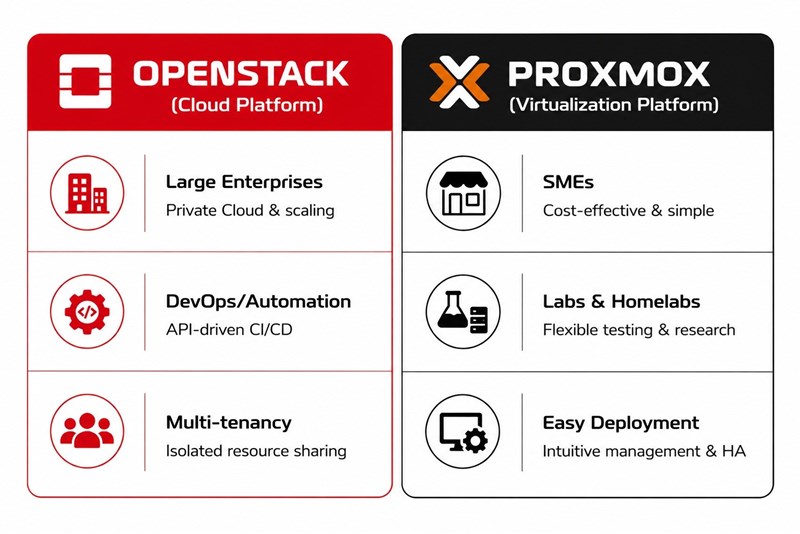
Large Enterprises and Private Cloud Systems
OpenStack is particularly suitable for large-scale enterprises where IT infrastructure not only serves internal needs but also must meet continuous expansion demands over time. When the system grows to a certain level, depending entirely on the public cloud can lead to increased costs and limited control. At this point, OpenStack allows businesses to build a private cloud where all resources—from compute and storage to network—are managed centrally and flexibly.
Beyond long-term cost savings, this model helps businesses be proactive in customizing infrastructure to specific requirements, from security and performance to operational processes. This is why OpenStack is often used in large organizations, banks, telcos, or technology companies with complex systems.
Environments Requiring Automation and Orchestration
In modern systems, especially DevOps environments, manual infrastructure deployment and management are no longer suitable. OpenStack is designed with powerful integration capabilities via API, allowing for the automation of almost the entire process from virtual machine initialization and network configuration to resource scaling.
Thanks to this, technical teams can build complete CI/CD pipelines where infrastructure is provisioned automatically according to application needs. This not only helps minimize errors due to manual operation but also increases deployment speed, shortening the time to market for products. For systems requiring complex orchestration, OpenStack offers a clear advantage over traditional virtualization platforms.
Multi-tenant Infrastructure
One of the standout strengths of OpenStack is its robust support for multi-tenancy. In this environment, multiple user groups or clients can share the same physical infrastructure while remaining completely separated in terms of resources and access rights.
This is especially important for businesses providing cloud services or organizations with multiple independently operating departments. Each tenant can be configured individually regarding network, resource quotas, and security policies without affecting other tenants. Consequently, OpenStack ensures not only performance but also meets security and administrative requirements in complex environments.
Who is Proxmox Suitable For?
Small and Medium-Sized Enterprises (SMEs)
For small and medium-sized enterprises, infrastructure needs often focus on cost optimization and ease of operation rather than building a complex cloud system. Proxmox meets this requirement very well by providing a feature-rich virtualization platform while maintaining simplicity in deployment.
Instead of needing a specialized team to operate it, businesses can quickly set up the system and put it into use with significantly lower costs. This helps optimize resources, especially in the early stages when the system scale is not yet too large.
Lab, Test Environments, and Homelabs
Proxmox is a very popular choice in testing, learning, or research environments. With the ability to create and manage multiple virtual machines on the same infrastructure, users can easily build test scenarios without investing in additional hardware.
Proxmox's strength in this case is flexibility and rapid operational capability. Users can create, delete, or snapshot virtual machines in just a few minutes, making the testing process convenient and effective. This is why Proxmox is often used in homelabs or training environments.
Easy-to-Deploy Virtualization
Not every system requires a complex cloud platform like OpenStack. In many cases, businesses only need a stable virtualization solution to run internal services. Proxmox satisfies this need well by providing all necessary features without requiring complex configuration.
The intuitive management interface helps users easily monitor and control the system, while features like backup, clustering, or high availability are pre-integrated. As a result, Proxmox becomes a suitable choice for those prioritizing simplicity, efficiency, and ease of operation in practice.
Conclusion
OpenStack and Proxmox are both powerful platforms, but they serve different goals. Choosing between the two platforms should not be based on which is "better," but rather on the specific needs of your system. If you need a flexible, scalable solution suitable for a modern cloud environment, OpenStack is worth considering. Conversely, if you prioritize simplicity, ease of deployment, and reasonable costs, Proxmox is the more suitable option.
FAQ
1. Is OpenStack too complex to deploy for a business?
Yes, if the business does not yet have a sufficiently strong technical team. OpenStack requires a clear understanding of cloud architecture, networking, and automation, so initial deployment and operational time are quite significant. However, if the system needs long-term expansion and high automation, investing in OpenStack will yield clear benefits in the future.
2. Is Proxmox powerful enough to replace OpenStack in a production environment?
In many cases, the answer is yes. For small and medium-sized systems, Proxmox fully meets the needs for stable operation and efficient VM and container management. However, when the system requires multi-tenancy, complex orchestration, or large-scale scaling, Proxmox will begin to show limitations compared to OpenStack.
3. Should I choose OpenStack or Proxmox to optimize costs while ensuring performance?
If you prioritize costs and rapid deployment, Proxmox is a logical choice because it is easy to operate and consumes fewer management resources. Conversely, if the system has a large expansion roadmap and needs to be managed according to a cloud model, OpenStack will be more optimized in the long run, despite higher initial costs.
Vcloudia Cloud Server – The Cloud You Can Count On
If you're concerned about the potential limitations of Cloud Servers, Cloud Server by Vcloudia is a reliable solution for businesses of all sizes. With a modern infrastructure and comprehensive customer support, Vcloudia delivers a cloud experience with:
- Powerful connectivity to ensure stable 24/7 access
- Advanced security standards, compliant with international certifications such as ISO 27001:2013, ISO 20000:2018, ISO 9001:2015
- Flexible pricing packages tailored to your specific business needs
- Expert technical support, making migration and system deployment fast, safe, and compatible
Contact information:
- Hotline: +855 888 55 66 08 (free of charge)
- Fanpage: https://www.facebook.com/vcloudia/
- Website: https://vcloudia.com
Featured news
Related news
What is a Snapshot? The Difference Between Snapshot and Backup
Snapshot is a familiar concept in data management and protection. In the context of the information technology boom, where data is a major asset for businesses, understanding Snapshots as well as their application is a key factor for enterprises to maximize technological efficiency.
What is a Firewall? The Role and Importance of Firewalls for Users
In the context of ever-increasing cyberattacks, system security has become a top priority for many enterprises. Alongside deploying antivirus software and controlling connection ports, firewalls are also considered a key solution to effectively enhance cybersecurity.
What is DDoS? Signs, Mitigation Strategies, and Effective Prevention
DDoS is a highly dangerous cyberattack that leaves severe consequences for enterprises. Therefore, gaining a clear understanding of DDoS attacks, as well as how to detect and prevent them, is a topic of significant interest to many.
What is a Trojan? How to Detect, Avoid, and Prevent It
A Trojan is a type of malicious code or software that can cause severe consequences to computer operations. So, what is a Trojan? How can you prevent a Trojan from infiltrating your computer? In the following article, Vcloudia will provide detailed information on these issues.
What is Cloud Backup? Classification, benefits, and limitations
Cloud Backup is a solution that plays an important role in backing up and recovering data when an incident occurs. So what exactly is Cloud Backup? Let's find out the details with Vcloudia in the following article.
What is Cloud Storage? Features and Benefits of Using It
Cloud Storage is the perfect storage solution alternative to bulky, space-consuming physical hard drives. So, what is Cloud Storage? Let's explore the details with Vcloudia through the following article.
What is an API? Characteristics and applications in website design
API, short for Application Programming Interface, is a concept no longer unfamiliar in the information technology field. So what exactly is an API and why is it so important? Let's find out with Vcloudia.
What is Node.js? Instructions on how to install Node.js on cPanel
Currently, it is easy to see that Node.js is being used by quite a lot of people. This is because Node.js can support users in running on multiple platforms and multiple devices.
What is Vultr VPS? Should you use Vultr VPS?
Vultr VPS is one of the best cloud storage solutions in the world. In this article, you will learn the concept: "What is Vultr VPS?", as well as understand its advantages and disadvantages.
Zoom Cloud Meeting: What is it? Basic Things You Should Know About Zoom Cloud Meeting
In 2020, Zoom Cloud Meeting became one of the leading video conferencing software applications. It allows you to virtually interact with colleagues when in-person meetings aren't possible, and it has also been very successful for social events.