



.png)



















.png)





OpenStack vs Azure Comparison: Choosing a Cloud Platform for Enterprises
Jun 30, 2026When discussing cloud strategy, two names are frequently weighed against each other: OpenStack and Microsoft Azure. One represents the open-source Private Cloud construction model, while the other is a global Public Cloud with a massive ecosystem of services. So, in the OpenStack vs Azure dilemma, which is the right choice? Let’s explore the details in this article with Vcloudia.
Introduction to OpenStack
What is OpenStack?
OpenStack is an open-source platform designed to build and operate cloud infrastructure under the Infrastructure as a Service (IaaS) model. Instead of using a public cloud, enterprises can deploy OpenStack on their own physical server systems to create a complete Private Cloud.
Unlike pre-packaged commercial solutions, OpenStack allows enterprises to control the entire infrastructure layer, from servers, storage, and networking to access control and security mechanisms. Thanks to its open architecture and deep customizability, OpenStack is often chosen by large corporations, financial institutions, or telecommunications carriers to build internal cloud platforms. The core of OpenStack lies not only in its virtualization capabilities but also in providing resources as services through APIs. This helps technical teams automate resource provisioning processes, integrate DevOps, and optimize operations at scale.
How OpenStack Works
OpenStack operates based on a distributed architecture consisting of many independent services that link together via APIs. The system is typically divided into two main parts: the Control Plane and Compute/Storage Nodes. The Control Plane acts as the manager, coordinator, and authenticator. This is where central services such as user authentication, resource management, and workload orchestration reside. Compute Nodes are responsible for running virtual machines or containers, while Storage Nodes provide block or object storage capacity.
When a user requests to create a virtual machine, the system processes the request via the API, authenticates access, and then allocates resources from the appropriate physical server cluster. The entire process is automated and can be integrated with CI/CD tools or configuration management systems. This approach transforms traditional infrastructure into a flexible platform where resources are provisioned on demand rather than configured manually.
Key Components of OpenStack
OpenStack consists of many modules, each responsible for a specific function:
- Nova: Manages computing resources and virtual machine lifecycles.
- Neutron: Provides virtual networking, routing, and firewall services.
- Cinder: Provides block storage for virtual machines.
- Swift: Provides large-scale object storage.
- Keystone: Authenticates and manages identities.
- Glance: Manages operating system images.
- Horizon: Provides a web administration interface.
This modular separation makes OpenStack flexible and scalable according to specific needs. However, this complex structure also means that deployment requires a highly specialized technical team.
Introduction to Microsoft Azure
What is Azure?
Microsoft Azure is a public cloud platform developed by Microsoft, offering a comprehensive suite of services ranging from Infrastructure (IaaS) and Platform (PaaS) to Software (SaaS). With hundreds of data centers spread globally, Azure allows enterprises to deploy applications in minutes without investing in hardware.
Azure stands out due to its diverse ecosystem and deep integration with Microsoft products such as Windows Server, Active Directory, and Office 365. It is a popular choice for enterprises that want to leverage cloud advantages without building their own data centers.
How Does Azure Work?
Azure operates on a Public Cloud model. Enterprises register for an account and consume resources on a pay-as-you-go basis. The physical infrastructure is fully managed by Microsoft, from servers and storage systems to physical security.
When deploying applications on Azure, users only need to configure the necessary virtual machines or services through the administration interface or API. Azure automatically allocates resources from its global system to meet demand. This model reduces the burden of infrastructure operations, allowing enterprises to focus on application and service development.
Key Components of Microsoft Azure
Azure offers a very broad service ecosystem, including:
- Azure Virtual Machines: Provides on-demand virtual machines.
- Azure Storage: Stores blobs, files, and disks.
- Azure Virtual Network: Virtual networking and secure connectivity.
- Azure Kubernetes Service (AKS): Manages containers.
- Azure SQL Database: Database as a service.
- Azure AI & Machine Learning: Integrated AI services.
This richness allows Azure to meet diverse needs, from startups to global corporations.
OpenStack vs. Azure Comparison
When Should You Choose OpenStack?
Enterprises Needing Full Infrastructure Control
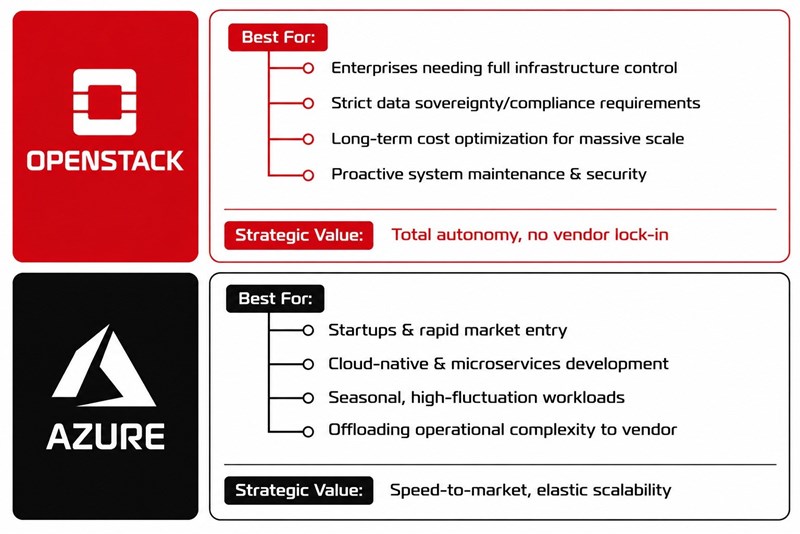
OpenStack is suitable for organizations that view technology infrastructure as a strategic asset rather than just an outsourced service. When an enterprise wants full control, from the physical layer (servers, storage, network) to the virtualization layer and resource provisioning APIs, OpenStack provides maximum autonomy. Building a Private Cloud with OpenStack allows enterprises to be proactive in network architecture design, tenant partitioning, security configuration, and performance optimization based on specific requirements. This is particularly important for systems with high customization needs, such as core banking, financial transaction systems, or telecommunications platforms.
Furthermore, control also manifests in the ability to proactively upgrade, patch, and integrate internal monitoring tools without being completely dependent on the product roadmap of a public cloud provider. For enterprises with strong technical teams, this is a significant long-term strategic advantage.
Requirements for Internal Data Storage
In the context of increasingly stringent data protection regulations, many organizations are required to store user information within national borders or internal systems. Banks, government agencies, healthcare enterprises, and financial institutions are often subject to strict legal requirements regarding data location.
OpenStack allows for deployment directly in private data centers or local data centers, helping to ensure compliance with data sovereignty requirements. Enterprises can physically control servers, manage internal access, and apply security policies according to their own standards.
Long-term Cost Optimization
Cost is a factor that cannot be ignored when choosing a cloud strategy. OpenStack requires initial investment in hardware, network infrastructure, cooling systems, and deployment personnel. However, as the scale grows to hundreds or thousands of servers, the total cost of ownership (TCO) over 5-10 years can be significantly lower than maintaining a large volume of workloads on a Public Cloud.
Not having to pay platform license fees is a major advantage of OpenStack. Enterprises only need to invest in hardware and operational teams. For systems with stable and predictable loads, this model helps better control budgets compared to a variable pay-as-you-go model. Especially for organizations that already have data centers or physical infrastructure, deploying OpenStack helps maximize existing assets instead of completely reinvesting in a public cloud.
When Should You Choose Azure?
Startups and Enterprises Needing Rapid Deployment
For startups or enterprises in a phase of rapid expansion, deployment speed is a critical survival factor. Azure allows the creation of virtual machines, databases, or container environments in just minutes without needing to purchase or configure hardware. This helps enterprises shorten time-to-market. Instead of taking months to design and install physical infrastructure, technical teams can focus on developing features and user experiences.
Cloud-native Applications
Azure is built to support modern architectures such as microservices, containers, and serverless. Services like managed Kubernetes, integrated CI/CD systems, and AI services help shorten software development cycles.
For enterprises transitioning to cloud-native, Azure provides an optimal environment to deploy and operate distributed applications. Built-in log management, monitoring, and data analytics services reduce manual operational workloads. Instead of building every component from scratch as in a Private Cloud, Azure provides a ready-made platform, allowing development teams to focus on business logic.
Flexible Seasonal Scalability Needs
Some industries experience strong traffic fluctuations based on time, such as e-commerce, online education, or media services. During peak periods, resource demand can increase many times over normal levels. Azure allows for almost instant resource scaling and contraction when not needed. This helps enterprises optimize costs, avoiding the situation of over-investing in infrastructure just to serve a few peak months per year.
Conclusion
Comparing OpenStack vs. Azure is not about finding the "better" platform, but about identifying the solution that fits the enterprise's strategy. OpenStack offers control and long-term cost optimization, while Azure provides speed, flexibility, and a comprehensive service ecosystem. The final decision should be based on organizational scale, security requirements, financial strategy, and the technical team's capabilities.
Vcloudia Cloud Server – The Cloud You Can Count On
If you're concerned about the potential limitations of Cloud Servers, Cloud Server by Vcloudia is a reliable solution for businesses of all sizes. With a modern infrastructure and comprehensive customer support, Vcloudia delivers a cloud experience with:
- Powerful connectivity to ensure stable 24/7 access
- Advanced security standards, compliant with international certifications such as ISO 27001:2013, ISO 20000:2018, ISO 9001:2015
- Flexible pricing packages tailored to your specific business needs
- Expert technical support, making migration and system deployment fast, safe, and compatible
Contact information:
- Hotline: +855 888 55 66 08 (free of charge)
- Fanpage: https://www.facebook.com/vcloudia/
- Website: https://vcloudia.com
Featured news
Related news
What is a Snapshot? The Difference Between Snapshot and Backup
Snapshot is a familiar concept in data management and protection. In the context of the information technology boom, where data is a major asset for businesses, understanding Snapshots as well as their application is a key factor for enterprises to maximize technological efficiency.
What is a Firewall? The Role and Importance of Firewalls for Users
In the context of ever-increasing cyberattacks, system security has become a top priority for many enterprises. Alongside deploying antivirus software and controlling connection ports, firewalls are also considered a key solution to effectively enhance cybersecurity.
What is DDoS? Signs, Mitigation Strategies, and Effective Prevention
DDoS is a highly dangerous cyberattack that leaves severe consequences for enterprises. Therefore, gaining a clear understanding of DDoS attacks, as well as how to detect and prevent them, is a topic of significant interest to many.
What is a Trojan? How to Detect, Avoid, and Prevent It
A Trojan is a type of malicious code or software that can cause severe consequences to computer operations. So, what is a Trojan? How can you prevent a Trojan from infiltrating your computer? In the following article, Vcloudia will provide detailed information on these issues.
What is Cloud Backup? Classification, benefits, and limitations
Cloud Backup is a solution that plays an important role in backing up and recovering data when an incident occurs. So what exactly is Cloud Backup? Let's find out the details with Vcloudia in the following article.
What is Cloud Storage? Features and Benefits of Using It
Cloud Storage is the perfect storage solution alternative to bulky, space-consuming physical hard drives. So, what is Cloud Storage? Let's explore the details with Vcloudia through the following article.
What is an API? Characteristics and applications in website design
API, short for Application Programming Interface, is a concept no longer unfamiliar in the information technology field. So what exactly is an API and why is it so important? Let's find out with Vcloudia.
What is Node.js? Instructions on how to install Node.js on cPanel
Currently, it is easy to see that Node.js is being used by quite a lot of people. This is because Node.js can support users in running on multiple platforms and multiple devices.
What is Vultr VPS? Should you use Vultr VPS?
Vultr VPS is one of the best cloud storage solutions in the world. In this article, you will learn the concept: "What is Vultr VPS?", as well as understand its advantages and disadvantages.
Zoom Cloud Meeting: What is it? Basic Things You Should Know About Zoom Cloud Meeting
In 2020, Zoom Cloud Meeting became one of the leading video conferencing software applications. It allows you to virtually interact with colleagues when in-person meetings aren't possible, and it has also been very successful for social events.