



.png)



















.png)





OpenStack vs AWS in Cloud Infrastructure Building
Jun 30, 2026OpenStack and AWS are two names frequently mentioned in Cloud strategies. However, these are two platforms with completely different approaches: OpenStack is often used to build Private Cloud, while AWS is one of the Public Cloud platforms. Choosing between OpenStack and AWS not only depends on technology but also involves many factors such as the level of infrastructure control, long-term costs, as well as system scalability.
In this article, Vcloudia will analyze in detail the differences between OpenStack and AWS to help you have a comprehensive view and make the right choice for your Cloud infrastructure.
What is OpenStack?
OpenStack Concepts
OpenStack is an open-source cloud computing platform designed to build and manage large-scale Cloud infrastructure. The OpenStack project is developed by a global open-source community with the participation of many large technology organizations. OpenStack's goal is to provide a platform capable of creating a Cloud environment similar to Public Cloud providers but deployed within an enterprise's internal system.
Through OpenStack, organizations can build Private Cloud to manage computing, storage, and network resources in their data centers. This helps enterprises maintain full control over infrastructure, data, and security policies. OpenStack is often used by large corporations, telecommunications service providers, financial institutions, or units with high requirements for security and data compliance.
Unlike commercial Cloud platforms, OpenStack is not a service provided ready-to-use over the internet. Instead, enterprises need to deploy and operate OpenStack on their physical infrastructure or in an outsourced Data Center environment.
The role of OpenStack in Private Cloud
In Private Cloud architecture, OpenStack acts as the operating system of the data center. It helps enterprises virtualize their entire infrastructure resources and provide them as internal services. Thanks to OpenStack, departments within the enterprise can independently create virtual machines, deploy applications, or allocate resources without needing direct hardware intervention. This helps improve resource utilization efficiency and reduce system deployment time.
Another important benefit of OpenStack is its high customizability. Enterprises can adjust configurations, integrate security tools, or build operating procedures tailored to their specific requirements. This is especially important for organizations that need strict data control or must comply with legal regulations.
What is AWS?
Amazon Web Services Concepts
AWS (Amazon Web Services) is a public cloud computing platform developed by Amazon. This is one of the world's largest Cloud providers, offering hundreds of different services related to computing, storage, artificial intelligence, data analytics, and security.
The distinguishing feature of AWS is the Public Cloud model. Instead of having to build physical infrastructure, enterprises can rent resources directly from AWS's global Data Center system. Users just need to create an account and can deploy servers, databases, or applications in minutes.
AWS operates on a pay-as-you-go model. Enterprises only pay for the resources they actually use, helping reduce initial investment costs for IT infrastructure.
The role of AWS in Public Cloud
AWS plays an important role in the Public Cloud ecosystem thanks to its ability to provide large-scale infrastructure with high reliability. AWS's Data Center system is distributed across multiple geographical regions and is designed with strong redundancy capabilities.
Thanks to the AWS platform, enterprises can deploy global applications without having to invest in a private Data Center. Services such as EC2, S3, RDS, or Lambda allow enterprises to build flexible, easily scalable, and cost-optimized systems. AWS is particularly suitable for startups or rapidly growing enterprises, as they can expand infrastructure almost limitlessly without having to invest in new hardware.
OpenStack vs AWS Comparison
OpenStack and AWS are both powerful Cloud platforms, but they serve different goals. OpenStack focuses on building Private Cloud within an enterprise's data center, while AWS provides Public Cloud services managed by the provider.
When should you choose OpenStack?
Enterprises needing infrastructure control
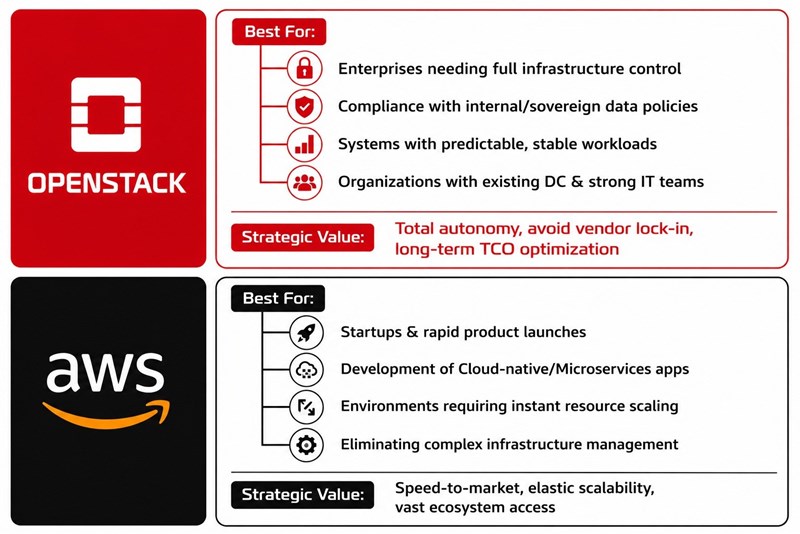
One of the important reasons many organizations choose OpenStack is the need to control their entire IT infrastructure. When using OpenStack, enterprises can directly manage hardware, network, and storage systems in their Data Center. This helps organizations build system architectures suitable for their specific requirements and avoid dependence on external Cloud providers.
Security and internal data storage requirements
In many industries such as finance, banking, or government, data must be stored in internal systems to ensure compliance with legal regulations. OpenStack allows Cloud deployment in a private environment, keeping data within the enterprise's data center. Thereby, organizations can apply strict security policies and tightly control data access.
Large-scale systems, stable workloads
OpenStack is especially suitable for systems with large scale and stable workloads. When an enterprise already has a Data Center and a strong infrastructure operations team, deploying Private Cloud using OpenStack can help optimize long-term costs. Furthermore, OpenStack also allows system expansion as needed by adding physical servers to the existing infrastructure.
When should you choose AWS?
Enterprises needing fast deployment
One of AWS's biggest advantages is the ability to deploy systems very quickly. Instead of taking many months to build a Data Center, enterprises only need a few minutes to initialize servers and deploy applications. This is especially useful for startups or projects that need to launch products quickly to test the market.
Cloud-native applications
AWS is designed to support Cloud-native applications. Services like containers, serverless, microservices, or CI/CD are integrated into the AWS ecosystem. As a result, software development teams can build and deploy modern applications without managing complex infrastructure.
Flexible scalability needs
AWS allows for almost unlimited resource expansion. When traffic increases, the system can automatically add servers to ensure performance. This flexible scalability helps enterprises handle sudden growth spikes without investing in new hardware.
Conclusion
OpenStack and AWS both play important roles in building modern Cloud infrastructure, but each platform is suitable for different goals. When choosing between OpenStack and AWS, enterprises need to consider many factors such as security requirements, system scale, investment budget, and long-term development strategy. Understanding the characteristics of each platform will help enterprises build more effective Cloud infrastructure, meeting development needs in the digital era.
Vcloudia Cloud Server – The Cloud You Can Count On
If you're concerned about the potential limitations of Cloud Servers, Cloud Server by Vcloudia is a reliable solution for businesses of all sizes. With a modern infrastructure and comprehensive customer support, Vcloudia delivers a cloud experience with:
- Powerful connectivity to ensure stable 24/7 access
- Advanced security standards, compliant with international certifications such as ISO 27001:2013, ISO 20000:2018, ISO 9001:2015
- Flexible pricing packages tailored to your specific business needs
- Expert technical support, making migration and system deployment fast, safe, and compatible
Contact information:
- Hotline: +855 888 55 66 08 (free of charge)
- Fanpage: https://www.facebook.com/vcloudia/
- Website: https://vcloudia.com
Featured news
Related news
What is a Snapshot? The Difference Between Snapshot and Backup
Snapshot is a familiar concept in data management and protection. In the context of the information technology boom, where data is a major asset for businesses, understanding Snapshots as well as their application is a key factor for enterprises to maximize technological efficiency.
What is a Firewall? The Role and Importance of Firewalls for Users
In the context of ever-increasing cyberattacks, system security has become a top priority for many enterprises. Alongside deploying antivirus software and controlling connection ports, firewalls are also considered a key solution to effectively enhance cybersecurity.
What is DDoS? Signs, Mitigation Strategies, and Effective Prevention
DDoS is a highly dangerous cyberattack that leaves severe consequences for enterprises. Therefore, gaining a clear understanding of DDoS attacks, as well as how to detect and prevent them, is a topic of significant interest to many.
What is a Trojan? How to Detect, Avoid, and Prevent It
A Trojan is a type of malicious code or software that can cause severe consequences to computer operations. So, what is a Trojan? How can you prevent a Trojan from infiltrating your computer? In the following article, Vcloudia will provide detailed information on these issues.
What is Cloud Backup? Classification, benefits, and limitations
Cloud Backup is a solution that plays an important role in backing up and recovering data when an incident occurs. So what exactly is Cloud Backup? Let's find out the details with Vcloudia in the following article.
What is Cloud Storage? Features and Benefits of Using It
Cloud Storage is the perfect storage solution alternative to bulky, space-consuming physical hard drives. So, what is Cloud Storage? Let's explore the details with Vcloudia through the following article.
What is an API? Characteristics and applications in website design
API, short for Application Programming Interface, is a concept no longer unfamiliar in the information technology field. So what exactly is an API and why is it so important? Let's find out with Vcloudia.
What is Node.js? Instructions on how to install Node.js on cPanel
Currently, it is easy to see that Node.js is being used by quite a lot of people. This is because Node.js can support users in running on multiple platforms and multiple devices.
What is Vultr VPS? Should you use Vultr VPS?
Vultr VPS is one of the best cloud storage solutions in the world. In this article, you will learn the concept: "What is Vultr VPS?", as well as understand its advantages and disadvantages.
Zoom Cloud Meeting: What is it? Basic Things You Should Know About Zoom Cloud Meeting
In 2020, Zoom Cloud Meeting became one of the leading video conferencing software applications. It allows you to virtually interact with colleagues when in-person meetings aren't possible, and it has also been very successful for social events.