



.png)
















.png)





Edge Data Center vs Centralized Data Center Comparison: The Choice for the 5G Era
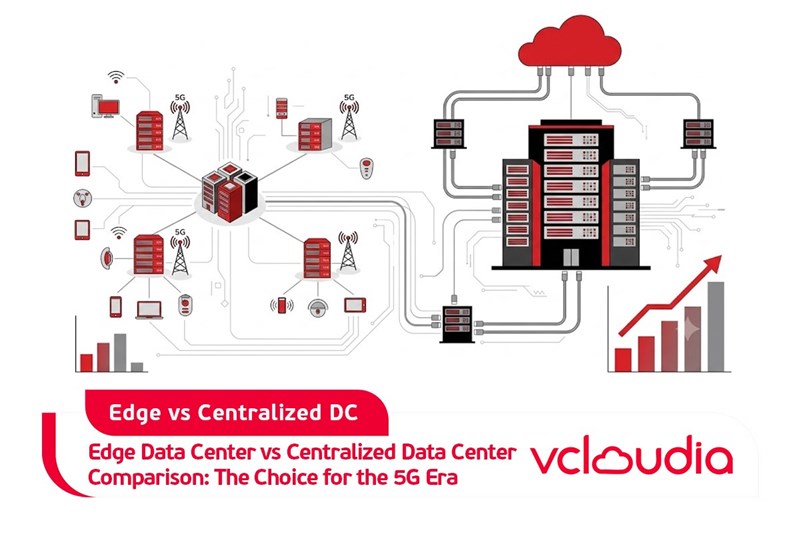
Jun 30, 2026The comparison between Edge Data Center vs Centralized Data Center does not merely stop at the server location, but is a strategy that determines processing speed and end-user experience. While the Centralized model maintains the role of a massive storage brain, the Edge data center is the extended arm that brings computing power close to the data generation source.
Let's analyze the core differences and the perfect combination trend between these two models with Vcloudia right below.
What is a Centralized Data Center?
A Centralized Data Center is an information technology infrastructure architecture in which all server resources, storage devices, and network systems are located at one or a few fixed physical locations. In this model, all data streams generated from end-user devices, branches, or peripheral sensors are transmitted through the telecommunications infrastructure back to the center for processing, analysis, and long-term storage.
The centralized data center model is built on the following core technical and operational characteristics:
- Centralized scale: The infrastructure is designed to house a large number of hardware devices, accompanied by high-capacity power and cooling systems to accommodate the entire workload of the enterprise.
- Synchronized management: The technical team can monitor, maintain, and deploy software updates and security patches for the entire system from a single control point.
- Large data processing capacity: The architecture is suitable for operating the enterprise's core applications such as enterprise resource planning (ERP) systems, customer relationship management (CRM), and storing historical data sets.
- Cost optimization at scale: The centralized procurement of hardware in large quantities and centralized management help enterprises optimize capital expenditures (CAPEX) as well as operational expenditures (OPEX) per resource unit.
What is an Edge Data Center?
An Edge Data Center is a small-scale information technology infrastructure distributed and deployed in geographical locations close to end-user devices or data generation sources. In this architecture, the process of collecting, processing, and storing information takes place right at the edge of the network instead of having to transmit everything back to centralized data centers over long distances.
The edge data center model operates based on the following typical technical characteristics:
- Latency minimization: The short physical distance between the server and the user's device helps the signal response time reach a low level, well-meeting the needs of applications requiring real-time such as 5G mobile networks, Internet of Things devices, and automated control systems.
- Transmission bandwidth optimization: The analysis and filtering of information right at the point of generation helps reduce transmission traffic on the main network backbone. The system only sends necessary data to the central server for long-term storage or advanced analysis.
- Risk distribution: The architecture consists of multiple independent physical points to help maintain service continuity. When a boundary facility encounters a technical incident, other facilities in the network and the core data center still maintain normal operations.
- Flexible deployment capability: The compact scale allows operators to easily install equipment in various spaces such as the base of telecommunications broadcasting stations, urban centers, or industrial parks.
Edge Data Center vs Centralized Data Center Comparison
Physical Distance and Network Latency
Geographical location directly determines the response time of the system.
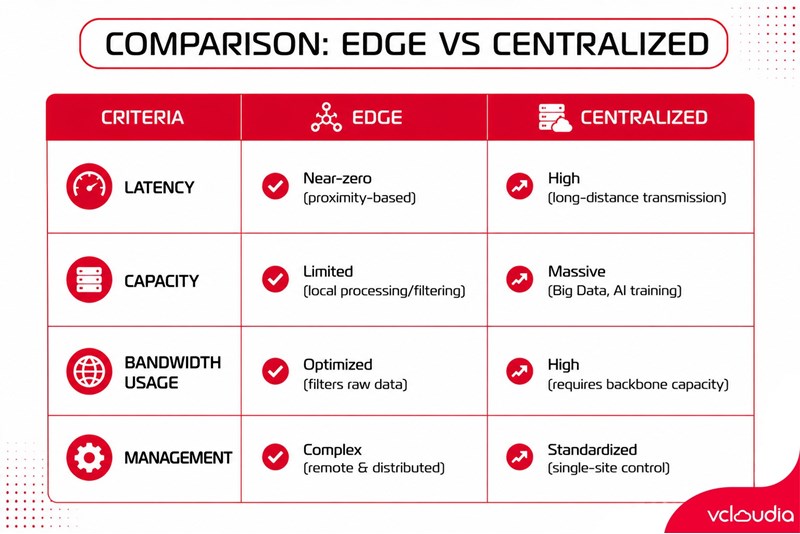
- Centralized Data Center: The server location is far from the end devices. Data must go through multiple routing stations and long fiber optic transmission lines, leading to high latency. This model is suitable for periodic data synchronization and applications that do not require real-time.
- Edge Data Center: The server location is close to users or data collection devices. The short physical transmission distance helps minimize latency, meeting the strict requirements of autonomous vehicle systems, industrial automation, and financial transactions.
Resource Scale and Computing Capacity
Each model is designed to serve a specific workload in the data processing workflow.
- Centralized Data Center: Possesses a large number of servers and high-capacity storage systems. This architecture provides powerful computing capabilities to perform complex tasks such as big data analysis, graphics rendering, and machine learning model training.
- Edge Data Center: Hardware resources and physical space are limited. Processing capacity is optimized for filtering, compressing, preliminary analyzing, and making on-the-spot decisions for newly generated data.
Transmission Bandwidth Optimization
The approach to routing data streams strongly impacts the performance of the network infrastructure.
- Centralized Data Center: Requires the system to transmit original data streams from all sources to a central point. This process consumes a lot of backbone bandwidth and poses a risk of causing local network congestion when traffic suddenly spikes.
- Edge Data Center: Acts as an intermediate data filter. By processing information at the edge, this model helps reduce the amount of raw data that needs to be transmitted to the center, thereby freeing up backbone bandwidth and saving telecommunications costs.
Operational Management and Security
The centralized or distributed nature directly affects the IT infrastructure management method.
- Centralized Data Center: Allows the IT team to implement cybersecurity policies, control physical access, and upgrade hardware in a single area. Maintenance is easily standardized, helping to effectively control overall operating costs.
- Edge Data Center: Managing a large number of distributed points requires enterprises to apply remote monitoring solutions and automation software. Maintaining physical security and synchronizing configurations for numerous small, scattered facilities is often more complex and resource-intensive.
Which Infrastructure Model Should Enterprises Choose?
The decision to deploy an Edge Data Center or Centralized Data Center depends on the technical requirements of the application, permissible latency limits, and the organization's data stream management strategy. Instead of a single choice, correctly identifying the function of each architecture helps the system achieve the highest operational efficiency.
The Centralized Data Center model is suitable for the following requirements:
- Storing large volumes of data and establishing periodic information backup mechanisms.
- Operating core internal management systems such as ERP software, customer databases, and financial accounting systems.
- Performing in-depth information analysis tasks and complex algorithm processing that do not require real-time output.
The Edge Data Center model well addresses the following requirements:
- Deploying 5G mobile network infrastructure and Internet of Things connected device systems.
- Operating industrial automation systems, autonomous vehicles, and security monitoring that need signal response with extremely low latency.
- Providing content delivery network services and live video streaming in geographical areas with high connection density.
Conclusion
Currently, the trend of designing information technology infrastructure is shifting strongly towards a Hybrid architecture. The contrast when comparing Edge Data Center vs Centralized Data Center is actually the perfect pieces for a comprehensive ecosystem. The Edge Data Center is responsible for collecting, analyzing, and processing high-speed signals at the network edge, then synchronizing the refined data sets back to the Centralized Data Center for long-term storage and in-depth exploitation. This method helps enterprises perfectly balance local response speed and global computing capacity.
Vcloudia Cloud Server – The Cloud You Can Count On
If you're concerned about the potential limitations of Cloud Servers, Cloud Server by Vcloudia is a reliable solution for businesses of all sizes. With a modern infrastructure and comprehensive customer support, Vcloudia delivers a cloud experience with:
- Powerful connectivity to ensure stable 24/7 access
- Advanced security standards, compliant with international certifications such as ISO 27001:2013, ISO 20000:2018, ISO 9001:2015
- Flexible pricing packages tailored to your specific business needs
- Expert technical support, making migration and system deployment fast, safe, and compatible
Contact information:
- Hotline: +855 888 55 66 08 (free of charge)
- Fanpage: https://www.facebook.com/vcloudia/
- Website: https://vcloudia.com
Featured news
Related news
What is a Snapshot? The Difference Between Snapshot and Backup
Snapshot is a familiar concept in data management and protection. In the context of the information technology boom, where data is a major asset for businesses, understanding Snapshots as well as their application is a key factor for enterprises to maximize technological efficiency.
What is a Firewall? The Role and Importance of Firewalls for Users
In the context of ever-increasing cyberattacks, system security has become a top priority for many enterprises. Alongside deploying antivirus software and controlling connection ports, firewalls are also considered a key solution to effectively enhance cybersecurity.
What is DDoS? Signs, Mitigation Strategies, and Effective Prevention
DDoS is a highly dangerous cyberattack that leaves severe consequences for enterprises. Therefore, gaining a clear understanding of DDoS attacks, as well as how to detect and prevent them, is a topic of significant interest to many.
What is a Trojan? How to Detect, Avoid, and Prevent It
A Trojan is a type of malicious code or software that can cause severe consequences to computer operations. So, what is a Trojan? How can you prevent a Trojan from infiltrating your computer? In the following article, Vcloudia will provide detailed information on these issues.
What is Cloud Backup? Classification, benefits, and limitations
Cloud Backup is a solution that plays an important role in backing up and recovering data when an incident occurs. So what exactly is Cloud Backup? Let's find out the details with Vcloudia in the following article.
What is Cloud Storage? Features and Benefits of Using It
Cloud Storage is the perfect storage solution alternative to bulky, space-consuming physical hard drives. So, what is Cloud Storage? Let's explore the details with Vcloudia through the following article.
What is an API? Characteristics and applications in website design
API, short for Application Programming Interface, is a concept no longer unfamiliar in the information technology field. So what exactly is an API and why is it so important? Let's find out with Vcloudia.
What is Node.js? Instructions on how to install Node.js on cPanel
Currently, it is easy to see that Node.js is being used by quite a lot of people. This is because Node.js can support users in running on multiple platforms and multiple devices.
What is Vultr VPS? Should you use Vultr VPS?
Vultr VPS is one of the best cloud storage solutions in the world. In this article, you will learn the concept: "What is Vultr VPS?", as well as understand its advantages and disadvantages.
Zoom Cloud Meeting: What is it? Basic Things You Should Know About Zoom Cloud Meeting
In 2020, Zoom Cloud Meeting became one of the leading video conferencing software applications. It allows you to virtually interact with colleagues when in-person meetings aren't possible, and it has also been very successful for social events.