


















Dedicated Private Cloud – The Optimal Private Cloud Solution for Enterprises
Aug 21, 2026As businesses increasingly depend on IT systems for operations and data processing, Cloud Computing has become a crucial model for boosting performance, security, and scalability. However, for organizations with strict requirements regarding security, data control, and operational efficiency, a Dedicated Private Cloud represents the best choice. This isolated cloud model dedicates all infrastructure resources exclusively to a single enterprise, entirely eliminating the risks associated with sharing resources with third parties.
What is Dedicated Private Cloud?
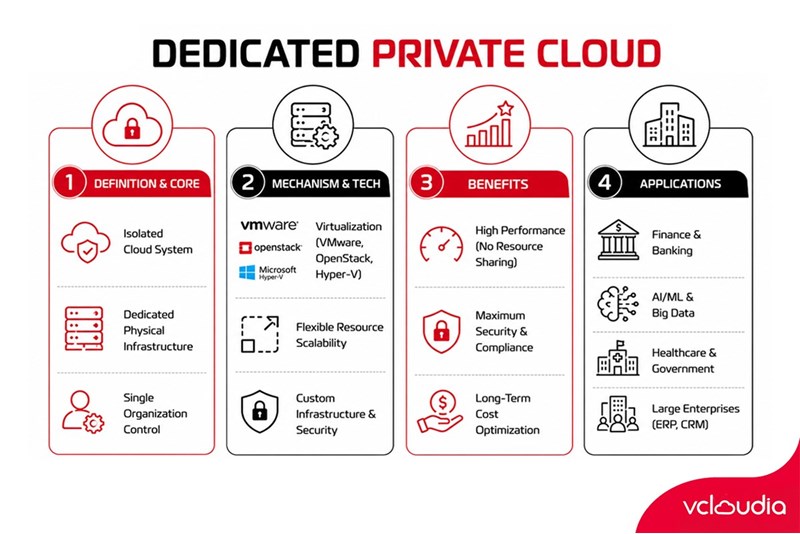
A Dedicated Private Cloud is an isolated cloud system where servers, memory, storage, and networking are fully managed by a single organization. In contrast to a Public Cloud, where multiple businesses share resources on a single platform, a Dedicated Private Cloud guarantees stable performance, maximum management rights, and the highest level of security. This model is particularly suitable for large enterprises, financial institutions, banks, governments, and healthcare organizations, where data security and regulatory compliance are paramount.
How Does Dedicated Private Cloud Work?
Essentially, a Dedicated Private Cloud is deployed on specialized physical infrastructure and is not shared with any other organization. Enterprises can manage the system themselves or opt for Managed Private Cloud services from a provider to streamline operations. This system utilizes virtualization technologies like VMware, OpenStack, or Hyper-V, allowing businesses to easily scale resources up or down as needed without interrupting operations. Furthermore, a Dedicated Private Cloud enables customized infrastructure, integration of advanced security features, and complete data control, offering a significant advantage over other cloud models.
Benefits of Using a Dedicated Private Cloud
High performance and independent resources are the primary advantages of a Dedicated Private Cloud. By avoiding the impact of resource sharing, the system maintains consistent processing speeds, particularly for critical applications such as ERP, AI/ML, Big Data, and financial transactions. Moreover, full control over the system empowers enterprises to customize security as required—deploying firewalls, VPNs, and data encryption to meet standards like ISO 27001, PCI DSS, and GDPR.
Another crucial benefit is flexible scalability. Businesses can adjust CPU, RAM, and storage based on their actual needs, which helps optimize costs while ensuring high performance. While the initial investment cost of a Dedicated Private Cloud is higher compared to a Public Cloud, it leads to long-term operational cost savings through resource optimization.
Comparison of Dedicated Private Cloud, Public Cloud, and Shared Private Cloud
Compared to a Public Cloud, a Dedicated Private Cloud offers superior performance, enhanced security, and maximum control. While a Public Cloud is suitable for startups and small businesses, a Dedicated Private Cloud is the ideal option for organizations requiring operational stability and absolute data privacy. When contrasted with a Shared Private Cloud, the Dedicated model provides entirely independent resources that are unaffected by other businesses, guaranteeing a higher level of availability.
Applications of Dedicated Private Cloud in Enterprises
The finance and banking sector is one of the industries that benefits most from a Dedicated Private Cloud due to its high-speed transaction processing, absolute data security, and strict adherence to PCI DSS and ISO 27001 standards. Similarly, enterprises in the AI/ML and Big Data sectors also use this model to process massive datasets, significantly reducing AI model training times.
Furthermore, healthcare organizations and government agencies require a Dedicated Private Cloud to safeguard sensitive information, support the storage of electronic health records, and ensure continuous system operations. For large conglomerates, this model ensures the smooth operation of ERP, CRM, and enterprise accounting systems, while also providing the capability to integrate with Hybrid Cloud for optimized operational costs.
Conclusion
A Dedicated Private Cloud is more than just a cloud deployment model; it is a strategic platform for enterprises that demand the highest levels of control, security, and performance. Unlike the Public Cloud model, which relies on shared resources, a Dedicated Private Cloud ensures that the entire infrastructure is completely isolated, allowing businesses to proactively establish operational policies, meet stringent compliance requirements, and eliminate data risks.
This model is particularly well-suited for organizations in the finance and banking sectors, healthcare, government, large-scale enterprises, or those operating complex business systems that necessitate sustained stability and flexible scalability. Implementing a Dedicated Private Cloud not only helps enterprises bolster their security but also optimizes performance, improves cost control, and ensures flexible integration with existing systems.
Vcloudia Cloud Server – The Cloud You Can Count On
If you're concerned about the potential limitations of Cloud Servers, Cloud Server by Vcloudia is a reliable solution for businesses of all sizes. With a modern infrastructure and comprehensive customer support, Vcloudia delivers a cloud experience with:
- Powerful connectivity to ensure stable 24/7 access
- Advanced security standards, compliant with international certifications such as ISO 27001:2013, ISO 20000:2018, ISO 9001:2015
- Flexible pricing packages tailored to your specific business needs
- Expert technical support, making migration and system deployment fast, safe, and compatible
Contact information:
- Hotline: +855 888 55 66 08 (free of charge)
- Fanpage: https://www.facebook.com/vcloudia/
- Website: https://vcloudia.com
Related news
On-Premise, Off-Premise, and Cloud – Which Storage Solution Is Right for Businesses?
There are three main infrastructure models that organizations can choose to deploy and manage their systems and applications: On-Premise, Off-Premise, and Cloud. So, which is the most suitable choice for businesses?
Is Cloud Storage Capacity Limited?
Storage capacity is one of the important factors that businesses need to understand before deploying a data storage system on a cloud computing platform. So, is Cloud Storage capacity limited? Join Vcloudia as we explore the answer in the following article.
How Can Small Clinics Securely Store Electronic Medical Records Without Extensive IT Infrastructure?
Does managing electronic medical records necessarily require a massive IT system? How can small clinics securely store electronic medical records without extensive IT infrastructure?
When Should You Stop Using Hard Drives and Switch to Cloud Storage?
In the following article, Vcloudia will help you understand the differences between traditional hard drives and Cloud platforms, while identifying the signs that indicate when businesses should change their storage methods to optimize security and improve system performance.
Should accounting and financial data be stored on the Cloud?
Many businesses remain quite hesitant about the security capabilities of the Cloud, especially when it comes to sensitive data. So, should accounting and financial data be stored on the Cloud? Let's join Vcloudia in finding the answer through the article below.
Differences Between HDD Servers and SSD Servers: Which Should Businesses Choose?
When choosing a storage server, businesses often consider HDD (Hard Disk Drive) and SSD (Solid State Drive) to ensure performance, speed, and costs that meet their needs. So, how do HDD and SSD servers differ? And which is the optimal choice for businesses?
Experience in Choosing the Right Hosting Service for Websites and Businesses
When building a website, choosing the right hosting service is a critical step that directly impacts the performance, stability, and long-term growth of the entire system. If the hosting service is unsuitable, businesses may face risks such as poor user experience, data loss, and damaged customer credibility.
9 Important Criteria for Choosing a Cloud Server Provider
The rise of digital technology has driven an increasing demand for Cloud Server usage. However, choosing a Cloud Server provider that ensures optimized operations, scalability, and cost savings is no easy task.
AWS vs Azure vs Google Cloud: A 2026 Cloud Comparison Guide
This article provides a comprehensive comparison of the three leading cloud providers, examining their market share, global infrastructure, core services, pricing, ease of use, security, support ecosystems, and capabilities in AI, DevOps, and hybrid cloud.
Where to Buy Cloud Servers in Phnom Penh
Are you looking to buy a cloud server in Phnom Penh for your website, business application, or enterprise IT infrastructure? With Cambodia's growing demand for digital services, finding a reliable cloud hosting provider has become increasingly important for companies seeking secure and flexible computing resources.