



.png)


















.png)





Comparing Hyperscale vs Enterprise Data Center: Which is the optimal choice for Enterprises?
Jun 30, 2026In the context of data explosion, choosing a storage model is no longer just a problem of physical space but a strategy to optimize long-term performance and costs. The two concepts of Enterprise Data Center and Hyperscale Data Center are often confused, but in reality, they represent two completely different operational philosophies.
The article below by Vcloudia will perform a comparison of Hyperscale vs Enterprise Data Center on multiple aspects, helping enterprises gain a thorough understanding before deciding to invest in digital infrastructure.
Concept and Scale of Hyperscale vs Enterprise Data Center
To clearly understand the differences when comparing Hyperscale vs Enterprise Data Center, we first need to look at the fundamental definitions and operational scales of each type. This is the key factor that determines the load capacity and investment costs of the enterprise.
What is a Hyperscale Data Center?
Hyperscale Data Centers are extremely large-scale infrastructures, specially designed to meet the unlimited expansion needs of technology "giants" such as Amazon, Google, or Microsoft.
- Area scale: Often exceeding 9,000 square meters.
- Processing capacity: The ability to process massive data traffic and incredible computing power.
- Architecture: Built to optimize "Scale-up" (vertical scaling) and "Scale-out" (horizontal scaling) capabilities at lightning speed, supporting tens of thousands of servers and global-scale applications.
What is an Enterprise Data Center?
In contrast, Enterprise Data Centers are usually smaller in scale, built to serve the specific needs of an individual enterprise or specific organization.
- Area scale: Ranging from a few dozen to a few hundred square meters, depending on the personnel scale and workload of the company.
- Technical characteristics: Designed to solve the specific IT problems of that particular enterprise.
- Customized solutions: Providing optimally customized configurations for internal applications, specialized data storage, and the unique computing needs of each industry (e.g., Finance, Healthcare, Retail).
Infrastructure and design: Maximum performance vs High flexibility
Hyperscale Infrastructure: Standardization for scale breakthroughs
The infrastructure of Hyperscale data centers is built based on two keywords: Scalability and Performance
- Modular design: Utilizing modular hardware and highly standardized designs. This allows engineers to replace or install thousands of new servers in a short time without disrupting the system.
- Advanced cooling solutions: With extremely dense server density, Hyperscale often applies modern technologies such as Liquid Cooling or Hot Aisle Containment to handle massive amounts of heat.
- Energy optimization: Hyperscale operators always prioritize renewable energy and smart power management systems to minimize carbon footprints and bring the PUE index to ideal levels (usually < 1.2).
Enterprise Infrastructure: Customization for specific needs
Conversely, Enterprise data centers focus on Flexibility and Maximum Stability for each specific operation.
- "Tailor-made" design: Each enterprise has different requirements for performance and latency. Enterprise infrastructure is designed to meet the specific performance indicators (KPIs) of that organization.
- Hybrid model: This infrastructure is often a combination of On-premises physical resources and Cloud resources, creating the best support ecosystem for core business applications.
- Backup and Disaster Recovery (DR): Power and cooling systems are optimized according to the specific requirements of the enterprise, with a particular focus on redundancy mechanisms (N+1, 2N) to ensure continuous 24/7 operations even during incidents.
Cost and Operational Efficiency: Large scale vs Focused efficiency
Hyperscale Data Centers have an advantage from economies of scale
- Optimizing unit costs: Thanks to operating tens of thousands of servers, the cost per unit of computing and storage power is reduced to an extremely low level.
- Comprehensive automation: Operational efficiency is driven by advanced automation systems and lean governance processes, helping to minimize personnel costs per rack.
- Purchasing power: Bulk purchasing of hardware equipment helps Hyperscale units achieve discount rates that ordinary enterprises can never attain.
Enterprise Data Centers achieve efficiency from absolute suitability
Although the cost per computing unit may be higher compared to Hyperscale, Enterprise data centers bring economic efficiency in a different way:
- "Tailor-made" solutions: Enterprises only invest exactly in what they truly need. The tight alignment between infrastructure and business needs helps eliminate unnecessary redundant resources.
- Minimizing waste: Instead of building a massive system and waiting for customers, Enterprise Data Centers focus on optimizing existing resources, helping to save costs through centralized management and cutting local operational waste.
- Proactive budget control: Enterprises have full authority to determine the infrastructure upgrade roadmap based on their actual financial situation, instead of relying on the tariffs of major public service providers.
Security: International standards vs Specific control
Security at Hyperscale Data Centers
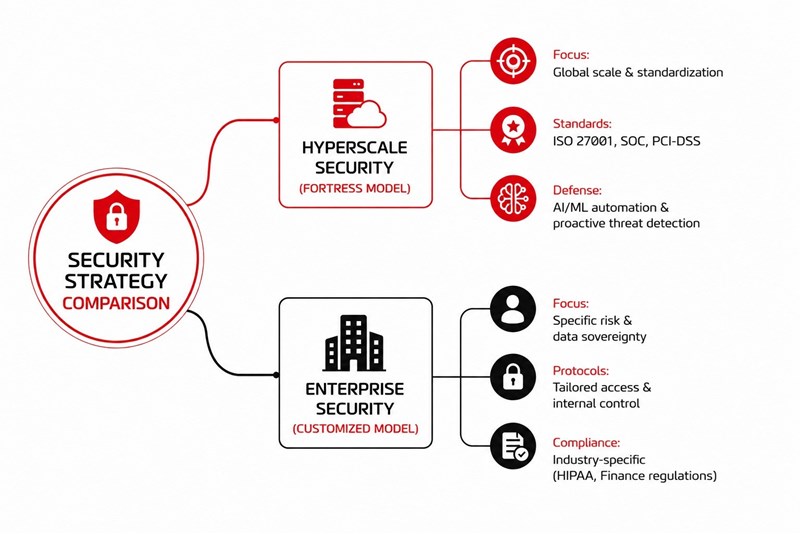
At Hyperscale data centers, security is built like a "fortress" with countless strict layers of protection:
- Physical & Cyber Security: Deploying multi-layers from biometric access control to the latest generation firewall systems.
- Strict international standards: Hyperscale units are required to comply with global certifications such as ISO 27001, SOC 1/2/3, and PCI-DSS to ensure data integrity for millions of customers.
- Proactive defense strategy: Applying AI and Machine Learning for Threat Detection and automating Incident Response processes as soon as signs of intrusion appear.
Security at Enterprise Data Centers
For Enterprise Data Centers, security is not just about complying with standards but also about addressing the specific risks of the organization itself:
- Customized protocols: Enterprises have full authority to establish specific access rules and security protocols, perfectly aligning with their internal operational processes.
- Protecting sensitive data: This is the top priority for units in the Finance, Banking, or Government sectors. Storing data at an Enterprise DC helps enterprises control the "flow" of data without relying on third parties.
- Vertical industry compliance: Focusing deeply on industry-specific regulations (e.g., HIPAA for Healthcare, State Bank regulations for Finance), ensuring all sensitive data remains in absolutely safe zones.
Choosing Hyperscale or Enterprise Data Center
Enterprise scale and growth rate
The expansion speed is the prerequisite factor when considering digital infrastructure. For businesses in an explosive stage, requiring high-performance computing capabilities and processing massive data volumes across borders, the Hyperscale Data Center model shows superior advantages thanks to its lightning-fast Scale-out capability.
Conversely, businesses with a moderate scale, stable data needs, and a focus on the domestic market should prioritize Enterprise Data Centers to ensure sustainability and certainty in operations.
Priority level for Security and Control
When weighing the comparison of Hyperscale vs Enterprise Data Center regarding security, enterprises need to clearly define the boundaries of control. Enterprise Data Center is the ideal choice for organizations that value absolute self-determination over physical infrastructure and specific security protocols of the financial or government sectors.
However, if an enterprise prioritizes economy and trusts the strict international standard multi-layered defense lines, Hyperscale will be a solution that brings peace of mind through readily available global security certifications.
Cloud ecosystem integration capability
The digital transformation roadmap and cloud computing integration directly affect infrastructure choices. Hyperscale data centers are inherently designed to be perfectly compatible with Cloud-native architectures, making the transition of workloads between physical and cloud environments seamless.
Meanwhile, Enterprise Data Centers are suitable for traditional Hybrid Cloud models, where businesses want to keep core applications on separate infrastructures but still want flexible connections to public cloud services when needed.
Budget and Operational Resources
Balancing finances and personnel is the final but extremely crucial step. Building and maintaining a Hyperscale Data Center requires massive investment capital and complex governance processes, usually only suitable for large technology corporations.
For Enterprise Data Centers, although construction costs may be lower, businesses need to prepare an in-depth internal technical team to directly operate and maintain. The final choice is a balancing act between initial investment costs and long-term system maintenance resources.
Conclusion
Ultimately, comparing Hyperscale vs Enterprise Data Center shows that each model has its own distinct advantages. Enterprises need to conduct a thorough analysis between benefits and risks before making a final decision.
Vcloudia Cloud Server – The Cloud You Can Count On
If you're concerned about the potential limitations of Cloud Servers, Cloud Server by Vcloudia is a reliable solution for businesses of all sizes. With a modern infrastructure and comprehensive customer support, Vcloudia delivers a cloud experience with:
- Powerful connectivity to ensure stable 24/7 access
- Advanced security standards, compliant with international certifications such as ISO 27001:2013, ISO 20000:2018, ISO 9001:2015
- Flexible pricing packages tailored to your specific business needs
- Expert technical support, making migration and system deployment fast, safe, and compatible
Contact information:
- Hotline: +855 888 55 66 08 (free of charge)
- Fanpage: https://www.facebook.com/vcloudia/
- Website: https://vcloudia.com
Featured news
Related news
What is a Snapshot? The Difference Between Snapshot and Backup
Snapshot is a familiar concept in data management and protection. In the context of the information technology boom, where data is a major asset for businesses, understanding Snapshots as well as their application is a key factor for enterprises to maximize technological efficiency.
What is a Firewall? The Role and Importance of Firewalls for Users
In the context of ever-increasing cyberattacks, system security has become a top priority for many enterprises. Alongside deploying antivirus software and controlling connection ports, firewalls are also considered a key solution to effectively enhance cybersecurity.
What is DDoS? Signs, Mitigation Strategies, and Effective Prevention
DDoS is a highly dangerous cyberattack that leaves severe consequences for enterprises. Therefore, gaining a clear understanding of DDoS attacks, as well as how to detect and prevent them, is a topic of significant interest to many.
What is a Trojan? How to Detect, Avoid, and Prevent It
A Trojan is a type of malicious code or software that can cause severe consequences to computer operations. So, what is a Trojan? How can you prevent a Trojan from infiltrating your computer? In the following article, Vcloudia will provide detailed information on these issues.
What is Cloud Backup? Classification, benefits, and limitations
Cloud Backup is a solution that plays an important role in backing up and recovering data when an incident occurs. So what exactly is Cloud Backup? Let's find out the details with Vcloudia in the following article.
What is Cloud Storage? Features and Benefits of Using It
Cloud Storage is the perfect storage solution alternative to bulky, space-consuming physical hard drives. So, what is Cloud Storage? Let's explore the details with Vcloudia through the following article.
What is an API? Characteristics and applications in website design
API, short for Application Programming Interface, is a concept no longer unfamiliar in the information technology field. So what exactly is an API and why is it so important? Let's find out with Vcloudia.
What is Node.js? Instructions on how to install Node.js on cPanel
Currently, it is easy to see that Node.js is being used by quite a lot of people. This is because Node.js can support users in running on multiple platforms and multiple devices.
What is Vultr VPS? Should you use Vultr VPS?
Vultr VPS is one of the best cloud storage solutions in the world. In this article, you will learn the concept: "What is Vultr VPS?", as well as understand its advantages and disadvantages.
Zoom Cloud Meeting: What is it? Basic Things You Should Know About Zoom Cloud Meeting
In 2020, Zoom Cloud Meeting became one of the leading video conferencing software applications. It allows you to virtually interact with colleagues when in-person meetings aren't possible, and it has also been very successful for social events.