



.png)


















.png)





Comparing CRAC vs CRAH Cooling Technologies: Which Solution to Choose for Your Data Center?
Jun 30, 2026In modern Data Centers, the cooling system is no longer a supporting factor but has become a decisive factor in performance, stability, and long-term operating costs. As rack density increases and server capacity constantly rises, choosing the appropriate cooling technology is a mandatory problem for every enterprise investing in IT infrastructure.
Among popular solutions, CRAC and CRAH are the two most mentioned technologies. However, not every Data Center is suitable for both. In this article, Vcloudia will explore the nature, pros, and cons of CRAC and CRAH with you so that you can make the most suitable choice.
Overview of Cooling Systems in Data Centers
A Data Center is a 24/7 continuous operating environment with a huge density of heat-generating equipment. Servers, networking equipment, and storage systems all generate high and stable heat over time. If not cooled effectively, rising temperatures will reduce processing performance, shorten hardware lifespan, and pose a risk of serious incidents.
An effective Data Center cooling system needs to simultaneously meet multiple requirements. Temperature must be precisely controlled within the allowable threshold, humidity must be stable to prevent condensation or static electricity, and the cold air flow must be evenly distributed to each server rack. In addition, the problem of energy saving is increasingly gaining attention as electricity costs account for a large proportion of the total operating costs of a Data Center. Therefore, cooling technologies such as CRAC and CRAH were born to meet these strict requirements at different Data Center scales.
Overview of CRAC
What is CRAC?
CRAC (Computer Room Air Conditioner) is a specialized air conditioning system for computer rooms and Data Centers. This is a traditional cooling technology, widely used since the early stages of the IT industry, and is still popular in many small and medium server rooms.
CRAC operates similarly to residential air conditioners but is specifically designed for continuous operation, precise control of temperature and humidity, suitable for the Data Center environment.
Operating Principle of CRAC Systems
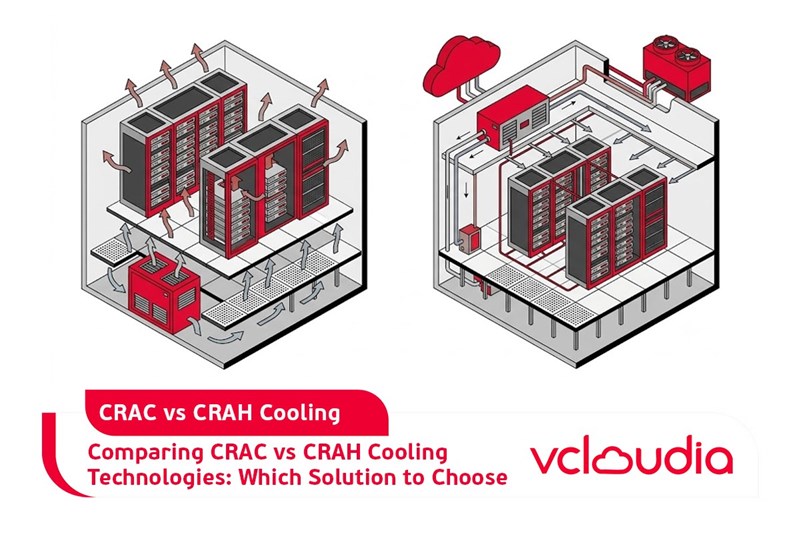
CRAC uses refrigerants to absorb heat from the hot air in the computer room. Hot air is drawn into the indoor unit, exchanges heat with the refrigerant, and then cold air is blown back into the room. The absorbed heat will be discharged to the outside environment through the outdoor unit. This entire process is closed and independent for each CRAC unit, making the system easy to deploy and operate.
Advantages of CRAC
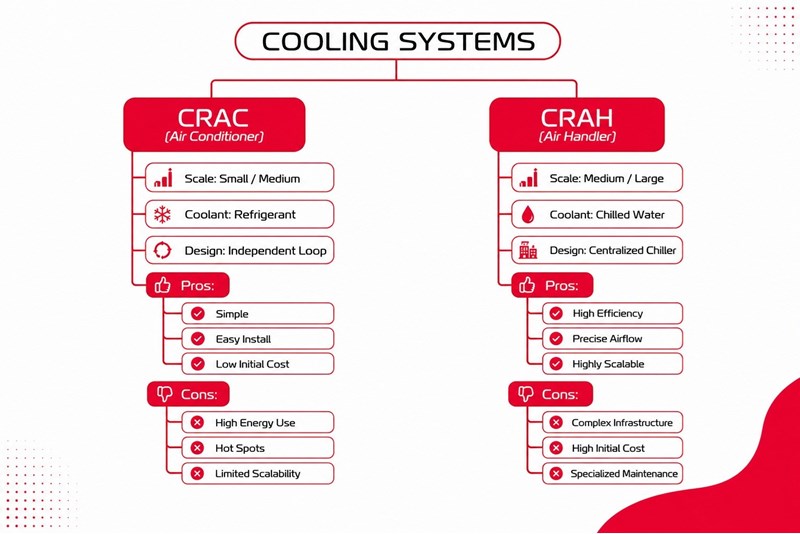
CRAC has a relatively simple design, is easy to install, and does not require complex supporting infrastructure. Due to its independent operation, this system is suitable for small-scale Data Centers, single server rooms, or IT environments that do not require exceptionally high cooling capacity. Furthermore, the initial investment cost of CRAC is usually lower than that of centralized cooling systems, helping businesses save budgets during the deployment phase.
Limitations of CRAC
The biggest limitation of CRAC lies in its energy efficiency. The use of compressors and refrigerants causes the system to consume a lot of electricity, especially when it has to operate continuously at high capacity. When rack density increases, it is difficult for CRAC to ensure even distribution of cold air, making local hot spots prone to occur. Besides, the scalability of CRAC is quite limited. As the Data Center expands in scale, adding many individual CRAC units will increase complexity in management and operation.
Overview of CRAH
What is CRAH?
CRAH (Computer Room Air Handler) is an air handling system for Data Centers, typically used in medium and large-scale data centers. Unlike CRAC, CRAH does not directly cool using refrigerants but uses chilled water supplied from a centralized cooling system. CRAH is considered a more modern cooling solution, suitable for Data Centers requiring high performance and flexible scalability.
Operating Principle of CRAH Systems
CRAH draws hot air from the computer room and passes it through a heat exchange coil using chilled water. Heat from the air is transferred to the chilled water, and then the hot water returns to the chiller system to be cooled again. The cooled air will be distributed back to the Data Center via a raised floor or duct system. By separating the cooling and air handling processes, CRAH helps optimize performance and reduce energy consumption.
Advantages of CRAH
The most prominent advantage of CRAH is its high energy efficiency. Using chilled water instead of refrigerants helps the system operate stably, saves electricity, and is suitable for high-density Data Centers. CRAH also allows for more precise airflow control, easily integrating with advanced cooling models such as hot aisle - cold aisle, in-row cooling, or containment. Flexible scalability makes CRAH a popular choice in large-scale and hyperscale Data Centers.
Limitations of CRAH
The limitations of CRAH lie in its initial investment costs and design complexity. This system requires chilled water infrastructure, chillers, piping, and appropriate technical space. Operation and maintenance also require a highly specialized technical team. Therefore, CRAH is usually not the optimal choice for small server rooms or businesses with limited budgets.
Comparing CRAC vs CRAH Cooling Technologies
When Should You Use CRAC?
CRAC is suitable for small server rooms, limited-scale Data Centers, or businesses just starting to invest in IT infrastructure. When rack density is not yet high and cooling requirements are not too complex, CRAC provides a fast, low-cost, and easy-to-deploy solution. CRAC is also a reasonable choice in environments requiring high flexibility, where chilled water infrastructure is not available or investing in a complex centralized cooling system is not desired.
When Should You Use CRAH?
CRAH is the ideal solution for large-scale Data Centers, commercial data centers, Cloud Data Centers, or systems requiring long-term stable operation. When server density is high, heat load is large, and energy saving is a top priority, CRAH delivers outstanding efficiency.
Furthermore, Data Centers aiming for green standards, reducing PUE, and optimizing long-term operating costs often prioritize deploying CRAH combined with advanced cooling technologies.
Should You Choose CRAC or CRAH for Your Data Center?
The choice between CRAC and CRAH depends on many factors such as Data Center scale, investment budget, expansion orientation, and energy optimization goals. For small server rooms, CRAC remains a reasonable solution. Conversely, if a business is building a modern Data Center, aiming for long-term expansion, CRAH is the strategic choice. Most importantly, the cooling system must be synchronously designed with the overall architecture of the Data Center to ensure performance and sustainability.
Conclusion
CRAC and CRAH are both important cooling technologies in Data Centers, each solution having its own advantages and being suitable for different scenarios. Clearly understanding the difference between CRAC vs CRAH helps businesses avoid wrong decisions, optimize investment costs, and ensure the IT infrastructure operates stably in the long term.
Looking for a high-performance, secure solution?
Explore the services offered by Vcloudia – a leading provider of Cloud Computing and Data Center solutions. Contact us for expert consultation and find the right model for your needs:
- Hotline: +855 888 55 66 08 (free of charge)
- Fanpage: https://www.facebook.com/vcloudia/
- Website: https://vcloudia.com
Featured news
Related news
What is a Snapshot? The Difference Between Snapshot and Backup
Snapshot is a familiar concept in data management and protection. In the context of the information technology boom, where data is a major asset for businesses, understanding Snapshots as well as their application is a key factor for enterprises to maximize technological efficiency.
What is a Firewall? The Role and Importance of Firewalls for Users
In the context of ever-increasing cyberattacks, system security has become a top priority for many enterprises. Alongside deploying antivirus software and controlling connection ports, firewalls are also considered a key solution to effectively enhance cybersecurity.
What is DDoS? Signs, Mitigation Strategies, and Effective Prevention
DDoS is a highly dangerous cyberattack that leaves severe consequences for enterprises. Therefore, gaining a clear understanding of DDoS attacks, as well as how to detect and prevent them, is a topic of significant interest to many.
What is a Trojan? How to Detect, Avoid, and Prevent It
A Trojan is a type of malicious code or software that can cause severe consequences to computer operations. So, what is a Trojan? How can you prevent a Trojan from infiltrating your computer? In the following article, Vcloudia will provide detailed information on these issues.
What is Cloud Backup? Classification, benefits, and limitations
Cloud Backup is a solution that plays an important role in backing up and recovering data when an incident occurs. So what exactly is Cloud Backup? Let's find out the details with Vcloudia in the following article.
What is Cloud Storage? Features and Benefits of Using It
Cloud Storage is the perfect storage solution alternative to bulky, space-consuming physical hard drives. So, what is Cloud Storage? Let's explore the details with Vcloudia through the following article.
What is an API? Characteristics and applications in website design
API, short for Application Programming Interface, is a concept no longer unfamiliar in the information technology field. So what exactly is an API and why is it so important? Let's find out with Vcloudia.
What is Node.js? Instructions on how to install Node.js on cPanel
Currently, it is easy to see that Node.js is being used by quite a lot of people. This is because Node.js can support users in running on multiple platforms and multiple devices.
What is Vultr VPS? Should you use Vultr VPS?
Vultr VPS is one of the best cloud storage solutions in the world. In this article, you will learn the concept: "What is Vultr VPS?", as well as understand its advantages and disadvantages.
Zoom Cloud Meeting: What is it? Basic Things You Should Know About Zoom Cloud Meeting
In 2020, Zoom Cloud Meeting became one of the leading video conferencing software applications. It allows you to virtually interact with colleagues when in-person meetings aren't possible, and it has also been very successful for social events.