



.png)

















.png)





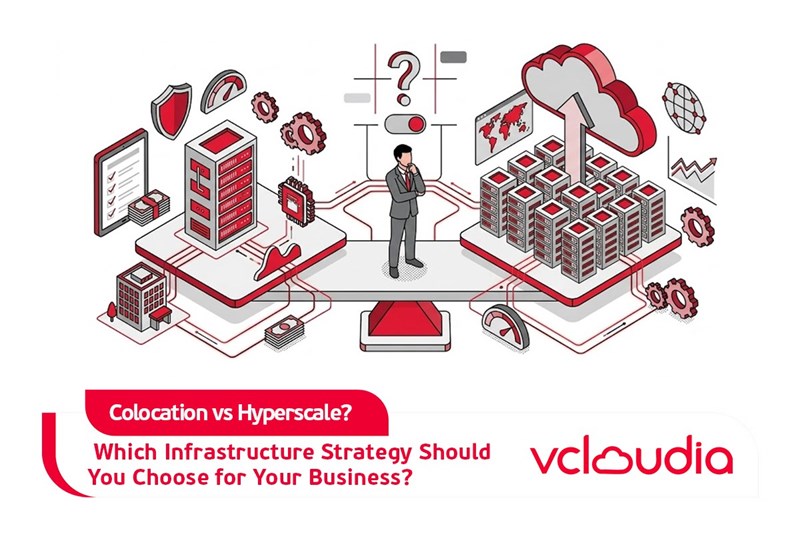
Colocation vs Hyperscale? Which Infrastructure Strategy Should You Choose for Your Business?
Jun 30, 2026In the era of big data, choosing the right storage infrastructure is a strategic decision for every business. Faced with the challenge of optimizing costs and scalability, the tech community often weighs two core models: colocation vs. hyperscale.
In this article, Vcloudia will provide a detailed analysis of the differences between self-managing equipment in a shared space and the power of hyperscale data centers, helping you find the perfect infrastructure launchpad for your project.
What is Colocation?
A Colocation Data Center, or "Colo" for short, is a shared infrastructure model where businesses rent physical space to house their own IT equipment. You can think of this as renting a high-end apartment for your servers instead of having to invest capital to build and operate an entire building of your own.
In a Colocation environment, multiple businesses share an infrastructure space, but each entity retains full ownership and management of its hardware devices. The service provider is responsible for maintaining essential foundational elements such as power, cooling systems, and strict security layers. This is an optimal solution for organizations that want absolute control over their data without spending resources on physical infrastructure management.
Key Advantages of Colocation
Choosing Colocation offers a perfect balance between autonomy and the ability to optimize operational costs:
- Absolute Ownership and Control: Businesses have full decision-making power over hardware configurations, operating system choices, and the setup of in-depth security protocols. You are the only one holding the keys and direct access to your physical data.
- Infrastructure Investment Savings: Building an international-standard data center requires millions of dollars in capital. Colocation helps you eliminate this massive investment, converting fixed capital expenditure (CAPEX) into more flexible monthly operational expenditure (OPEX).
- High Stability and Reliability: Your servers will benefit from redundant power systems (UPS/Generators), specialized fire suppression systems, and multi-homed internet connectivity. This ensures your website or application always operates 24/7 with the highest availability.
Limitations to Consider
Despite its many advantages, this model also presents certain logistical and personnel challenges:
- Scalability Speed Depends on Hardware: Unlike virtualization solutions, when you want to increase storage or processing scale, you must go through the process of purchasing, transporting, and installing physical equipment into racks. This can cause certain delays in responding to immediate growth needs.
- Requires Internal Technical Expertise: Because the provider only supports the general infrastructure, your business is required to have a highly skilled team of engineers to self-manage, maintain, and handle incidents arising on individual server systems.
What is Hyperscale?
Hyperscale is a concept used to describe extremely large-scale data centers with the ability to automate and scale resources almost infinitely through advanced virtualization technology. Unlike traditional server rooms, Hyperscale infrastructure is designed based on a robust distributed architecture, allowing the system to flexibly increase processing capacity without disrupting ongoing services. This is the core foundation behind the power of global tech giants when serving billions of users simultaneously.
The Superior Power of Large-Scale Data Centers
Applying the Hyperscale model brings advantages in speed and performance that older architectures cannot match:
- Instant Scalability: The system allows businesses to scale up thousands of virtual servers in just minutes through automated software commands. This helps you react extremely quickly to sudden traffic spikes without waiting for time-consuming physical hardware installation processes.
- Processing Performance Optimization: Thanks to uniform hardware and software architecture, Hyperscale becomes an ideal environment for processing massive workloads such as Big Data analytics, Artificial Intelligence (AI), and Machine Learning.
- Economies of Scale: Service providers leverage efficiency from purchasing and operating massive infrastructure to reduce the cost of resources per unit used. This helps businesses access high-end computing power at a much more optimized cost compared to investing on their own.
Technical Weaknesses to Note
Despite its impressive power, this model still has certain barriers that managers need to consider:
- High Dependency: When using this infrastructure, the business has absolutely no control over the underlying physical hardware layer. All maintenance, upgrades, or equipment configurations are handled by the provider, sometimes creating a lack of transparency regarding specific security requirements.
- Vendor Lock-in Risk: Because each Hyperscale provider usually uses its own separate set of tools and management interfaces, businesses will encounter many difficulties and costs if they want to migrate their entire data or applications to another platform in the future.
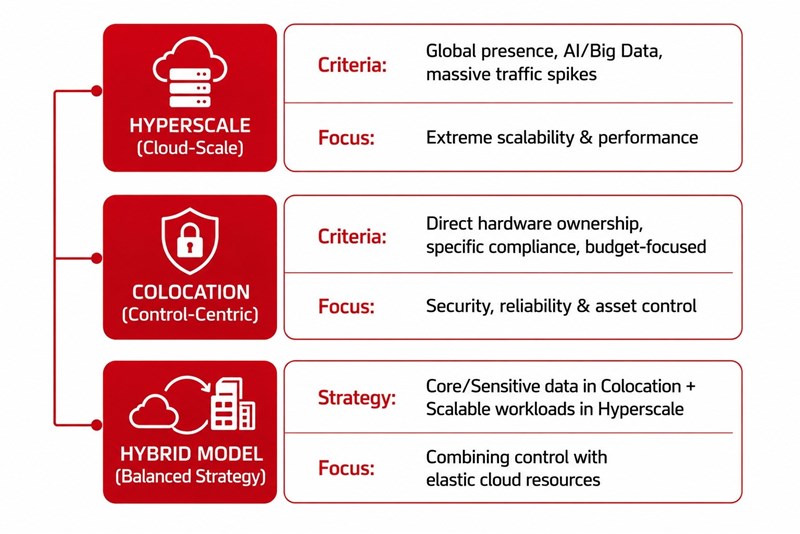
Detailed Comparison: Colocation vs. Hyperscale
Although both solutions support data storage and processing, they operate according to completely different philosophies. Below is a quick comparison table for your overview:
Which is the right choice for your business?
The final decision depends on the actual needs of the project:
Choose Hyperscale if:
- Your business operates on a global scale.
- You need to process huge amounts of data daily.
- You rely on the Cloud or advanced AI technologies.
- You frequently face sudden traffic growth spikes.
Choose Colocation if:
- You want to retain direct control over IT equipment.
- You are a small or medium-sized business with a limited budget.
- You need a secure, reliable space for individual servers.
- You do not require the extreme scalability of the large data center model.
Hybrid Model - The Perfect Combination
Many companies today are prioritizing the use of a hybrid model. They store sensitive, core data at Colocation facilities to ensure privacy, while using Hyperscale for cloud applications that need flexible scaling. This approach helps you leverage the strengths of both worlds: control and scalability.
Frequently Asked Questions (FAQ) about Colocation and Hyperscale
Should small and medium-sized businesses invest in Hyperscale?
Generally, it is not necessary. Hyperscale architecture is designed to serve global technology corporations, large e-commerce platforms, or applications that process massive data. For small and medium-sized businesses, using Colocation services combined with standard virtualization server packages will help optimize budgets more effectively while still ensuring good operational performance.
Is the transition from Colocation to a Hyperscale platform complex?
Migrating the entire system from physical servers to large-scale infrastructure requires a thorough planning strategy. The technical team needs to re-evaluate the software structure, package applications, and set up secure data transmission protocols. To minimize risks, many organizations often apply a partial migration strategy, starting by building a Hybrid model before moving to a fully Hyperscale platform.
Which model provides better data security?
Both models comply with the strictest information security standards but approach it from two different directions. Colocation gives you the privilege of controlling physical hardware and the freedom to set up firewall systems as you wish. Conversely, Hyperscale possesses an extremely powerful automated cybersecurity defense system to counter large-scale attacks, but you are forced to entrust the entire physical security layer to the provider.
Can I use both models together?
Absolutely. In fact, the Hybrid IT model is currently the most popular architectural trend. You can place servers containing core financial data and sensitive customer information at Rated 3 standard Colocation centers to ensure privacy, while running user-interactive web applications on a Hyperscale platform to take advantage of automatic scaling when traffic increases.
Conclusion
The decision to choose between these two infrastructure platforms depends entirely on the development strategy and the nature of your project's data. If your project requires massive computing power and limitless scalability for global applications, large data centers are the inevitable path. Conversely, if security, control over physical hardware, and budget optimization are top priorities, shared storage space is the most perfect piece of the puzzle.
Vcloudia Cloud Server – The Cloud You Can Count On
If you're concerned about the potential limitations of Cloud Servers, Cloud Server by Vcloudia is a reliable solution for businesses of all sizes. With a modern infrastructure and comprehensive customer support, Vcloudia delivers a cloud experience with:
- Powerful connectivity to ensure stable 24/7 access
- Advanced security standards, compliant with international certifications such as ISO 27001:2013, ISO 20000:2018, ISO 9001:2015
- Flexible pricing packages tailored to your specific business needs
- Expert technical support, making migration and system deployment fast, safe, and compatible
Contact information:
- Hotline: +855 888 55 66 08 (free of charge)
- Fanpage: https://www.facebook.com/vcloudia/
- Website: https://vcloudia.com
Featured news
Related news
What is a Snapshot? The Difference Between Snapshot and Backup
Snapshot is a familiar concept in data management and protection. In the context of the information technology boom, where data is a major asset for businesses, understanding Snapshots as well as their application is a key factor for enterprises to maximize technological efficiency.
What is a Firewall? The Role and Importance of Firewalls for Users
In the context of ever-increasing cyberattacks, system security has become a top priority for many enterprises. Alongside deploying antivirus software and controlling connection ports, firewalls are also considered a key solution to effectively enhance cybersecurity.
What is DDoS? Signs, Mitigation Strategies, and Effective Prevention
DDoS is a highly dangerous cyberattack that leaves severe consequences for enterprises. Therefore, gaining a clear understanding of DDoS attacks, as well as how to detect and prevent them, is a topic of significant interest to many.
What is a Trojan? How to Detect, Avoid, and Prevent It
A Trojan is a type of malicious code or software that can cause severe consequences to computer operations. So, what is a Trojan? How can you prevent a Trojan from infiltrating your computer? In the following article, Vcloudia will provide detailed information on these issues.
What is Cloud Backup? Classification, benefits, and limitations
Cloud Backup is a solution that plays an important role in backing up and recovering data when an incident occurs. So what exactly is Cloud Backup? Let's find out the details with Vcloudia in the following article.
What is Cloud Storage? Features and Benefits of Using It
Cloud Storage is the perfect storage solution alternative to bulky, space-consuming physical hard drives. So, what is Cloud Storage? Let's explore the details with Vcloudia through the following article.
What is an API? Characteristics and applications in website design
API, short for Application Programming Interface, is a concept no longer unfamiliar in the information technology field. So what exactly is an API and why is it so important? Let's find out with Vcloudia.
What is Node.js? Instructions on how to install Node.js on cPanel
Currently, it is easy to see that Node.js is being used by quite a lot of people. This is because Node.js can support users in running on multiple platforms and multiple devices.
What is Vultr VPS? Should you use Vultr VPS?
Vultr VPS is one of the best cloud storage solutions in the world. In this article, you will learn the concept: "What is Vultr VPS?", as well as understand its advantages and disadvantages.
Zoom Cloud Meeting: What is it? Basic Things You Should Know About Zoom Cloud Meeting
In 2020, Zoom Cloud Meeting became one of the leading video conferencing software applications. It allows you to virtually interact with colleagues when in-person meetings aren't possible, and it has also been very successful for social events.