



.png)

















.png)





Can a Data Center be hacked? Real risks and ways to protect data centers
Jun 30, 2026In the context of strong digital transformation, Data Centers play the role of core infrastructure platforms for businesses. Therefore, the question "Can a Data Center be hacked?" is not merely technical but also directly relates to financial safety and brand reputation. The article below by Vcloudia will help you answer this question.
Can a Data Center be hacked?
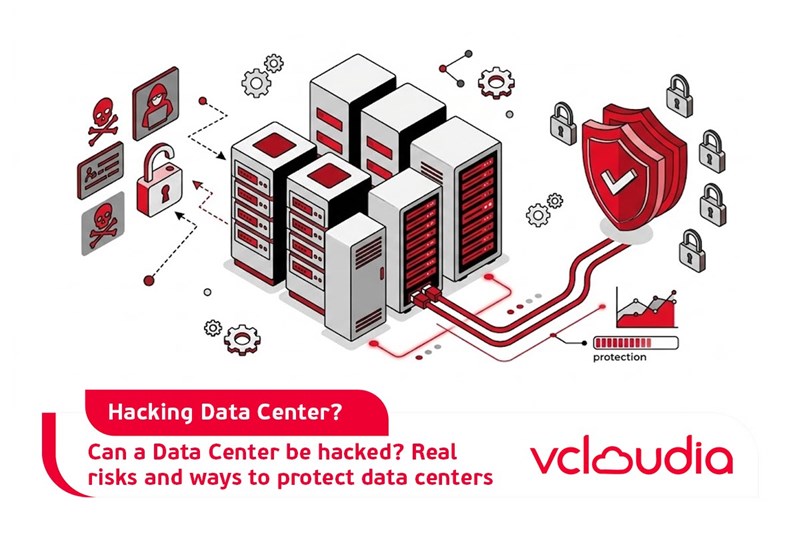
The answer is yes. No technological system is completely immune to cybersecurity threats. However, the risk level of a Data Center is significantly lower than that of conventional IT infrastructure if it is designed to high security standards.
The concept of hacking a Data Center is not simply about breaking into a server room. Attacks can occur at many different layers, such as the network layer, operating system layer, virtualization management layer, human layer, and even the physical security layer. A small vulnerability in any layer can become the starting point for a large-scale attack. Modern Data Centers often apply a multi-tier defense model. However, if the access control process is not strict or the system is not updated with security patches in a timely manner, the risk of exploitation still exists.
In what ways can hackers attack a Data Center?
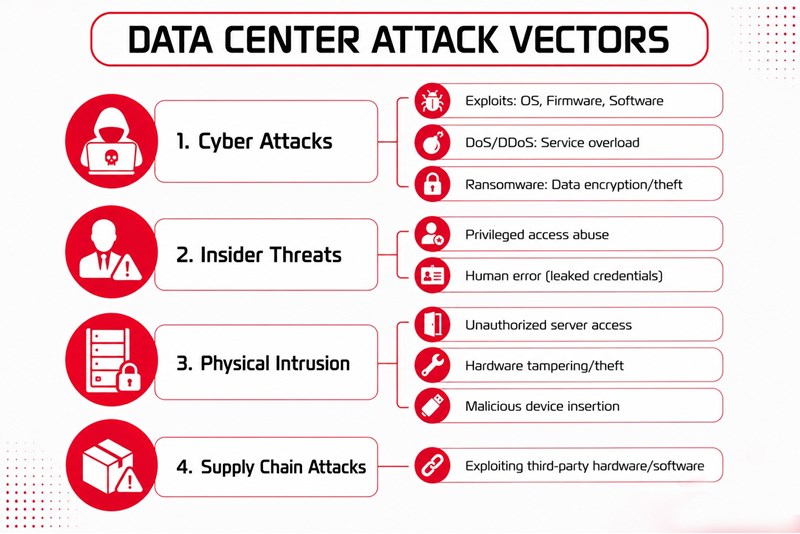
Cyber Attack
Cyber attack is the most common form when it comes to Data Centers being hacked. Hackers can exploit vulnerabilities in the operating system, management software, or network device firmware to seize control. Distributed denial-of-service attacks can overload the system, causing widespread service disruption.
In addition, ransomware can infiltrate the system through stolen accounts or misconfigurations. Once inside the internal network environment, the attacker can spread to storage systems or virtualization servers, causing serious impacts on the entire infrastructure.
Insider Threat
Not all threats come from the outside. Internal personnel with high access privileges who abuse their privileges or accidentally leak login information can also create major risks. In some cases, sharing admin accounts or failing to comply with security procedures makes the system vulnerable to intrusion without requiring overly complex techniques. The human element is always a sensitive link in the security chain. Therefore, controlling access privileges and monitoring privileged user behavior are mandatory requirements.
Physical Intrusion
Besides cyber attacks, physical intrusion is also a notable hazard. If an unauthorized individual gains access to the server area, they could plug malicious devices into the network system or steal storage drives containing critical data. In severe situations, hardware sabotage can cause a disruption of the entire service. Thus, physical protection layers such as multi-tier access control, surveillance cameras, and entry/exit logging play an essential role.
Supply Chain Attack
Another dangerous trend is attacking through the supply chain. Instead of direct intrusion, hackers can exploit vulnerabilities from software, hardware suppliers, or technical partners. When a system is deployed based on a component that has been pre-installed with malware, detection will become much more difficult. Strictly controlling suppliers and conducting periodic security assessments is the way to mitigate risks from this form of attack.
Which systems in a Data Center are prone to becoming targets?
In a data center, not every component has the same level of risk. Infrastructure management systems, if hijacked, can affect the entire operating environment. Virtualization management servers play the role of coordinating resources, so they often become a priority target for hackers.
Storage systems containing critical data are also common points of attack. If core network devices are compromised, attackers can control data flows and cause widespread disruptions. Additionally, backup systems and disaster recovery data centers, if not adequately protected, can cause businesses to lose their ability to recover when an incident occurs.
Consequences if a Data Center is hacked
When a Data Center is hacked, the consequences do not just stop at the technical scope but also spread to business operations, legal matters, and brand image. Below are the severe consequences that businesses may face if a Data Center is successfully breached.
Widespread service disruption
Service disruption is the most noticeable consequence when a Data Center is attacked. When hackers exploit access to the core infrastructure, they can paralyze the server system, crash applications, or throttle network bandwidth. This leads to a widespread downtime situation, directly affecting end users.
For businesses operating online services such as digital banking, e-commerce, SaaS platforms, or electronic payment systems, just a few minutes of downtime can also cause massive revenue losses. Besides immediate losses, prolonged disruption also causes customers to switch to competitors' services. In the digital business environment, service continuity is a vital factor, so an incident at the Data Center can shake the entire operational strategy.
Sensitive data leakage
One of the most severe risks when a Data Center is hacked is data leakage. Data centers usually store customer information, financial data, transaction records, trade secrets, and many other critical digital assets. If hackers gain access to storage systems or virtualized environments, data can be copied, sold on the black market, or used for extortion purposes.
The consequences of data leakage do not only stop at direct financial damage. Businesses also have to face media crises, pressure from customers, and strict oversight from regulatory bodies. In many cases, data leakage incidents cause brands to take many years to recover their image.
Massive financial damage
The financial damage from an attack on a Data Center usually far exceeds the initial preventive investment costs. When an incident occurs, businesses must pay for security investigations, hiring digital forensic experts, restoring the system, and deploying additional security solutions.
If the incident involves ransomware, the business might have to pay a large ransom or accept data loss if there are no safe backups. Besides, compensation clauses in service contracts with customers can also increase costs. For Data Center or cloud service providers, SLA compensation for violating uptime commitments can be highly substantial.
Loss of brand reputation
Brand reputation is an intangible asset but holds long-term value. When a Data Center is hacked, especially if the incident is widely publicized, the trust of customers and partners will be severely affected. In a highly competitive environment, customers tend to choose providers with clear security commitments and a stable operating history.
A cybersecurity incident can result in a business being labeled as unsafe, thereby reducing the ability to sign new contracts or expand partnerships. Even when the system is completely restored, apprehension from customers can still linger for a long time. This is particularly severe for organizations operating in the financial, healthcare, or high-tech sectors, where the security factor is placed on top.
Legal compliance violations
Many industries are subject to strict regulations on data protection and information security. If a Data Center is hacked leading to a leak of personal data or financial information, the business may violate existing legal regulations. Consequences can include administrative fines, demands for damage compensation, and even suspension of operations in some serious cases. Moreover, the business might have to undergo additional audits or be subjected to special supervision from regulatory agencies for a long period.
Compliance is not only a legal requirement but also a factor that helps enhance reputation and reliability in the market. Therefore, when a Data Center is hacked resulting in compliance violations, the loss is not just financial but also directly impacts the long-term development strategy.
How to prevent a Data Center from being hacked
To limit the risk of being hacked, a data center needs to be designed following a multi-tier security model, combining technology and processes. Network segmentation helps isolate critical areas, while multi-factor authentication reduces the risk of account hijacking. Data encryption ensures that even if illegally accessed, the information remains unusable. Continuously operating security monitoring systems help early detection of abnormal behaviors and trigger incident response procedures.
In parallel with that, cybersecurity awareness training for employees and periodic penetration testing help strengthen overall defense capabilities. Data Center security is a continuous improvement process, not a deploy-once-and-maintain-fixed solution.
Conclusion
A Data Center can be hacked if vulnerabilities exist in its architecture or operational processes. However, with a comprehensive security strategy, compliance with international standards, and continuous monitoring, risks can be controlled at the lowest level.
Vcloudia Cloud Server – The Cloud You Can Count On
If you're concerned about the potential limitations of Cloud Servers, Cloud Server by Vcloudia is a reliable solution for businesses of all sizes. With a modern infrastructure and comprehensive customer support, Vcloudia delivers a cloud experience with:
- Powerful connectivity to ensure stable 24/7 access
- Advanced security standards, compliant with international certifications such as ISO 27001:2013, ISO 20000:2018, ISO 9001:2015
- Flexible pricing packages tailored to your specific business needs
- Expert technical support, making migration and system deployment fast, safe, and compatible
Contact information:
- Hotline: +855 888 55 66 08 (free of charge)
- Fanpage: https://www.facebook.com/vcloudia/
- Website: https://vcloudia.com
Featured news
Related news
What is a Snapshot? The Difference Between Snapshot and Backup
Snapshot is a familiar concept in data management and protection. In the context of the information technology boom, where data is a major asset for businesses, understanding Snapshots as well as their application is a key factor for enterprises to maximize technological efficiency.
What is a Firewall? The Role and Importance of Firewalls for Users
In the context of ever-increasing cyberattacks, system security has become a top priority for many enterprises. Alongside deploying antivirus software and controlling connection ports, firewalls are also considered a key solution to effectively enhance cybersecurity.
What is DDoS? Signs, Mitigation Strategies, and Effective Prevention
DDoS is a highly dangerous cyberattack that leaves severe consequences for enterprises. Therefore, gaining a clear understanding of DDoS attacks, as well as how to detect and prevent them, is a topic of significant interest to many.
What is a Trojan? How to Detect, Avoid, and Prevent It
A Trojan is a type of malicious code or software that can cause severe consequences to computer operations. So, what is a Trojan? How can you prevent a Trojan from infiltrating your computer? In the following article, Vcloudia will provide detailed information on these issues.
What is Cloud Backup? Classification, benefits, and limitations
Cloud Backup is a solution that plays an important role in backing up and recovering data when an incident occurs. So what exactly is Cloud Backup? Let's find out the details with Vcloudia in the following article.
What is Cloud Storage? Features and Benefits of Using It
Cloud Storage is the perfect storage solution alternative to bulky, space-consuming physical hard drives. So, what is Cloud Storage? Let's explore the details with Vcloudia through the following article.
What is an API? Characteristics and applications in website design
API, short for Application Programming Interface, is a concept no longer unfamiliar in the information technology field. So what exactly is an API and why is it so important? Let's find out with Vcloudia.
What is Node.js? Instructions on how to install Node.js on cPanel
Currently, it is easy to see that Node.js is being used by quite a lot of people. This is because Node.js can support users in running on multiple platforms and multiple devices.
What is Vultr VPS? Should you use Vultr VPS?
Vultr VPS is one of the best cloud storage solutions in the world. In this article, you will learn the concept: "What is Vultr VPS?", as well as understand its advantages and disadvantages.
Zoom Cloud Meeting: What is it? Basic Things You Should Know About Zoom Cloud Meeting
In 2020, Zoom Cloud Meeting became one of the leading video conferencing software applications. It allows you to virtually interact with colleagues when in-person meetings aren't possible, and it has also been very successful for social events.