



.png)



















.png)





Applications of Cloud Computing in Modern Logistics
Feb 27, 2026Cloud Computing is increasingly becoming a dominant trend in the digital era, contributing to operational efficiency optimization, enhanced competitiveness, and greater flexibility in management. In this article, together with Vcloudia, we will explore in depth the concepts, benefits, and challenges of integrating Cloud Computing into modern Logistics. Through this, readers will gain a comprehensive understanding of the role and impact of Cloud Computing on today’s global supply chains.
Overview of Cloud Computing
Cloud Computing is a model for delivering information technology services via the Internet without requiring enterprises to own or maintain their own physical infrastructure. It enables users to access data and applications anytime, anywhere, across multiple devices, thereby supporting continuous and flexible business operations.
Cloud Computing has become an essential component of digital transformation strategies for businesses worldwide. Common service models such as Infrastructure as a Service (IaaS), Platform as a Service (PaaS), and Software as a Service (SaaS) offer optimized resource utilization, cost reduction, and enhanced flexibility. The evolution of cloud computing has led to the emergence of various deployment models to meet the diverse needs of different industries, particularly the logistics sector.
Cloud Computing not only improves management efficiency for logistics enterprises but also enables them to adapt quickly to rapid changes in markets and customer demands. This integration opens new opportunities for managers to optimize processes and enhance customer experience.
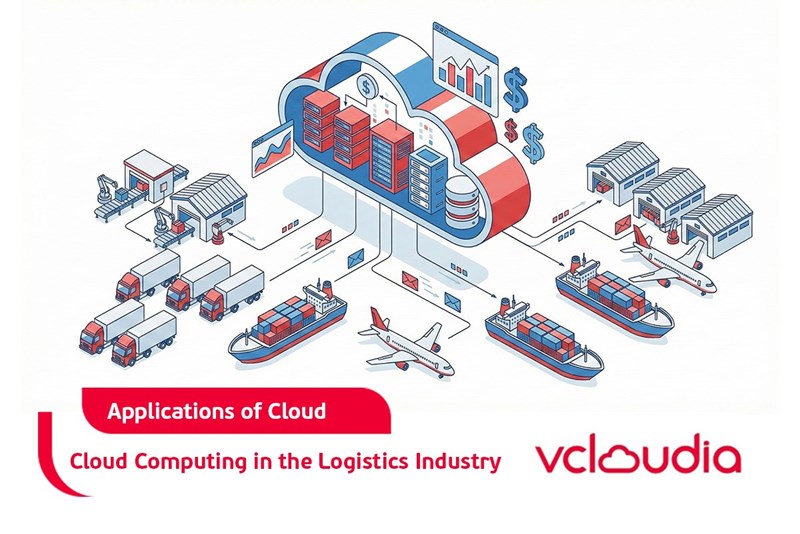
Overview of the Logistics Industry
The logistics industry, or supply chain management, involves managing the flow of goods, services, information, and financial resources from the point of origin to the end consumer. It plays a central role in facilitating production and consumption activities and contributes significantly to global economic growth.
With the rapid development of e-commerce, digital technologies, and globalization, the logistics industry has become more complex than ever. Activities such as warehouse management, transportation, forecasting, tracking, and monitoring require high levels of accuracy, timeliness, and transparency to ensure operational efficiency. Today, logistics enterprises face numerous challenges in process optimization, cost reduction, customer service improvement, and rapid adaptation to emerging trends.
To meet these demands, businesses have increasingly adopted digital technologies to enhance competitiveness, with Cloud Computing being one of the core solutions. Alongside this, the integration of technologies such as IoT, Big Data, and AI has become a key success factor in the logistics industry.
Why Does the Logistics Industry Need Cloud Computing?
Logistics is inherently characterized by interconnected processes that require close coordination among departments and service providers. Therefore, adopting Cloud Computing has become an inevitable requirement to ensure smooth, continuous, and highly feasible operations.
In an increasingly competitive environment, logistics enterprises must leverage technology to minimize risks, enhance operational efficiency, and optimize costs. At the same time, digital transformation trends demand high capabilities in real-time data processing and flexible IT system scalability. These factors explain why the logistics industry must adopt Cloud Computing on a broad scale.
Moreover, cloud-based infrastructure and services allow logistics enterprises to easily scale operations up or down according to different development stages without significant investment in hardware. This not only reduces costs but also optimizes resource utilization and enhances flexibility in managing and operating the entire supply chain.
The Role of Cloud Computing in Modern Logistics
Integrating Cloud Computing into logistics is ushering in a new era, accelerating speed, flexibility, and accuracy in supply chain management activities. The key roles of this technology are clearly reflected in process optimization, enhanced forecasting capabilities, and more customer-centric solutions.
Cloud Computing plays a central role in delivering solutions to challenges related to operations, forecasting, monitoring, and decision-making. With real-time data integration and analytics capabilities, enterprises can rapidly and accurately adjust strategies and optimize workflows. As a result, the logistics industry is no longer constrained by physical infrastructure limitations or large-scale data processing barriers.
Furthermore, cloud platforms facilitate collaboration and data sharing among logistics enterprises, promoting cross-industry coordination and improving overall service quality. As technology continues to evolve, Cloud Computing is becoming increasingly indispensable to the logistics industry.
Cloud Deployment Models in the Logistics Industry
Cloud deployment models in the logistics industry are diverse, catering to different enterprise sizes, objectives, and budgets. The most common models include Public Cloud, Private Cloud, Hybrid Cloud, and Multi-Cloud. Each model has its own advantages and limitations, addressing specific technical and strategic requirements.
In practice, many logistics enterprises adopt a Hybrid Cloud model to leverage the benefits of both Public Cloud (cost efficiency and scalability) and Private Cloud (enhanced security and control). Additionally, multi-cloud strategies improve redundancy, minimize risks, and provide flexible expansion of technological resources, enabling enterprises to adopt new technologies without infrastructure or security constraints.
Deployment choices also depend on data requirements, operational characteristics, and long-term development strategies. Startups may prefer Public Cloud solutions for cost efficiency and ease of adoption, while large enterprises with high security requirements often prioritize Private or Hybrid Cloud models to better manage sensitive data.
Applications of Cloud Computing in the Logistics Industry
Applying Cloud Computing in logistics delivers significant benefits and creates new business opportunities. From warehouse and transportation management to tracking, monitoring, and predictive analytics, cloud technology enhances operational capability and efficiency.
1. Warehouse Management
Warehouse management is one of the most complex areas without technological support. With Cloud Computing, enterprises can build centralized warehouse management systems that allow real-time access to inventory data from anywhere. This reduces losses, prevents overstocking or stockouts, and improves customer service levels.
Cloud-based Warehouse Management Systems (WMS) enable managers to update item locations, automatically synchronize data across departments, and flexibly control access permissions. These systems also support demand-based inventory forecasting and adjustments, optimizing operational processes and reducing costs.
2. Transportation Management
In transportation, route optimization, vehicle tracking, and order management are essential to ensuring on-time delivery and minimizing fuel costs. Cloud Computing enables intelligent Transportation Management Systems (TMS) that continuously update delivery status and support efficient dispatching.
Cloud-based solutions connect vehicles with control centers in real time, allowing optimized load allocation, accurate ETA predictions, and rapid incident handling. As a result, logistics enterprises can respond flexibly, improve service quality, and significantly reduce operational expenses.
3. Tracking and Monitoring
Continuous tracking and monitoring in logistics has become increasingly complex. Cloud Computing enables IoT systems to collect data from sensors, GPS devices, and surveillance cameras and transmit it to cloud-based processing centers, providing real-time visibility for managers.
This comprehensive monitoring capability allows timely issue detection, minimizes losses, and enhances safety for goods, vehicles, and personnel. Cloud platforms also support automated alerts, risk analysis, and optimization solutions, improving overall supply chain efficiency.
4. Supply Chain Management
Cloud Computing enables data integration across multiple sources throughout the supply chain, enhancing collaboration among stakeholders. Real-time data sharing reduces delays, identifies bottlenecks, and optimizes supply chain processes.
Cloud-based supply chain management systems support demand forecasting, inventory optimization, resource balancing, risk reduction, and operational continuity. From procurement to final distribution, enterprises can make faster, more accurate, and more effective decisions.
5. Analytics and Forecasting
Big Data is one of Cloud Computing’s key strengths, enabling logistics enterprises to conduct advanced analytics for trend forecasting, strategy optimization, and risk mitigation. By leveraging AI and Machine Learning tools on cloud platforms, enterprises can accurately predict demand, delivery times, and emerging market trends.
Cloud-based analytics systems also support scenario planning, flexible decision-making, and data-driven strategies, reducing losses and expanding growth opportunities. This capability forms the foundation for both short-term and long-term competitiveness in the logistics industry.
6. IoT Integration
Integrating IoT into logistics systems via cloud platforms is an inevitable trend. Sensors, RFID, and GPS devices connected through the cloud enable automated, accurate, and continuous data collection, forming a solid foundation for efficient management.
IoT supports automated alerts, operational optimization, error reduction, and enhanced transparency across the supply chain. Additionally, cloud scalability allows enterprises to easily integrate new devices, continuously improving operational performance.
Benefits of Applying Cloud Computing in Logistics
Adopting cloud technology not only optimizes current logistics operations but also unlocks opportunities for innovation and sustainable growth.
1. Enhanced Flexibility
In a highly dynamic and competitive environment, adaptability is critical. Cloud Computing allows enterprises to easily adjust, upgrade, or scale IT resources based on actual needs without heavy investments in hardware or software.
Cloud systems support both vertical and horizontal scalability, enabling rapid responses to changes in scale or processes. This is particularly valuable during peak seasons, holidays, or market expansion, ensuring uninterrupted operations.
2. Scalability
As enterprises grow, expanding IT infrastructure can be time-consuming and costly. Cloud Computing enables seamless resource expansion without building new infrastructure, saving both time and cost.
Modern cloud platforms offer automatic capacity scaling and on-demand services, helping enterprises quickly adapt to market changes while maintaining cost control and budget optimization.
3. Cost Optimization
One of the most significant benefits of Cloud Computing is reduced operational and upfront investment costs. Instead of spending on hardware, software, maintenance, technical staff, and infrastructure, enterprises pay only for the services they actually use.
Usage-based pricing simplifies budgeting and minimizes financial risks from inefficient investments. Additionally, automation reduces manpower requirements and improves productivity, leading to higher profitability.
4. Real-Time Data Access
In logistics, real-time visibility and responsiveness are critical. Cloud Computing enables instant data access and sharing via the Internet, empowering managers with accurate, timely information for decision-making.
This capability improves inventory control, transportation management, forecasting, and emergency handling, ensuring smooth operations, reduced downtime, and improved customer satisfaction.
5. Data Security and Disaster Recovery
Information security and data recovery are vital, especially in logistics where large volumes of sensitive data are processed. Modern cloud platforms integrate advanced security measures to protect data from cyber threats.
Automatic data backup and recovery minimize the risk of data loss due to natural disasters, technical failures, or other incidents. This ensures business continuity, strengthens customer trust, and maintains enterprise credibility.
Challenges in Implementing Cloud Computing in Logistics
Despite its benefits, transitioning to Cloud Computing presents challenges. Logistics enterprises must address issues related to data security, legacy system integration, skills shortages, and cost management during implementation.
Data security and privacy are major concerns when storing information in the cloud. Enterprises must select reputable service providers and develop appropriate security strategies to prevent cyberattacks and data breaches. Integrating legacy systems with modern platforms also poses challenges, particularly for organizations with long-established infrastructures.
Additionally, a shortage of skilled cloud and data analytics professionals may delay implementation. Initial investment costs can also raise budget concerns, especially during early adoption stages.
Future Development Trends
In the near future, Cloud Computing will continue to evolve alongside trends such as Artificial Intelligence (AI), Internet of Things (IoT), and Big Data analytics. Logistics enterprises will enter a phase of high automation, optimized data processing, and enhanced customer experience.
Cloud platforms will become more integrated and comprehensive, supporting advanced forecasting, transportation optimization, automated warehouse management, and IoT-based monitoring. Blockchain technology is also expected to play a crucial role in ensuring security and transparency in international trade transactions.
Enterprises must proactively adapt and invest in new technologies to remain competitive. A well-defined digital transformation strategy will determine success or failure as technology becomes increasingly central to the logistics industry.
Conclusion
The application of Cloud Computing in the logistics industry has clearly demonstrated its role in driving growth, efficiency, and competitiveness. From warehouse and transportation management to tracking, monitoring, and predictive analytics, cloud technology enables comprehensive optimization.
Although challenges remain, digital transformation in logistics is irreversible. Enterprises must actively update, invest, and develop appropriate strategies to fully harness the potential of Cloud Computing. In an increasingly competitive global market, successful adoption of this technology will define an enterprise’s position and future growth.
Looking for a high-performance, secure solution?Explore the services offered by Vcloudia – a leading provider of cloud computing and data center solutions. Contact us for expert consultation and find the right model for your needs:
- Hotline: +855 888 55 66 08 (free of charge)
- Fanpage: https://www.facebook.com/vcloudia/
- Website: https://vcloudia.com
Featured news
Related news
What is a Snapshot? The Difference Between Snapshot and Backup
Snapshot is a familiar concept in data management and protection. In the context of the information technology boom, where data is a major asset for businesses, understanding Snapshots as well as their application is a key factor for enterprises to maximize technological efficiency.
What is a Firewall? The Role and Importance of Firewalls for Users
In the context of ever-increasing cyberattacks, system security has become a top priority for many enterprises. Alongside deploying antivirus software and controlling connection ports, firewalls are also considered a key solution to effectively enhance cybersecurity.
What is DDoS? Signs, Mitigation Strategies, and Effective Prevention
DDoS is a highly dangerous cyberattack that leaves severe consequences for enterprises. Therefore, gaining a clear understanding of DDoS attacks, as well as how to detect and prevent them, is a topic of significant interest to many.
What is a Trojan? How to Detect, Avoid, and Prevent It
A Trojan is a type of malicious code or software that can cause severe consequences to computer operations. So, what is a Trojan? How can you prevent a Trojan from infiltrating your computer? In the following article, Vcloudia will provide detailed information on these issues.
What is Cloud Backup? Classification, benefits, and limitations
Cloud Backup is a solution that plays an important role in backing up and recovering data when an incident occurs. So what exactly is Cloud Backup? Let's find out the details with Vcloudia in the following article.
What is Cloud Storage? Features and Benefits of Using It
Cloud Storage is the perfect storage solution alternative to bulky, space-consuming physical hard drives. So, what is Cloud Storage? Let's explore the details with Vcloudia through the following article.
What is an API? Characteristics and applications in website design
API, short for Application Programming Interface, is a concept no longer unfamiliar in the information technology field. So what exactly is an API and why is it so important? Let's find out with Vcloudia.
What is Node.js? Instructions on how to install Node.js on cPanel
Currently, it is easy to see that Node.js is being used by quite a lot of people. This is because Node.js can support users in running on multiple platforms and multiple devices.
What is Vultr VPS? Should you use Vultr VPS?
Vultr VPS is one of the best cloud storage solutions in the world. In this article, you will learn the concept: "What is Vultr VPS?", as well as understand its advantages and disadvantages.
Zoom Cloud Meeting: What is it? Basic Things You Should Know About Zoom Cloud Meeting
In 2020, Zoom Cloud Meeting became one of the leading video conferencing software applications. It allows you to virtually interact with colleagues when in-person meetings aren't possible, and it has also been very successful for social events.