



.png)
















.png)





Advantages and Disadvantages of Cloud Servers
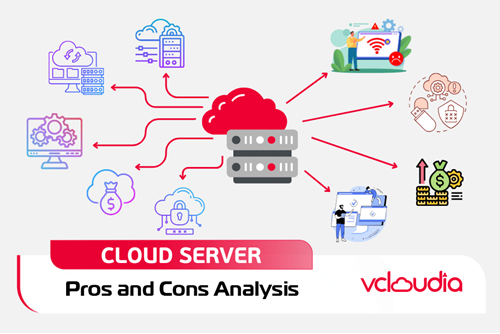
18/06/2025Cloud Servers have become a go-to data storage solution for many businesses due to their outstanding benefits in scalability, performance, and cost-efficiency. However, is this solution perfect for every organization? In this article, (Vcloudia) will break down the key advantages and disadvantages of Cloud Servers, helping you make the most informed decision for your business.
Advantages of Cloud Servers
1. Flexibility
One of the greatest strengths of Cloud Servers is the ability to quickly scale resources up or down based on real-time usage. Businesses no longer need to invest heavily in complex hardware systems, reducing wasted resources during idle periods. Application deployment and software upgrades are also fast and seamless—no need for long waiting times.
2. High Stability and Availability
Cloud Servers are designed to deliver near-perfect uptime and system continuity. Most Cloud Server providers offer Service Level Agreements (SLAs) with guaranteed high uptime rates.
If a failure occurs on one server, services and data are immediately transferred to another, minimizing downtime. This ensures that critical systems like websites and applications can operate reliably 24/7.
3. Easy Management
With a user-friendly interface, smart management tools, and remote monitoring, Cloud Servers allow businesses to manage resources easily from anywhere. Tasks like maintenance, software updates, data backup, and security configurations can be done in just a few clicks through an online dashboard—saving time, manpower, and reducing operational risk.
4. Cost-Efficiency
Unlike traditional server models, Cloud Servers follow a pay-as-you-go pricing model. Businesses only pay for the resources they actually use, significantly reducing initial capital investment in hardware.
For example, a startup can begin with a basic Cloud Server package and scale up as the company grows—without having to upgrade physical infrastructure. Moreover, maintenance, power, and cooling costs are offloaded to the cloud service provider.
5. High Security
Cloud Servers offer comprehensive security features to protect your data. These include data encryption, multi-factor authentication, and advanced firewalls to block cyber threats.
In addition, data on Cloud Servers is often automatically backed up across multiple data centers, ensuring quick recovery in the event of disasters or attacks.
Disadvantages of Cloud Servers
Despite the many benefits, Cloud Servers also have some drawbacks that businesses should consider before implementation:
-
Internet Dependency: Cloud Servers rely entirely on a stable internet connection. Any disruptions or slowdowns in your connection can severely impact system performance and operational continuity.
-
Limited Control Over Data: Although security measures are strong, storing data on third-party infrastructure may still pose privacy and control concerns, especially for sensitive or regulated information.
-
Cost Accumulation Over Time: While the initial cost is low, businesses with heavy and long-term resource demands may see costs grow rapidly. Effective resource management is essential to avoid unexpected expenses.
-
Compatibility Issues: Migrating legacy systems to the cloud can be challenging, especially if existing software is not cloud-compatible. The process might require customizations or upgrades—resulting in higher time and cost commitments.
Vcloudia Cloud Server – The Cloud You Can Count On
If you're concerned about the potential limitations of Cloud Servers, Cloud server by Vcloudia is a reliable solution for businesses of all sizes. With a modern infrastructure and comprehensive customer support, Vcloudia delivers a cloud experience with:
-
Powerful connectivity to ensure stable 24/7 access
-
Advanced security standards, compliant with international certifications such as ISO 27001:2013, ISO 20000:2018, ISO 9001:2015
-
Flexible pricing packages tailored to your specific business needs
-
Expert technical support, making migration and system deployment fast, safe, and compatible
Conclusion
Cloud Servers offer significant advantages—from flexibility and cost-efficiency to ease of management and strong security. However, to ensure successful adoption, businesses must understand both the strengths and limitations of Cloud Servers and choose a reliable service provider.
With Vcloudia, you can rest assured that Cloud Server limitations will be minimized—allowing your business to focus on sustainable growth and innovation.
ព័ត៌មានពិសេស
ព័ត៌មានដែលទាក់ទង
What is a Snapshot? The Difference Between Snapshot and Backup
Snapshot is a familiar concept in data management and protection. In the context of the information technology boom, where data is a major asset for businesses, understanding Snapshots as well as their application is a key factor for enterprises to maximize technological efficiency.
What is a Firewall? The Role and Importance of Firewalls for Users
In the context of ever-increasing cyberattacks, system security has become a top priority for many enterprises. Alongside deploying antivirus software and controlling connection ports, firewalls are also considered a key solution to effectively enhance cybersecurity.
What is DDoS? Signs, Mitigation Strategies, and Effective Prevention
DDoS is a highly dangerous cyberattack that leaves severe consequences for enterprises. Therefore, gaining a clear understanding of DDoS attacks, as well as how to detect and prevent them, is a topic of significant interest to many.
What is a Trojan? How to Detect, Avoid, and Prevent It
A Trojan is a type of malicious code or software that can cause severe consequences to computer operations. So, what is a Trojan? How can you prevent a Trojan from infiltrating your computer? In the following article, Vcloudia will provide detailed information on these issues.
What is Cloud Backup? Classification, benefits, and limitations
Cloud Backup is a solution that plays an important role in backing up and recovering data when an incident occurs. So what exactly is Cloud Backup? Let's find out the details with Vcloudia in the following article.
What is Cloud Storage? Features and Benefits of Using It
Cloud Storage is the perfect storage solution alternative to bulky, space-consuming physical hard drives. So, what is Cloud Storage? Let's explore the details with Vcloudia through the following article.
What is an API? Characteristics and applications in website design
API, short for Application Programming Interface, is a concept no longer unfamiliar in the information technology field. So what exactly is an API and why is it so important? Let's find out with Vcloudia.
What is Node.js? Instructions on how to install Node.js on cPanel
Currently, it is easy to see that Node.js is being used by quite a lot of people. This is because Node.js can support users in running on multiple platforms and multiple devices.
What is Vultr VPS? Should you use Vultr VPS?
Vultr VPS is one of the best cloud storage solutions in the world. In this article, you will learn the concept: "What is Vultr VPS?", as well as understand its advantages and disadvantages.
Zoom Cloud Meeting: What is it? Basic Things You Should Know About Zoom Cloud Meeting
In 2020, Zoom Cloud Meeting became one of the leading video conferencing software applications. It allows you to virtually interact with colleagues when in-person meetings aren't possible, and it has also been very successful for social events.