



.png)



















.png)





Active-active vs Active-passive in Data Centers: Detailed Comparison and How to Choose the Suitable Model
Jun 30, 2026When an enterprise operates an e-commerce system, digital bank, SaaS, or 24/7 digital platform, even a few minutes of downtime can cause significant losses in revenue and reputation. Therefore, the two most common architectural models to ensure service continuity are Active-active and Active-passive.
So, what are Active-active vs Active-passive in Data Centers? How are they different? Which model is suitable for each type of enterprise? Let's explore the details with Vcloudia in the article below!
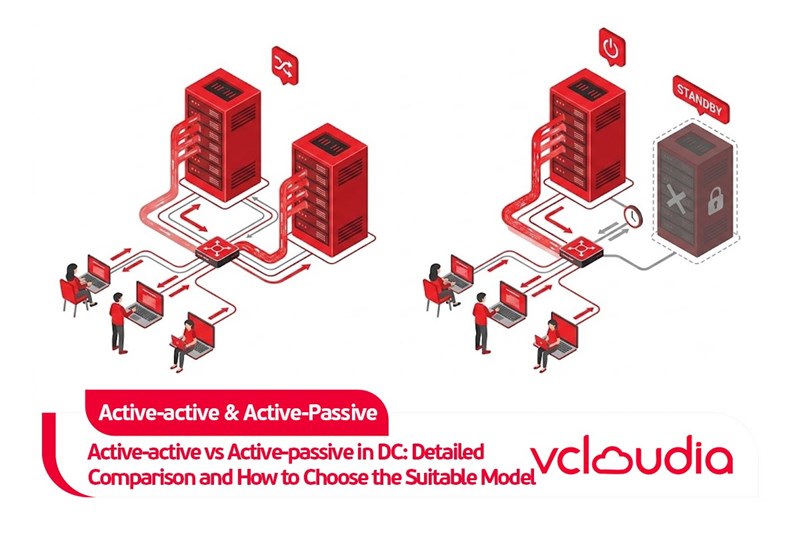
What are Active-active and Active-passive in Data Centers?
In a Data Center environment, Active-active and Active-passive are two system design models aimed at ensuring continuous operation capabilities when an incident occurs. Active-active is an architecture in which multiple nodes (servers, sites, or Data Centers) operate in parallel and handle traffic simultaneously. All components are in an “active” state and share the load with one another.
Conversely, Active-passive is a model in which only one primary node or site is operational (active), while the remaining node or site is in a standby state (passive). When the primary system encounters an incident, the backup system will be activated through a failover mechanism.
Both models serve the common goal of reducing downtime and protecting service availability. However, the deployment method and complexity level of each model are very different.
How the Active-active model works
The Active-active model is built upon the principles of load balancing and real-time data synchronization. In this architecture, multiple servers or multiple Data Centers simultaneously participate in handling traffic. A load balancer will distribute user requests to the active nodes. This helps the system fully utilize resources and optimize performance.
An important element of Active-active is two-way data synchronization. Nodes must continuously update data with each other to ensure consistency. In a database environment, this can be executed through multi-master replication or synchronous clusters. When a node experiences an incident, the remaining nodes still continue to handle traffic without the need to activate a complex failover process. Users almost do not notice the disruption.
Active-active is typically deployed in:
- High-traffic e-commerce systems
- Financial applications requiring an uptime of 99.99% or higher
- SaaS platforms serving global customers
- Multi-region cloud architectures
However, to operate effectively, Active-active requires high network bandwidth, low latency between sites, and strong data synchronization mechanisms.
How the Active-passive model works
In the Active-passive model, the primary system is responsible for processing all traffic. The backup system (secondary) does not participate in processing, but is always ready to take over when necessary. Data from the primary system is synchronized to the backup system via a one-way replication mechanism. When an incident occurs, the failover mechanism will activate the backup node to take over the service. Failover can happen automatically (automatic failover) or manually, depending on the system configuration.
Compared to Active-active, Active-passive is simpler in design and management. This is a popular model in:
- Traditional DR Site systems
- Internal enterprise applications
- Systems that do not require real-time processing
Comparison of Active-active vs Active-passive in Data Centers
Advantages and disadvantages of Active-active
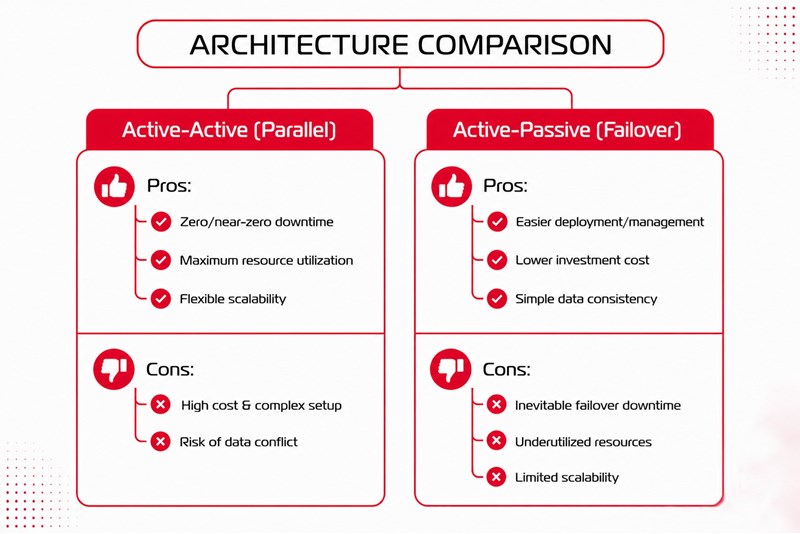
The Active-active model is evaluated as the architecture with the highest level of availability in modern Data Center environments. The most prominent strength of this model lies in its ability to maintain nearly continuous operations even when a node or a site encounters an incident. Because all nodes operate in parallel and share the load, when a component fails, the traffic will automatically be distributed to the remaining nodes without needing to activate a complex failover process. This helps minimize downtime to almost zero, which is especially important for systems requiring an SLA of 99.99% or above.
Additionally, Active-active optimizes infrastructure performance because all resources are exploited instead of being left in a standby state. The load balancer plays a central role in distributing access evenly, avoiding bottlenecks, and improving the user experience. Furthermore, flexible scalability is also a huge advantage as enterprises can add new nodes to meet growth demands without disrupting the system.
However, accompanying the high performance and availability is a significant investment cost. Active-active demands dual or multi-site infrastructure, real-time data synchronization technology, and sufficiently large network bandwidth to ensure consistency. Configuration is also much more complex, particularly for databases or systems that require strict data integrity. If the synchronization mechanism is not designed accurately, the risk of data conflict can occur.
In addition, this model requires a highly specialized technical team for deployment, monitoring, and troubleshooting. This makes Active-active more suitable for large enterprises or systems with continuous operational requirements and a massive scale.
Advantages and disadvantages of Active-passive
The biggest advantage of Active-passive is that it is easier to deploy and manage than Active-active. The system does not need complex load balancing configurations, while the one-way data synchronization mechanism is also simpler in ensuring consistency. The investment cost is therefore lower, suitable for small and medium enterprises or internal systems that do not demand absolute uptime. This model is also frequently used in traditional Disaster Recovery (DR) scenarios, where the backup site is only activated when the primary site suffers a severe incident.
However, Active-passive cannot avoid certain limitations. During the failover process, the system may experience short downtime due to the time needed to switch from the primary node to the backup node. For enterprises requiring uninterrupted continuous services, this time period, although short, can still cause significant impacts.
Additionally, because the backup node does not participate in processing traffic under normal conditions, infrastructure resources are not utilized to the fullest, leading to suboptimal investment efficiency. The scalability of Active-passive is also less flexible, especially when traffic suddenly spikes beyond the capacity of the primary node.
When should you choose Active-active?
Choosing Active-active should be based on the business requirements and the enterprise's risk tolerance level. This model is particularly suitable for organizations demanding extremely high uptime, typically from 99.99% and above, and cannot accept downtime even for a brief period. Systems processing real-time financial transactions, digital banking platforms, large-scale e-commerce exchanges, or global streaming services all need an architecture that ensures continuous availability. When a business operates 24/7 and serves users across multiple geographical regions, Active-active allows for the deployment of a multi-region architecture, helping to reduce latency and enhance resilience when localized incidents occur.
Moreover, in the context of digital transformation and rapid growth, this model creates favorable conditions for scaling the system without interrupting services. Even though the investment cost is higher, for strategic systems, the long-term benefits of Active-active usually outweigh the potential risks of downtime.
When should you choose Active-passive?
Active-passive is suitable for businesses that need a solution to guarantee a reasonable level of availability while still optimizing investment costs. Organizations with limited budgets or systems that do not require real-time processing can choose this model to balance efficiency and security. For instance, internal ERP systems, human resource management applications, or business support platforms that do not directly serve customers 24/7 can usually tolerate short downtime in the event of an incident.
Active-passive is also an appropriate choice for traditional DR scenarios, where the backup site is only utilized when the primary site encounters a major disaster. With a small to medium scale, enterprises can deploy Active-passive to protect crucial data and systems without having to invest in complex infrastructure like Active-active.
Conclusion
Active-active vs Active-passive in Data Centers is not a question of "which model is better," but rather "which model is more suitable." Active-active delivers the highest level of availability and performance, but comes with great cost and complexity. Active-passive is simpler and more economical, but can incur downtime during the transition. Choosing a model must be based on business objectives, budget, SLA requirements, and risk tolerance level. Amid strong digital transformation, enterprises should thoroughly evaluate the infrastructure architecture before deployment to ensure that the system not only operates stably today but is also ready to expand for the future.
Looking for a high-performance, secure solution?
Explore the services offered by Vcloudia – a leading provider of Cloud Computing and Data Center solutions. Contact us for expert consultation and find the right model for your needs:
- Hotline: +855 888 55 66 08 (free of charge)
- Fanpage: https://www.facebook.com/vcloudia/
- Website: https://vcloudia.com
Featured news
Related news
What is a Snapshot? The Difference Between Snapshot and Backup
Snapshot is a familiar concept in data management and protection. In the context of the information technology boom, where data is a major asset for businesses, understanding Snapshots as well as their application is a key factor for enterprises to maximize technological efficiency.
What is a Firewall? The Role and Importance of Firewalls for Users
In the context of ever-increasing cyberattacks, system security has become a top priority for many enterprises. Alongside deploying antivirus software and controlling connection ports, firewalls are also considered a key solution to effectively enhance cybersecurity.
What is DDoS? Signs, Mitigation Strategies, and Effective Prevention
DDoS is a highly dangerous cyberattack that leaves severe consequences for enterprises. Therefore, gaining a clear understanding of DDoS attacks, as well as how to detect and prevent them, is a topic of significant interest to many.
What is a Trojan? How to Detect, Avoid, and Prevent It
A Trojan is a type of malicious code or software that can cause severe consequences to computer operations. So, what is a Trojan? How can you prevent a Trojan from infiltrating your computer? In the following article, Vcloudia will provide detailed information on these issues.
What is Cloud Backup? Classification, benefits, and limitations
Cloud Backup is a solution that plays an important role in backing up and recovering data when an incident occurs. So what exactly is Cloud Backup? Let's find out the details with Vcloudia in the following article.
What is Cloud Storage? Features and Benefits of Using It
Cloud Storage is the perfect storage solution alternative to bulky, space-consuming physical hard drives. So, what is Cloud Storage? Let's explore the details with Vcloudia through the following article.
What is an API? Characteristics and applications in website design
API, short for Application Programming Interface, is a concept no longer unfamiliar in the information technology field. So what exactly is an API and why is it so important? Let's find out with Vcloudia.
What is Node.js? Instructions on how to install Node.js on cPanel
Currently, it is easy to see that Node.js is being used by quite a lot of people. This is because Node.js can support users in running on multiple platforms and multiple devices.
What is Vultr VPS? Should you use Vultr VPS?
Vultr VPS is one of the best cloud storage solutions in the world. In this article, you will learn the concept: "What is Vultr VPS?", as well as understand its advantages and disadvantages.
Zoom Cloud Meeting: What is it? Basic Things You Should Know About Zoom Cloud Meeting
In 2020, Zoom Cloud Meeting became one of the leading video conferencing software applications. It allows you to virtually interact with colleagues when in-person meetings aren't possible, and it has also been very successful for social events.