



.png)
















.png)





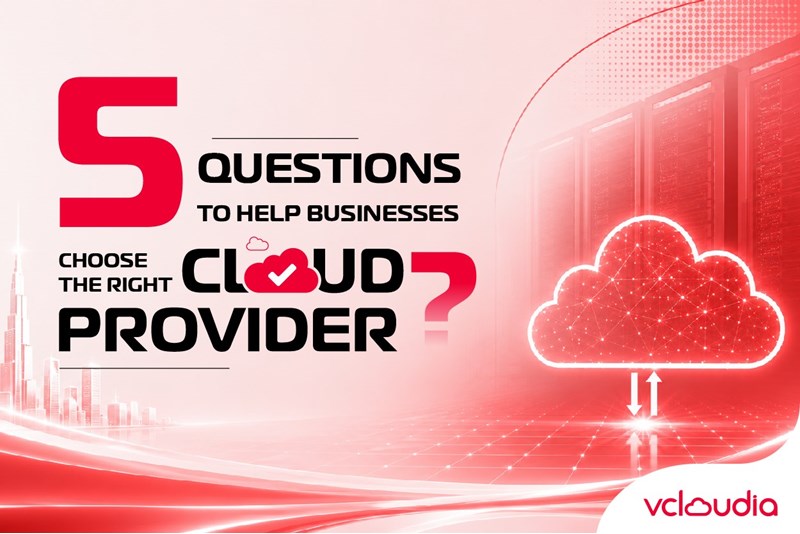
5 Questions Businesses Should Ask Before Choosing a Cloud Provider
Jul 15, 2026Cloud computing is becoming an essential infrastructure foundation in the digital transformation process of businesses. However, among many providers in the market with commitments to performance, security, and cost, choosing a suitable cloud platform is not simple. In reality, many businesses often focus on service prices or server configurations while ignoring factors that directly affect the long-term operational capability of the system.
To make the right decision, businesses need a more comprehensive evaluation instead of just comparing technical specifications. Below are 5 important questions to help businesses choose a cloud provider that fits their current needs as well as their future development orientation.
1. Where will the business's data be stored?
Data is one of the most important assets of a business, so the data storage location is always a factor that needs to be considered right from the start. Where the data is placed can directly affect user access speed, connection latency between systems, as well as the experience when operating applications.
In addition to the performance factor, businesses also need to find out which region the data will be stored in, how the infrastructure is deployed, and what data management policies the provider is applying. These are factors directly related to meeting the security, data governance, as well as compliance regulations of each business or each field of activity.
In addition, businesses should also clarify how data is backed up, the ability to recover when incidents occur, and measures to ensure data integrity. A reliable cloud platform not only provides computing resources but must also help businesses manage data safely throughout its lifecycle of use.
2. How does the provider commit to the service availability level?
Many providers offer SLA commitments with very high uptime levels such as 99.9% or 99.99%. However, this number itself does not fully reflect the service quality. What businesses need to care about is how the provider will fulfill that commitment.
When an incident occurs, how long is the response time? Is the technical support team available 24/7 or only during business hours? How are the handling, recovery, and service status update processes carried out? These are all important questions that help businesses evaluate the actual operational capability of the provider.
A cloud system can experience incidents at any time, but what makes the difference is the response speed and handling capability of the operations team. Therefore, a truly valuable SLA does not only lie in the uptime rate but also demonstrates technical capacity, support processes, and the commitment to accompany customers throughout the process of using the service.
3. Does the system have enough capability to protect the business's data?
Using the Cloud does not mean that data will automatically be protected absolutely. The responsibility for ensuring information security always requires coordination between the business and the service provider.
Businesses should find out what security mechanisms the provider is deploying, from data encryption during storage and transmission, access control, multi-factor authentication, to infrastructure protection solutions such as Firewall, Web Application Firewall (WAF), DDoS mitigation, regular data backup, and disaster recovery.
Beside technical solutions, international certificates such as ISO 27001, PCI DSS, or SOC are also important bases to evaluate the maturity in information security management and operational processes of the provider. These are not only certifications of standards but also demonstrate that the provider maintains regular control and security evaluation processes.
4. If needs change, can the business easily migrate to another platform?
The technology needs of a business always change according to the development speed of business activities. Therefore, the capability to scale or migrate between cloud platforms is also a factor to be considered right from the initial selection phase.
One of the common risks today is vendor lock-in, which makes moving data or changing platforms in the future complex and expensive.
Businesses should find out whether data can be easily exported, and whether the system supports open standards, APIs, or data migration tools. At the same time, it is also necessary to clarify the potential costs that may arise if there is a need to migrate large volumes of data or switch to another platform.
A flexible cloud platform will help businesses be more proactive in the face of market changes, avoid depending on a single ecosystem, and minimize risks in the long-term development process.
5. Does the provider have enough capability to accompany the business in the long term?
Cloud is not just an infrastructure service but also a foundation serving the technology development strategy for many years to come. As the business scales, deploys new applications, integrates AI, analyzes data, or modernizes the IT system, the cloud platform also needs to have the corresponding capability to meet those needs.
Therefore, beside the current infrastructure capacity, businesses should comprehensively evaluate the service portfolio that the provider can offer, the capability to scale resources on demand, the system architecture consulting capability, deployment experience, as well as the supporting technical team.
A suitable cloud partner does not only provide computing resources but also plays the role of an accompanying unit, consulting and supporting the business to optimize the infrastructure in each stage of development. This is an especially important factor when the business has an orientation to expand its scale or deploy technology projects in the future.
Conclusion
Choosing a cloud provider should not be based solely on price or service configuration. A correct decision needs to be made based on many factors such as data storage location, capability to ensure service availability, security level, flexibility when expanding or migrating, and the long-term accompanying capability of the provider.
Spending time to answer the five questions above will help businesses have a more comprehensive view before making a decision, thereby choosing a cloud platform that fits current needs, while being ready to meet future development requirements. A right choice from the start will contribute to building a stable, secure IT infrastructure that is capable of supporting sustainable business growth in the digital era.
Vcloudia Cloud Server – The Cloud You Can Count On
If you're concerned about the potential limitations of Cloud Servers, Cloud Server by Vcloudia is a reliable solution for businesses of all sizes. With a modern infrastructure and comprehensive customer support, Vcloudia delivers a cloud experience with:
- Powerful connectivity to ensure stable 24/7 access
- Advanced security standards, compliant with international certifications such as ISO 27001:2013, ISO 20000:2018, ISO 9001:2015
- Flexible pricing packages tailored to your specific business needs
- Expert technical support, making migration and system deployment fast, safe, and compatible
Contact information:
- Hotline: +855 888 55 66 08 (free of charge)
- Fanpage: https://www.facebook.com/vcloudia/
- Website: https://vcloudia.com
Featured news
Related news
What is a Snapshot? The Difference Between Snapshot and Backup
Snapshot is a familiar concept in data management and protection. In the context of the information technology boom, where data is a major asset for businesses, understanding Snapshots as well as their application is a key factor for enterprises to maximize technological efficiency.
What is a Firewall? The Role and Importance of Firewalls for Users
In the context of ever-increasing cyberattacks, system security has become a top priority for many enterprises. Alongside deploying antivirus software and controlling connection ports, firewalls are also considered a key solution to effectively enhance cybersecurity.
What is DDoS? Signs, Mitigation Strategies, and Effective Prevention
DDoS is a highly dangerous cyberattack that leaves severe consequences for enterprises. Therefore, gaining a clear understanding of DDoS attacks, as well as how to detect and prevent them, is a topic of significant interest to many.
What is a Trojan? How to Detect, Avoid, and Prevent It
A Trojan is a type of malicious code or software that can cause severe consequences to computer operations. So, what is a Trojan? How can you prevent a Trojan from infiltrating your computer? In the following article, Vcloudia will provide detailed information on these issues.
What is Cloud Backup? Classification, benefits, and limitations
Cloud Backup is a solution that plays an important role in backing up and recovering data when an incident occurs. So what exactly is Cloud Backup? Let's find out the details with Vcloudia in the following article.
What is Cloud Storage? Features and Benefits of Using It
Cloud Storage is the perfect storage solution alternative to bulky, space-consuming physical hard drives. So, what is Cloud Storage? Let's explore the details with Vcloudia through the following article.
What is an API? Characteristics and applications in website design
API, short for Application Programming Interface, is a concept no longer unfamiliar in the information technology field. So what exactly is an API and why is it so important? Let's find out with Vcloudia.
What is Node.js? Instructions on how to install Node.js on cPanel
Currently, it is easy to see that Node.js is being used by quite a lot of people. This is because Node.js can support users in running on multiple platforms and multiple devices.
What is Vultr VPS? Should you use Vultr VPS?
Vultr VPS is one of the best cloud storage solutions in the world. In this article, you will learn the concept: "What is Vultr VPS?", as well as understand its advantages and disadvantages.
Zoom Cloud Meeting: What is it? Basic Things You Should Know About Zoom Cloud Meeting
In 2020, Zoom Cloud Meeting became one of the leading video conferencing software applications. It allows you to virtually interact with colleagues when in-person meetings aren't possible, and it has also been very successful for social events.