



.png)















.png)





What Is Multi Cloud? How It Works, Along With Its Advantages and Disadvantages
10/11/2025In today’s digital era, businesses are constantly seeking optimal solutions to enhance operational efficiency, minimize risks, and maximize profitability. One increasingly popular strategy is Multi Cloud. In this article, Vcloudia explores Multi Cloud in depth — from theory to real-world applications.
What is Multi Cloud?
Multi Cloud is a strategy that involves using multiple cloud services from different providers simultaneously to achieve an organization’s business goals. Instead of relying entirely on a single provider, businesses distribute their workloads across various cloud platforms such as AWS, Google Cloud, Azure, or suitable local providers.
The key strength of Multi Cloud lies in its flexibility — allowing organizations to choose the most optimal service for each specific need, from storage and data processing to artificial intelligence and data analytics.
Although the term Multi Cloud is often mentioned alongside Hybrid Cloud (which integrates public and private clouds), there is a fundamental difference. Multi Cloud does not necessarily require combining public and private clouds; rather, it focuses on selecting independent cloud platforms from multiple providers. This creates greater diversity and flexibility, avoiding vendor lock-in while improving adaptability and risk management.
How does Multi Cloud work?
Multi Cloud operates through seamless integration among different cloud platforms using middleware, APIs (Application Programming Interfaces), and specialized management tools. Businesses must design an appropriate architecture to ensure smooth data transfer and workflow between clouds without disruption or data loss.
A key factor in successful Multi Cloud implementation is centralized management through Cloud Management Platforms (CMPs). These tools allow businesses to monitor, orchestrate, synchronize data, and optimize performance across multiple clouds simultaneously.
For example, a company might process AI workloads on Google Cloud while storing data on AWS to reduce storage costs. APIs enable secure and flexible data exchange between these platforms.
Additionally, Multi Cloud architectures often include backup and load balancing strategies to maintain business continuity. When one cloud provider experiences downtime, operations automatically fail over to another provider, ensuring uninterrupted service and user experience.
Advantages of Multi Cloud
- Cost Optimization: Businesses can choose services that best match their budget, performance, and feature requirements, without being locked into one vendor’s pricing model.
- Flexibility and Scalability: Using multiple clouds allows organizations to scale resources up or down quickly, customize workloads, and adapt to market changes.
- Enhanced Security and Resilience: Data and workloads are distributed across multiple clouds, reducing the risk of loss or cyberattacks. Backup and disaster recovery processes also become more robust and flexible.
- Performance Optimization: Different workloads can be allocated to the most suitable cloud — for instance, leveraging machine learning services on one provider and enterprise software hosting on another.
Thanks to these advantages, Multi Cloud is becoming an ideal approach for organizations seeking competitiveness, efficiency, and security in the digital age.
Disadvantages of Multi Cloud
Despite its benefits, Multi Cloud comes with challenges:
- Complex Management and Higher Operational Costs: Coordinating and maintaining consistency across multiple platforms requires advanced management tools, skilled personnel, and robust processes.
- Security and Compliance Risks: Sharing data across different providers increases exposure to compliance and privacy risks. Organizations must enforce strict access controls and adhere to data protection regulations, which can be both costly and complex.
- In short, Multi Cloud demands careful preparation — both technologically and organizationally. While it can optimize cost and flexibility, it also introduces management complexity and security risks. A clear strategy and competent IT team are essential to fully harness its potential.
Multi Cloud vs. Hybrid Cloud
Although often confused, Multi Cloud and Hybrid Cloud differ significantly:
- Hybrid Cloud combines private and public clouds, allowing businesses to store sensitive data privately while using public clouds for less-sensitive operations or scalability. Multi Cloud, on the other hand, focuses on using multiple public cloud providers to optimize performance, reduce risk, and prevent vendor dependency.
- Hybrid Cloud emphasizes integration between private and public systems, while Multi Cloud prioritizes diversity and flexibility across multiple providers. Both aim to optimize IT efficiency and remove traditional infrastructure limitations.
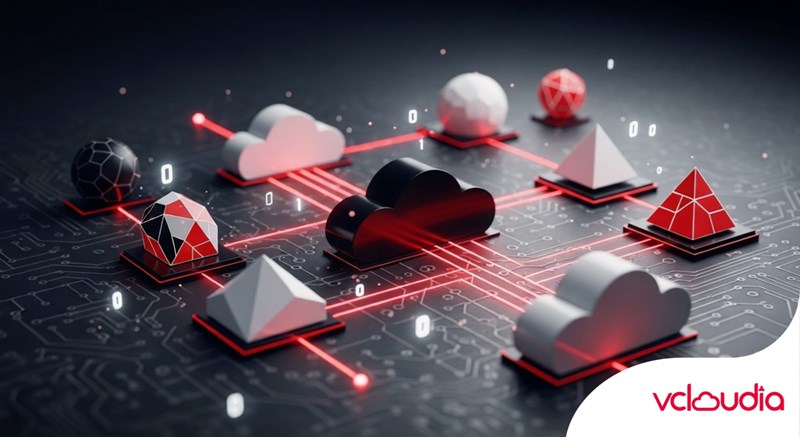
In practice, many organizations combine both models — creating flexible, hybrid multi-cloud architectures that maximize control, minimize risk, and leverage advanced technologies across providers.
Practical Applications of Multi Cloud
Multi Cloud is widely adopted across industries that demand scalability, high availability, and intensive data processing — such as finance, healthcare, e-commerce, and creative industries.
- For instance, an e-commerce company might:
- Use AWS for transaction processing,
- Google Cloud for customer data analytics, and
- Azure for internal application development.
This distribution optimizes cost, performance, and operational continuity. Moreover, Multi Cloud enables businesses to experiment with emerging technologies and respond quickly to market fluctuations or unforeseen disruptions.
In the future, Multi Cloud will expand into supply chain management, IoT, AI, and large-scale digital transformation projects — driving flexibility, efficiency, and innovation across all business operations.
Key considerations when adopting Multi Cloud
When implementing a Multi Cloud strategy, businesses should evaluate:
- Objectives and Requirements: Clearly define goals to avoid over-distribution and unnecessary cost.
- Data Governance and Access Control: Establish strict policies for data security and compliance.
- Integration and Monitoring Tools: Use unified management solutions to reduce risks of data inconsistency or downtime.
- Cost Management: Account for the higher expenses associated with personnel, monitoring tools, and maintenance.
- Additionally, compliance with regional and industry-specific data protection laws must be prioritized. Organizations should continuously monitor legal updates to ensure secure and lawful cloud operations.
Conclusion
In the digital era, Multi Cloud has become a cornerstone of enterprise IT strategies. It offers outstanding benefits such as cost optimization, flexibility, scalability, and enhanced security. However, it also presents challenges in management complexity, technology integration, and compliance.
To succeed with Multi Cloud, businesses must establish a well-defined strategy, invest in skilled personnel, and adopt effective management tools — ensuring sustainable growth and competitive advantage in the rapidly evolving digital landscape.
Looking for a high-performance, secure solution?
Explore the services offered by Vcloudia – a leading provider of cloud computing and data center solutions. Contact us for expert consultation and find the right model for your needs:
- Hotline: +855 888 55 66 08 (free of charge)
- Fanpage: https://www.facebook.com/vcloudia/
- Website: https://vcloudia.com
ព័ត៌មានពិសេស
ព័ត៌មានដែលទាក់ទង
What is a Snapshot? The Difference Between Snapshot and Backup
Snapshot is a familiar concept in data management and protection. In the context of the information technology boom, where data is a major asset for businesses, understanding Snapshots as well as their application is a key factor for enterprises to maximize technological efficiency.
What is a Firewall? The Role and Importance of Firewalls for Users
In the context of ever-increasing cyberattacks, system security has become a top priority for many enterprises. Alongside deploying antivirus software and controlling connection ports, firewalls are also considered a key solution to effectively enhance cybersecurity.
What is DDoS? Signs, Mitigation Strategies, and Effective Prevention
DDoS is a highly dangerous cyberattack that leaves severe consequences for enterprises. Therefore, gaining a clear understanding of DDoS attacks, as well as how to detect and prevent them, is a topic of significant interest to many.
What is a Trojan? How to Detect, Avoid, and Prevent It
A Trojan is a type of malicious code or software that can cause severe consequences to computer operations. So, what is a Trojan? How can you prevent a Trojan from infiltrating your computer? In the following article, Vcloudia will provide detailed information on these issues.
What is Cloud Backup? Classification, benefits, and limitations
Cloud Backup is a solution that plays an important role in backing up and recovering data when an incident occurs. So what exactly is Cloud Backup? Let's find out the details with Vcloudia in the following article.
What is Cloud Storage? Features and Benefits of Using It
Cloud Storage is the perfect storage solution alternative to bulky, space-consuming physical hard drives. So, what is Cloud Storage? Let's explore the details with Vcloudia through the following article.
What is an API? Characteristics and applications in website design
API, short for Application Programming Interface, is a concept no longer unfamiliar in the information technology field. So what exactly is an API and why is it so important? Let's find out with Vcloudia.
What is Node.js? Instructions on how to install Node.js on cPanel
Currently, it is easy to see that Node.js is being used by quite a lot of people. This is because Node.js can support users in running on multiple platforms and multiple devices.
What is Vultr VPS? Should you use Vultr VPS?
Vultr VPS is one of the best cloud storage solutions in the world. In this article, you will learn the concept: "What is Vultr VPS?", as well as understand its advantages and disadvantages.
Zoom Cloud Meeting: What is it? Basic Things You Should Know About Zoom Cloud Meeting
In 2020, Zoom Cloud Meeting became one of the leading video conferencing software applications. It allows you to virtually interact with colleagues when in-person meetings aren't possible, and it has also been very successful for social events.